


Reciprocating Saw Blades for Hardened Steel: What to Check
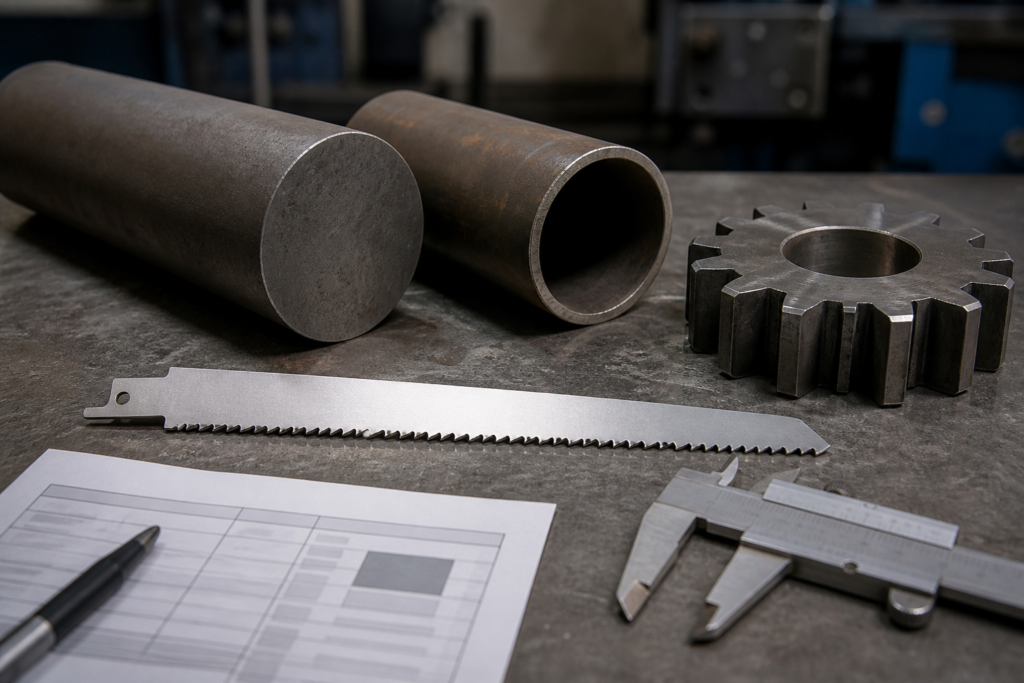
Reciprocating saw blades for hardened steel should be selected from the verified steel grade and heat-treatment condition, not from the words “hard steel” alone. Record the workpiece section, choose a tooth material that the blade manufacturer supports for that application, match tooth pitch and blade body to the geometry, and approve the combination through a controlled sample cut.
Carbide-tipped blades are available for tough-metal and high-alloy applications, but carbide is not a universal answer. A product designed for cast iron, masonry, or nail-embedded wood cannot automatically be reassigned to a hardened-steel component. The model’s published application remains the boundary.
Define reciprocating saw blades for hardened steel from the workpiece
The phrase can refer to different alloys, treatments, hardness levels, and component shapes. Ask for the grade or specification, heat-treatment state, and any available hardness record. If that information is unknown, say so. Substituting an assumed grade produces a false blade requirement.
Next, describe the section being cut. A solid bar, thin-wall tube, hardened fastener, shaft, and interrupted gear profile present different tooth engagement and impact conditions. Record the maximum solid thickness or wall thickness, the cut length, access, whether the part is clamped, and whether the cut passes through hard surface layers or interrupted features.
This is the main difference from a generic thick-metal blade guide. Thickness matters here, but it comes after the material condition. A thick mild-steel profile and a thinner heat-treated part do not create the same selection task.
Choose a manufacturer-supported tooth system
Bi-metal blades combine a hard tooth edge with a flexible backing and cover many metal-cutting tasks. Carbide-tipped products place carbide at the cutting edge for specified tough applications. The correct choice depends on what the exact model lists, not on a rule that one construction always wins.
Bosch publishes an EXPERT Thick Tough Metal carbide model for tough steel and cast-iron applications. Hilti publishes a carbide family that includes high-alloy steel pipe and parts. Those records prove that model-scoped carbide options exist. They do not prove that every carbide reciprocating blade cuts every hardened alloy.
| Input | Question to answer | Release evidence |
|---|---|---|
| Steel condition | What grade, treatment, and known hardness apply? | Material record or explicit “unknown” status |
| Tooth system | Does the named blade list this material/application? | Current manufacturer datasheet |
| Pitch | Will enough teeth engage the actual section? | Model pitch and section guidance |
| Blade body | Does length, width, and thickness support access and control? | Tool and blade dimensions |
| Trial | What result and stop criteria approve the combination? | Controlled sample-cut record |
The carbide-versus-bi-metal guide can help compare construction after the workpiece is defined. Do not use the construction label to skip the product application statement.
Match TPI, blade body, and tool to the section
Tooth pitch controls how teeth engage the section and clear chips. A coarse pitch that works on a thick solid area may engage too few teeth on a thin wall. A very fine pitch can load differently in a thick, interrupted cut. Use the actual wall or solid thickness with the model guidance; do not select TPI from alloy name alone. The reciprocating blade TPI guide for metal covers this separate step.
Blade length must cover the full stroke and workpiece while remaining within the tool and model limits. Body width and thickness affect stiffness and access. A narrow or flexible body may reach a restricted point but wander more readily under side load; a wider body can improve guidance where access permits. The shoe should be adjusted and supported according to the saw manual.
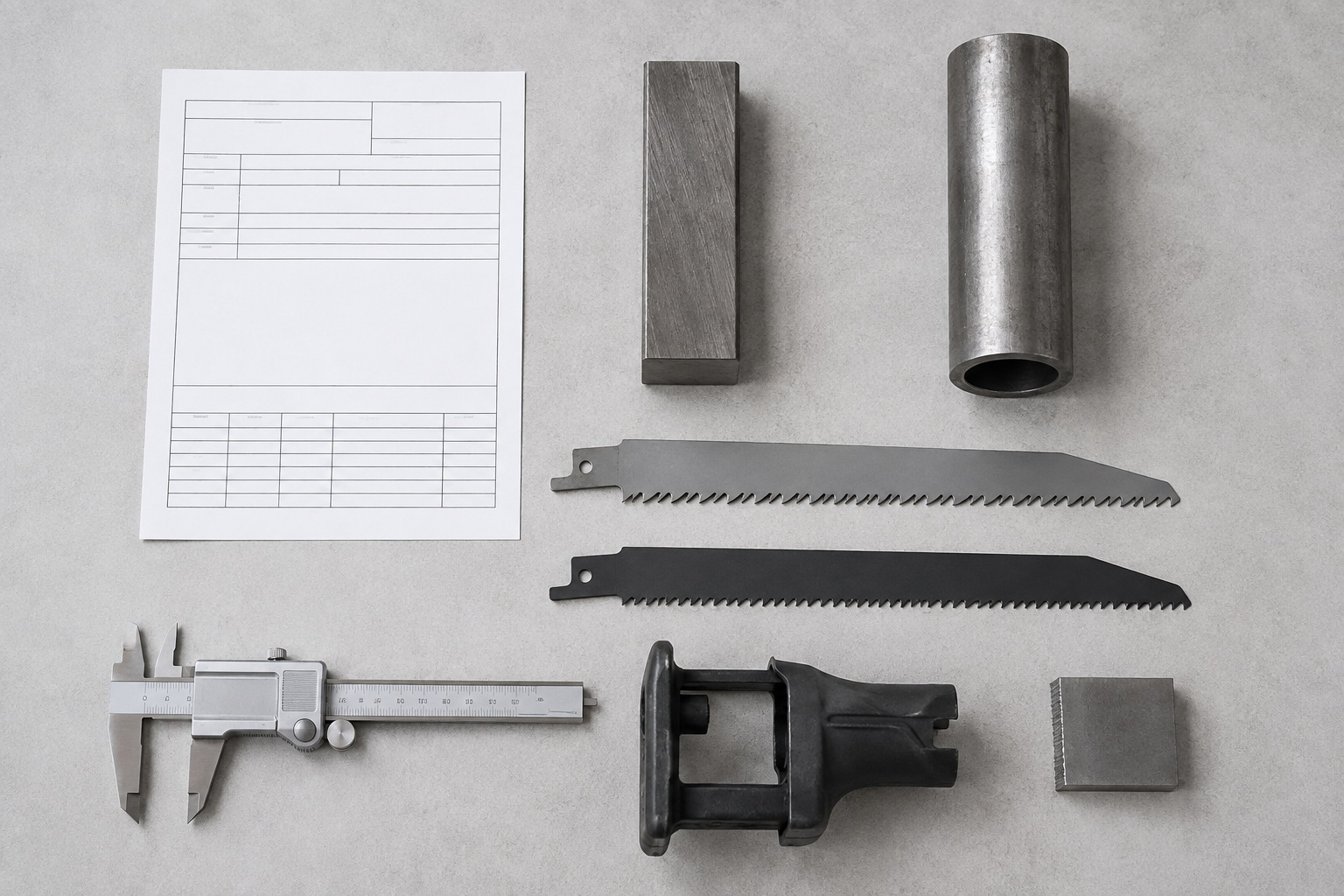
Machine limits also matter. Check the accepted shank, stroke, speed controls, and any manufacturer restriction. Do not copy feed or speed advice from a different saw-and-blade combination. Excess heat, tooth damage, vibration, and loss of tracking are conditions to investigate, not reasons to push harder.
Use a controlled sample cut before releasing the blade
A trial should use representative material, heat treatment, and section geometry. Record the saw model, blade model and lot, clamp condition, work support, speed setting, applied technique, cut length, and observations. Keep the workpiece restrained and follow the tool and blade instructions.
Define stop criteria before the cut. Stop if the blade loses retention, teeth chip, the body kinks, the kerf closes, vibration becomes uncontrolled, heat rises unexpectedly, or the saw cannot maintain the planned path. These are observable controls, not performance guarantees.
- Confirm material grade and treatment or record that they are unknown.
- Capture solid thickness, wall thickness, and interrupted features.
- Require a current model application statement for the proposed tooth system.
- Verify pitch, length, body dimensions, shank, and saw limits.
- Approve only the tested combination and record the rejection reasons.
The public EACHLEAD carbide reciprocating blade range is a starting point for an inquiry, but its currently visible examples are masonry-focused. Ask for model-specific evidence before describing an EACHLEAD blade as suitable for hardened steel. For a wider product-family review, use the reciprocating saw blade category. If the trial shows uncontrolled vibration, the blade vibration guide helps separate support and setup factors.