


When Does Carbide Beat a Bi-Metal Reciprocating Blade?
Carbide vs Bi-Metal Reciprocating Saw Blades: Guide begins with the workpiece and cut conditions, not with a marketing hierarchy. Record the holder, material, dimensions, access, and required edge before comparing blade families. For the commercial path, review the carbide reciprocating saw blade category.
Part 1. What is the real difference between carbide and bi-metal blades?
Carbide and bi-metal describe different cutting-edge constructions, but the useful buying question is which construction matches the actual material and cut conditions. A bi-metal blade generally combines a flexible alloy-steel body with a harder high-speed-steel tooth edge. A carbide-tipped or carbide-tooth blade places a much harder cutting material at the tooth, which can help on abrasive or unusually hard workpieces.
Neither label proves that a blade is suitable for every hard material. Tooth geometry, body width, length, TPI, and the exact carbide or bi-metal design still matter. Buyers should therefore treat construction as one field in an application record, not as a quality ranking.
| Decision field | Bi-metal direction | Carbide direction |
|---|---|---|
| Typical starting point | General metal and mixed demolition | Verified abrasive or hard-material application |
| Body behavior | Flexibility is often a priority | Application-specific body and carbide teeth |
| Main validation | TPI, thickness, length, holder | Listed substrate, tooth design, length, holder |
| Substitution risk | Wrong TPI or body geometry | Assuming carbide fits every hard material |
Important: Use the proper blade for the material and follow the tool instructions; see OSHA handheld saw guidance.
Part 2. Where does bi-metal remain the practical baseline?
Bi-metal is often the practical baseline for general metal, nail-embedded wood, and mixed demolition because the body can tolerate flex while the tooth edge handles heat better than a basic carbon-steel blade. That balance is valuable in cuts where the shoe cannot stay perfectly square or the blade may be side-loaded.
The bi-metal reciprocating saw blade selection guide should be the next stop when the job involves conventional steel sheet, pipe, channel, or wood with nails. It explains the product family without implying that one TPI covers every thickness.
Part 3. When does carbide become a justified option?
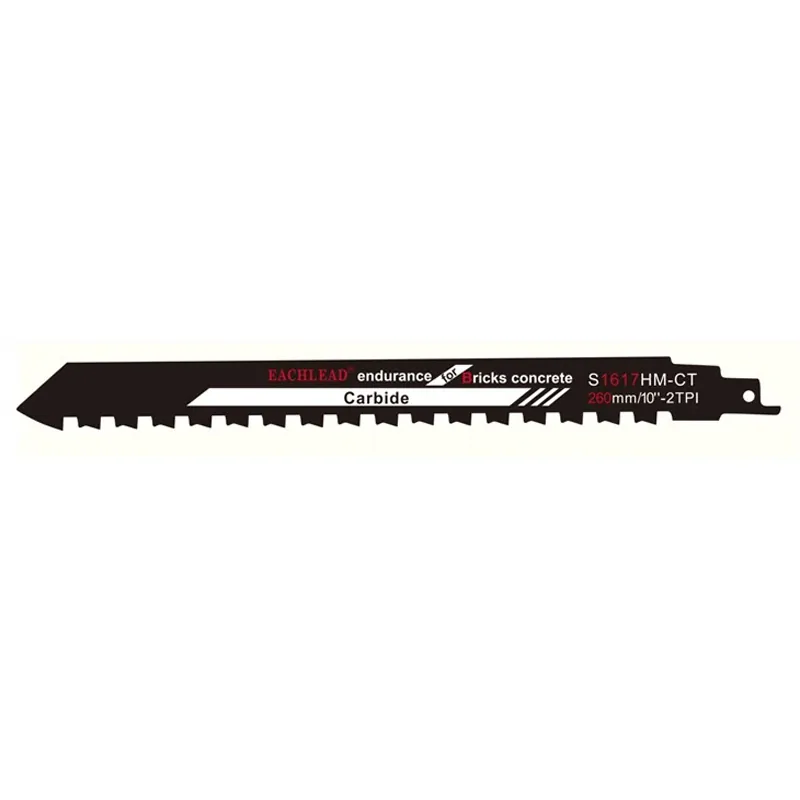
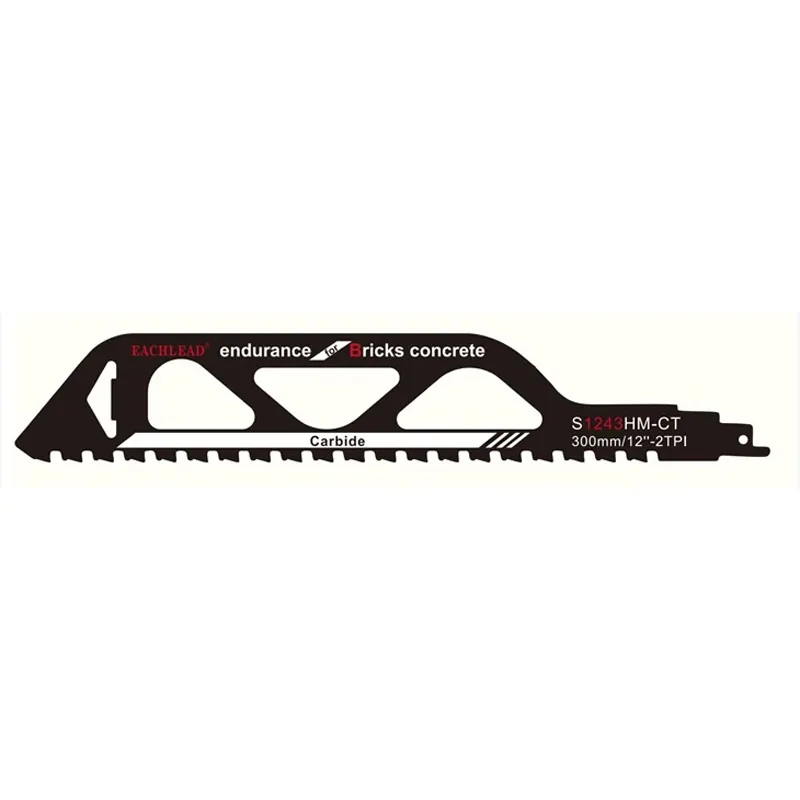
Carbide becomes relevant when conventional teeth wear quickly on an abrasive substrate or when a verified carbide blade is explicitly listed for the target material. The current EACHLEAD carbide pages list S1617HM and S1243HM for stone, block, brick, stucco, and concrete-related cutting. Those pages support a masonry-focused recommendation; they do not support a universal claim for all metals.
Procurement teams should ask what failure they are trying to solve. If the bi-metal blade is wearing because the workpiece is abrasive, a listed carbide family may be appropriate. If the real problem is wrong TPI, excessive feed, or poor support, changing tooth material alone will not correct the process.
| Failure signal | First inspection | Possible response |
|---|---|---|
| Uniform tooth wear | Material abrasiveness and heat | Verify carbide-listed substrate |
| Missing teeth | Impact, TPI, feed | Correct setup before upgrading |
| Shank crack | Holder and side load | Inspect tool and overhang |
| Wandering cut | Length, body width, shoe support | Choose geometry, not just tooth material |
Part 4. How do flexibility, impact, and tooth loss change the choice?
A reciprocating blade sees repeated bending because the tool stroke, shoe position, and workpiece can introduce side load. Bi-metal construction is often selected where body flexibility matters. Carbide teeth are harder, but the selected blade still needs the correct body and tooth design for impact and interrupted cuts.
Inspect the failed blade before changing families. A polished, worn tooth line suggests abrasion or heat. Missing teeth can indicate impact, tooth overload, or an unsuitable pitch.
A crack near the shank points toward mounting, overhang, or side force rather than tooth material alone.
A controlled trial should hold the tool, workpiece, and setup constant while changing one blade variable. Record the edge, heat, tooth condition, vibration, and operator feed. This produces evidence a distributor can use instead of relying on a broad product label.
Part 5. Why TPI and blade geometry still control the cut?
Construction does not replace TPI selection. Thin metal needs enough teeth engaged to prevent snagging, while thicker sections need adequate gullet space for chip clearance. Masonry carbide products may use a tooth or grit geometry that does not translate to a bi-metal metal-cutting chart.
Blade length also changes stability. Use the shortest blade that safely clears the workpiece, keep the shoe against the material where the tool instructions allow, and avoid unnecessary overhang. A wide, stiff body may track better in a straight cut, while tight access can require a different geometry.
Do not treat a faster first cut as proof of a better production choice. The acceptance test should include repeatability, edge condition, safe control, and whether the selected blade stays within its listed material boundary.
Part 6. What belongs in a carbide-vs-bi-metal RFQ?
An RFQ should name the workpiece before it names the blade family. Ask the supplier to map each proposed SKU to a material, thickness range, tooth construction, TPI or tooth pitch, length, body dimensions, and pack label. For carbide, request the exact listed substrate rather than accepting the word “carbide” as proof of fit.
Where an abrasive masonry application matches the public listing, the S1617HM page provides a legitimate product discussion. For conventional metal or mixed demolition, begin with the bi-metal category and a sample-cut plan instead.
| RFQ field | Buyer supplies | Supplier confirms |
|---|---|---|
| Workpiece | Exact material or substrate | Listed application |
| Thickness / section | Wall, plate, block, or profile size | TPI or tooth geometry |
| Cut conditions | Straight, flush, interrupted, abrasive | Body, length, and tooth construction |
| Acceptance test | Sample stock and failure criteria | Candidate SKU and pack label |
Product recommendation: review the S1617HM Carbide Reciprocating Saw Blade for Concrete Cut only after the RFQ fields are documented. It is not a default substitute for a bi-metal metal-cutting blade: the public listing identifies stone, block, brick, and stucco applications, not general sheet-metal work.
Fit Boundary
For buyers able to run a controlled sample and verify the product listing, this workflow provides a defensible selection path. It is not sufficient where the tool is damaged, the holder is unknown, or the project requires an unsupported performance guarantee.
Part 7. Which purchasing mistakes create expensive substitutions?
The first mistake is replacing a proven bi-metal SKU with carbide solely because carbide sounds more durable. The second is sending a masonry carbide blade to a metal-cutting job without evidence. The third is ignoring TPI, length, and holder compatibility after choosing the tooth material.
A distributor can reduce these substitutions by separating application families in the SKU master: general metal, nail-embedded wood, masonry and abrasive materials, and specialty hard materials. Record the tool holder, workpiece, thickness, and observed failure before approving an alternative.
To request a configuration review, send the application details to EACHLEAD: tool, holder, workpiece, dimensions, cut geometry, current blade, observed failure, and target pack quantity.
FAQs
Are carbide reciprocating blades always better than bi-metal?
No. Carbide is justified when the exact blade is listed for the abrasive or hard material. Bi-metal remains a practical baseline for many general metal and mixed demolition cuts.
Can a concrete carbide blade cut steel?
Do not assume so. The cited EACHLEAD carbide models are publicly listed for stone, block, brick, stucco, and concrete-related work, not as universal steel blades.
Why is bi-metal flexible?
Bi-metal designs generally use a flexible body with a harder tooth edge. The exact construction varies by SKU, so buyers should request the product specification.
Does carbide eliminate the need to select TPI?
No. Carbide products still use application-specific tooth geometry, and bi-metal products still require a TPI matched to thickness.
Which blade is better for wood with nails?
A verified bi-metal demolition blade is usually the more relevant starting family. Confirm the nail load, wood thickness, length, and TPI.
What evidence should a distributor request for carbide?
Request the listed substrate, model number, tooth material, dimensions, application range, and a sample test on representative stock.
How should a failed blade be evaluated?
Record tooth wear, missing teeth, fracture location, holder condition, feed, and workpiece. That evidence helps distinguish abrasion from setup or compatibility failure.