


Bi-Metal Reciprocating Saw Blades: Selection Guide
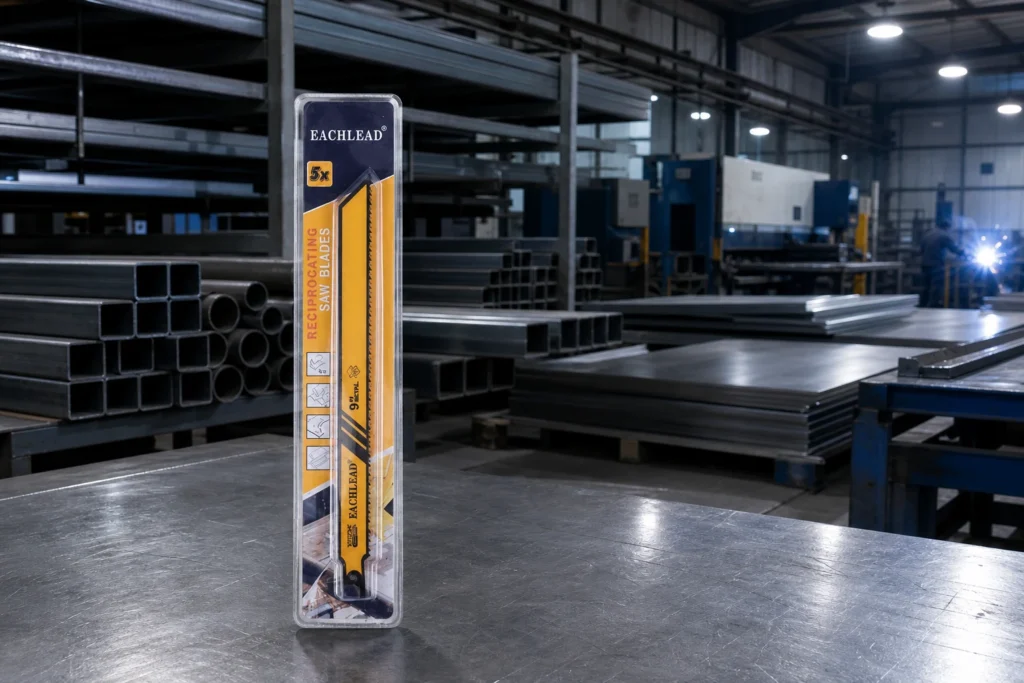
Bi metal reciprocating saw blades pair a flexible steel back with high-speed steel teeth—the default for remodel, nail-embedded wood, and routine metal cuts. Importers who stock only HCS wood lines see fast returns when contractors hit nails or light gauge steel. This guide explains how TPI, grade (6150+M2 vs M42), and length map to channel assortments and OEM quotes.
Part 1. What Bi-Metal Reciprocating Blades Are and Why Buyers Stock Them
Bi-metal (BIM) blades electron-beam weld HSS teeth to a spring-steel or high-carbon back. The body flexes in tight access cuts; tooth tips stay harder than plain HCS when cutting nails, pipe, or profile steel.
Buying guides commonly cite longer life than carbon steel in demanding trades use—exact ratios vary by material and feed rate, so distributors should log field minutes-per-blade instead of copying marketing multiples.
EACHLEAD lists bi-metal grade pairings on remodel and metal-capable SKUs—see S1122VF wood-with-nails line and reciprocating saw blade range for catalog examples.
> **From the field:** “Bi-metal is what you reach for when the cut hits nails—you need flex and harder teeth.” — Benchmark Abrasives reciprocating blade guide
Private-label programs should specify electron-beam weld quality and tooth steel grade on the purchase spec—visual similarity between HCS and BIM cards does not mean interchangeable performance.
Part 2. How TPI and the Three-Tooth Rule Drive Selection
TPI sets cut speed and finish. Workshop guidance: keep at least three teeth in contact with the workpiece thickness—too coarse on thin metal and teeth straddle the wall; too fine on thick timber and the blade overheats.
Rough bands: 6–10 TPI for wood demolition and nail-embedded lumber; 10–14 TPI for pipe and structural profiles; 14–24 TPI for thin sheet and conduit.
Variable-pitch bi-metal blades (e.g., 10/14) help renovation where one stroke crosses wood, nails, and light metal without a blade change.
> **From the field:** “Match TPI so three teeth stay in the cut—too coarse on thin metal and the blade catches.” — AIMS Industrial three-tooth rule
Retail planograms that sort only by length force buyers to open every pack—add TPI and grade icons at the bay header to speed contractor self-service.
| Material / task | Typical TPI | Bi-metal note | Common mistake |
|---|---|---|---|
| Wood demolition | 6–10 | Aggressive gullets | Using 18 TPI metal blade |
| Wood with nails | 6–10 | BIM standard | HCS wood-only pack |
| Pipe / profile steel | 10–14 | M42 optional for hard stock | Pruning geometry |
| Thin sheet / conduit | 14–24 | Finer finish | 6 TPI on 1 mm sheet |
Part 3. Bi-Metal Grades Compared (M2, M42, and When to Upgrade)
6150+M2 is the common general-purpose pairing in hardware channels—balanced cost and life on remodel and light metal.
6150+M42 (or similar cobalt HSS edges) adds heat and wear resistance for harder stock or high-minute pro accounts; expect higher unit cost.
Upgrade grade when field logs show consistent early tooth rounding on the same material—not when users simply feed too aggressively on the wrong TPI.
Some pro dealers stock parallel M2 and M42 slots at the same TPI so contractors can step up without learning a new tooth geometry—keep color bands distinct on the card.
| Grade pairing | Best for | Trade-off | Channel |
|---|---|---|---|
| 6150 + M2 | General remodel, mixed metal | Mid price | Hardware, rental |
| 6150 + M42 | Harder metal, longer pro life | Higher unit cost | Pro dealer |
| HCS wood | Wood-only, no nails | Lowest cost | Seasonal / garden |
| Carbide-tipped | Abrasive masonry, cast iron | Premium | Specialty industrial |
Part 4. Bi-Metal vs HCS and Carbide for Channel Assortments
HCS remains valid for wood-only seasonal SKUs; bi-metal should own remodel, demolition, and metal-capable slots in the same blade length family.
Carbide-tipped or grit blades fit abrasive masonry, cast iron, or extremely hard alloys—price them separately so hardware endcaps do not confuse contractors comparing to 9 in bi-metal packs.
For rental fleets, bi-metal should be the default refill behind the counter—HCS pruning refills belong in a separate SKU bin to avoid accidental swaps during busy Saturday mornings.
Related reading: metal recip guide, wood-with-nails guide, and how recip blades work.
Part 5. Safety, Sourcing, and OEM Checklist for Buyers
Metal and nail cuts throw chips and sparks on ferrous work. Eye protection and stable workholding are baseline; cordless users should avoid stall-induced heat at the teeth.
Request from suppliers: back steel grade, tooth steel grade, TPI matrix, shank compatibility, blister artwork, and sample cut tests. Contact EACHLEAD for OEM quotes. About EACHLEAD covers export packaging support.
Confirm MOQ, lead time, and labeling language in writing—do not publish unverified certification claims on product pages.
Include a one-page TPI and grade matrix with every OEM quote so factory and buyer stay aligned on which slots are M2 general purpose vs M42 pro life.
Recommended EACHLEAD Products
For project support, explore our related product line, solution options, and OEM/ODM capabilities on eachlead.com.
FAQ
What is a bi-metal reciprocating saw blade?
A blade with a flexible steel back electron-beam welded to high-speed steel teeth—common for remodel, metal, and nail-embedded wood.
How long do bi-metal reciprocating blades last?
Life depends on material, TPI, and feed rate; bi-metal typically outlasts HCS in nail and metal cuts—log minutes-per-blade in field tests.
What TPI for bi-metal reciprocating blades?
Use roughly 6–10 TPI for wood demolition, 10–14 for pipe and profile steel, and 14–24 for thin sheet—match thickness to the three-tooth rule.
Bi-metal vs high carbon steel reciprocating blades?
HCS is lower cost for wood-only cuts; bi-metal flexes and keeps teeth sharper when nails or light metal appear.
6150+M2 vs 6150+M42 bi-metal blades?
M42 tooth steel often adds heat and wear resistance for harder stock; M2 is the common general-purpose grade in hardware channels.
When should I use bi-metal instead of carbide?
Bi-metal is usually the default for nail-embedded wood and routine metal; carbide fits abrasive masonry, cast iron, or extremely hard alloys.
How do OEM buyers spec bi-metal reciprocating blades?
Request back steel grade, tooth steel grade, TPI matrix, length mix, and blister artwork before container orders.
References
- Discount Saw Blade — Reciprocating Buying Guide
- AIMS Industrial — Reciprocating Saw Blade Guide
- Benchmark Abrasives — Recip Blade Types
- EACHLEAD S1122VF product page
Ready to discuss your project? Contact EACHLEAD engineering support with your project parameters and technical requirements.