


Metal Cutting Sawzall Blades: A Buyer Selection Guide
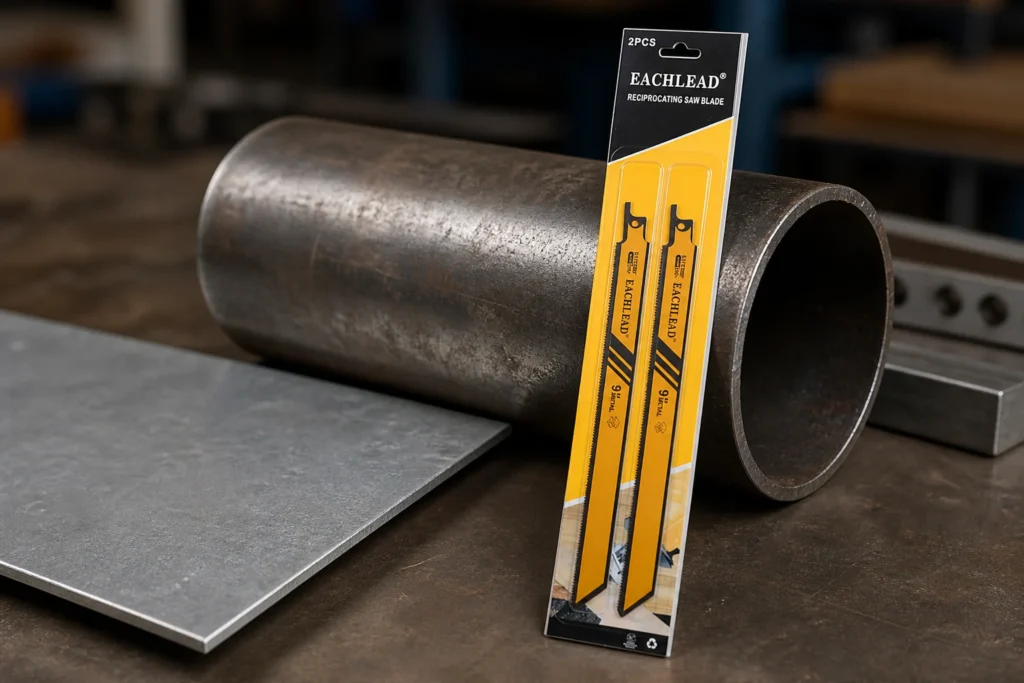
Metal Cutting Sawzall Blades are metal-rated reciprocating saw blades—usually bi-metal, sometimes carbide-tipped—chosen first by material thickness (TPI), then by duty and length, with controlled speed so heat does not kill the teeth. Buyers then lock construction, blade length, and technique before stocking a pack, walking thickness → TPI → bi-metal vs carbide → length → heat control → EACHLEAD bi-metal pathways for sheet and pipe work.
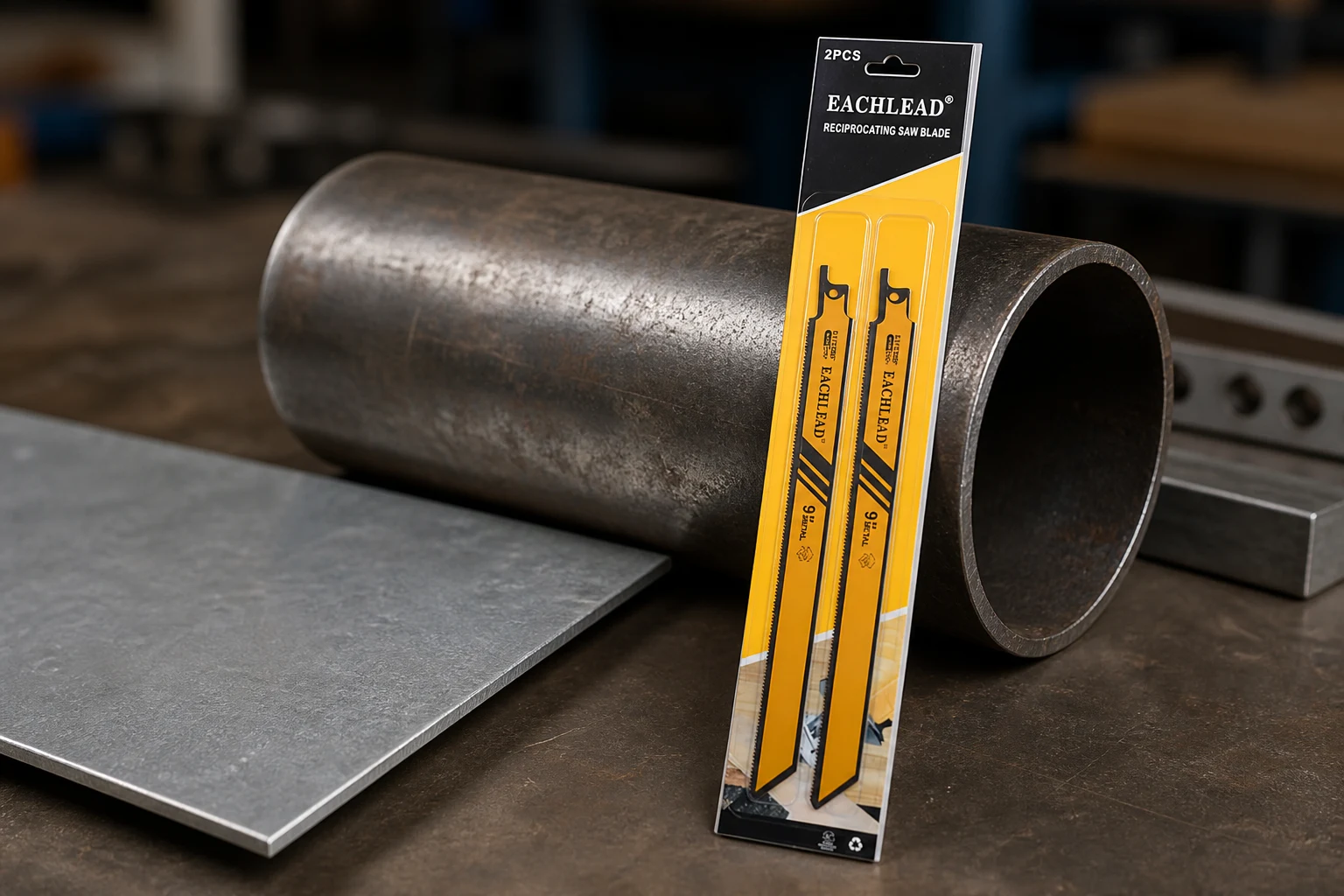
What Metal Cutting Sawzall Blades Actually Are
They are metal-rated reciprocating saw blades—often searched as Sawzall blades—not wood or HCS blades, and they shine when access beats precision.
A reciprocating saw blade for metal work is a toothed recip accessory specified by TPI, length, body thickness, and tooth construction. Metal cutting with a recip saw is common on sheet metal, pipe / conduit / angle iron, and related ferrous stock when a bandsaw or cold saw cannot reach the joint.
“Sawzall” started as a trademark name and is now common search language for recip saws and blades. Shoppers still mean a metal-rated recip blade when they ask for a sawzall metal cutting blade—not a wood demolition tooth set.
Use a recip when access, demolition reach, or in-place pipe work matters more than a milled finish. When the shop floor is open and square cuts are the priority, a dedicated metal saw usually wastes fewer blades.
Browse the parent reciprocating saw blades hub to see how metal-rated lines sit beside wood and mixed-duty families.
Match TPI to Metal Thickness First
Start with thickness: keep about three teeth in the cut; use finer TPI on thin sheet and coarser TPI on thicker sections.
TPI (teeth per inch) sets how fine or coarse the tooth row is and how chip load builds in the stroke. Higher TPI spreads the cut on thin stock; lower TPI improves gullet / chip clearance on thicker walls.
Keep at least three teeth in contact with the material so the tooth row does not snag or overload a single tip. HVAC thin duct and black-pipe wall thickness on the same truck stock list often need two TPI bands, not one “metal” SKU.
| Metal situation | Typical TPI band | Why it fits |
|---|---|---|
| Thin sheet / light wall | About 18–24 TPI | More teeth stay in thin stock and reduce snagging |
| Mid sheet, conduit, light pipe | About 14–18 TPI | Balance between engagement and chip room |
| Thicker sections, pipe, angle | About 8–14 TPI (often 10–14) | Coarser teeth clear chips and heat |
Treat those bands as planning ranges, then confirm against the published label for the blade you stock. For a deeper TPI-only walkthrough, see how to choose reciprocating saw blade TPI for metal.
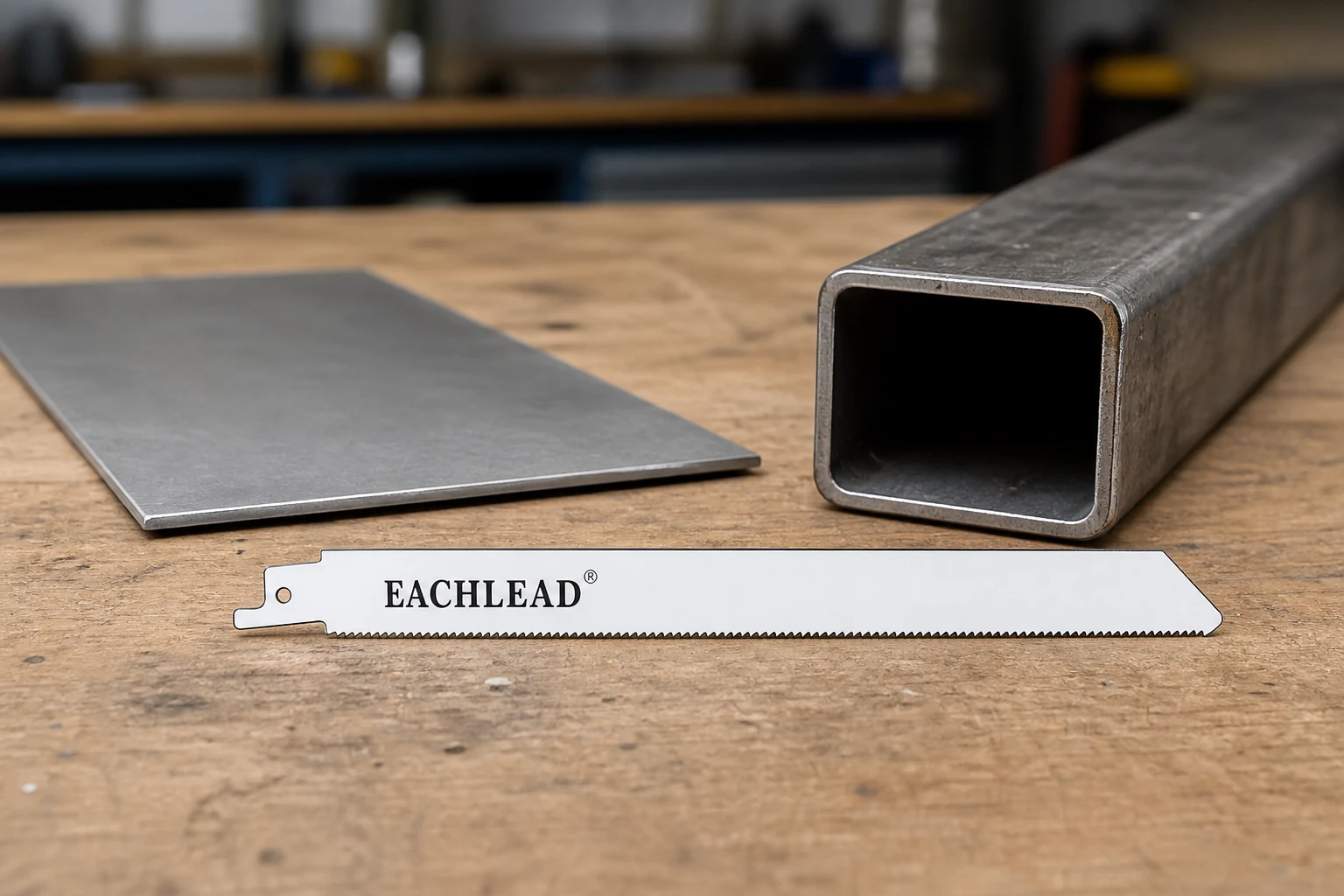
Thin-gauge flashing that chatters usually wants more teeth, not a heavier trigger pull. Thick wall that packs the gullets usually wants fewer teeth and a slower stroke.
Recip saw metal cutting blades fail early when the TPI band fights the thickness—even when the brand stamp looks “metal ready.”
Bi-Metal vs Carbide for Metal Cutting Duty
Bi-metal is the default for general metal; carbide-tipped is the step-up for hard, abrasive, or extreme metal duty—not always “better.”
Bi-metal (BIM) pairs a flexible spring-steel body with an HSS tooth edge, so the blade can flex in a recip stroke without shedding teeth as quickly as soft HCS. HCS wood blades dull immediately on steel and belong off the metal cart.
Carbide-tipped / TCT teeth are the industry step-up when cast iron / stainless / hardened fasteners or other abrasive metal duty burns bi-metal packs too fast. Cost rises with that tip class, so treat carbide as a duty decision, not a status upgrade.
| Decision factor | Bi-metal | Carbide-tipped |
|---|---|---|
| Best-fit duty | General mild/medium metal, intermittent demo | Hard, abrasive, or extreme metal where bi-metal dulls quickly |
| Body behavior | Flexible body with hard tooth edge | Harder tips; higher unit cost |
| Cost-of-ownership | Default stocking class for most metal recip work | Step-up when repeat hardness kills bi-metal life |
| Industry life notes | Guides often cite roughly 10× life vs HCS on average | Guides often cite roughly 20× life vs bi-metal on average—not EACHLEAD test data |
Intermittent mild-steel demo usually stays on bi-metal. Repeated cast-iron soil pipe or seized hardened bolts are where crews discuss carbide step-up blades.
For a full construction shootout, read carbide vs bi-metal reciprocating saw blades. Stainless-specific factors live on reciprocating saw blades for stainless steel selection factors.
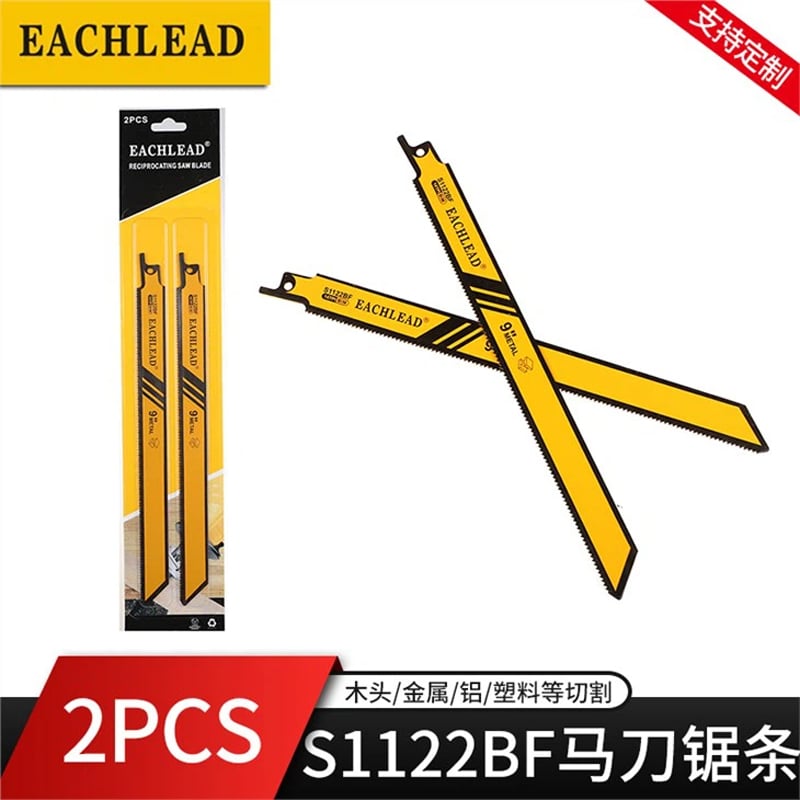
Metal cutting reciprocating saw blades in bi-metal form cover most distributor truck stock. Reserve carbide talk for hardness and abrasion, then confirm what your supplier actually publishes for metal—not masonry—duty.
Blade Length and Body Rigidity for Metal Cuts
Choose length that clears the workpiece with modest overrun; thicker bodies resist flex on denser metal.
Blade length should overrun the cut so the tip is not whipping inside the kerf. Common guidance is about 2–3 inches longer than the material width; thick pipe jobs sometimes want about 4 inches or more of overrun.
Too much length adds wobble and vibration, so do not default to the longest blade in the pack. Cutting pipe in a chase needs enough overrun to finish the wall without a tip that flails past the shoe.
Blade thickness / rigidity matters on denser metal because a thin body flexes and chatters. Educational thickness classes often run from about 0.035 in standard up through 0.042, 0.050, and 0.062 in ultra-heavy bodies.
Match blade length to the depth you must clear, then pick a stiffer body when the metal fights sideways flex. When duty moves into heavy structural stock, compare the specialty notes on choosing reciprocating saw blades for thick metal.
Speed, Shoe Contact, and Lubrication on Metal
Start slower on metal, keep the shoe planted, clamp the work, and use cutting oil on demanding cuts—heat kills teeth faster than brand choice.
For metals, begin cutting at a slow speed and increase gradually as chips form cleanly. Always hold the shoe (base plate) flat against the workpiece to limit vibration and broken teeth.
Secure the stock before you cut; a free-hanging pipe or sheet turns every stroke into impact loading. Replace dull blades instead of forcing a glazed tooth row through steel.
From the field: Going too fast, applying too much pressure, and skipping lubricant often kills a recip blade quickly—take your time and apply cutting oil / lubricant to the blade and work.
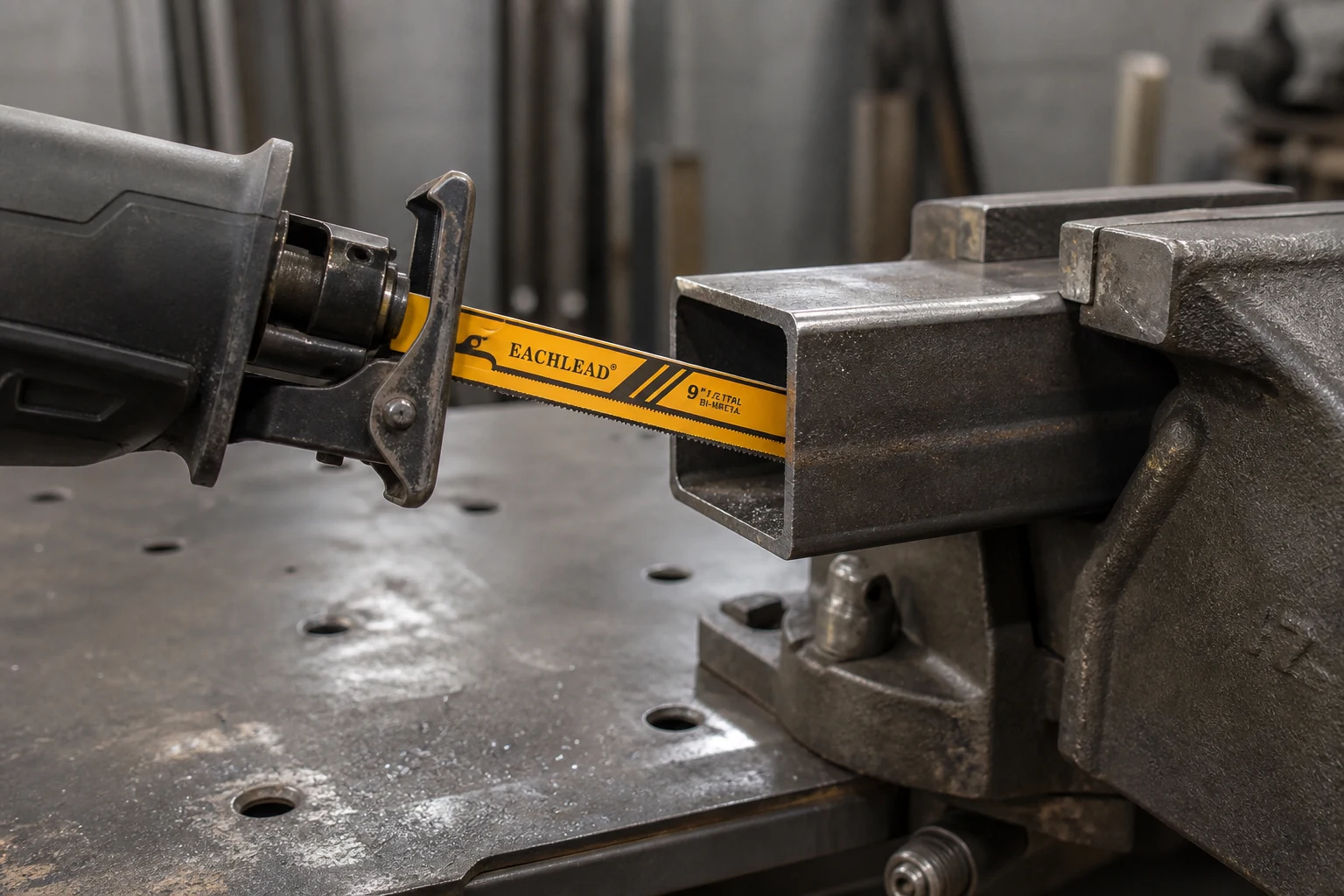
A blade that “dies” mid-bolt with the trigger wide open and no oil is usually a technique failure, not a mystery brand defect. Controlled stroke rate plus oil on demanding cuts saves more packs than swapping labels alone.
Metal Blade Buying Checklist for Workshops and Distributors
Record material thickness, metal type, TPI band, length, construction class, and pack need before you standardize a SKU.
Write the job thickness and metal family first so TPI and construction choices stay honest. Note whether the cut is sheet, pipe, angle, or mixed demo access work.
Capture preferred blade length and whether a stiffer body is required for denser stock. Mark bi-metal as the default class unless hardness or abrasion already proved bi-metal life too short.
List pack quantity and shank/holder confirmation for the saws on site—do not invent universal fit across every tool brand. Keep one thin-sheet fine-TPI option and one mid-thickness metal option on the shelf when trucks see both duct and pipe.
Distributors stocking metal cutting reciprocating saw blades should label thickness bands on the bin, not only “metal” as a single catch-all. That labeling habit prevents thin-sheet blades from being burned on thick wall.
Select EACHLEAD Bi-Metal Pathways for Metal Cutting Jobs
Review published bi-metal metal listings by thickness band; do not treat live masonry carbide SKUs as thick-metal carbide.
EACHLEAD BIM metal SKUs publish TPI and thickness application bands on live listings. Match the job thickness to that band before you standardize a pack.
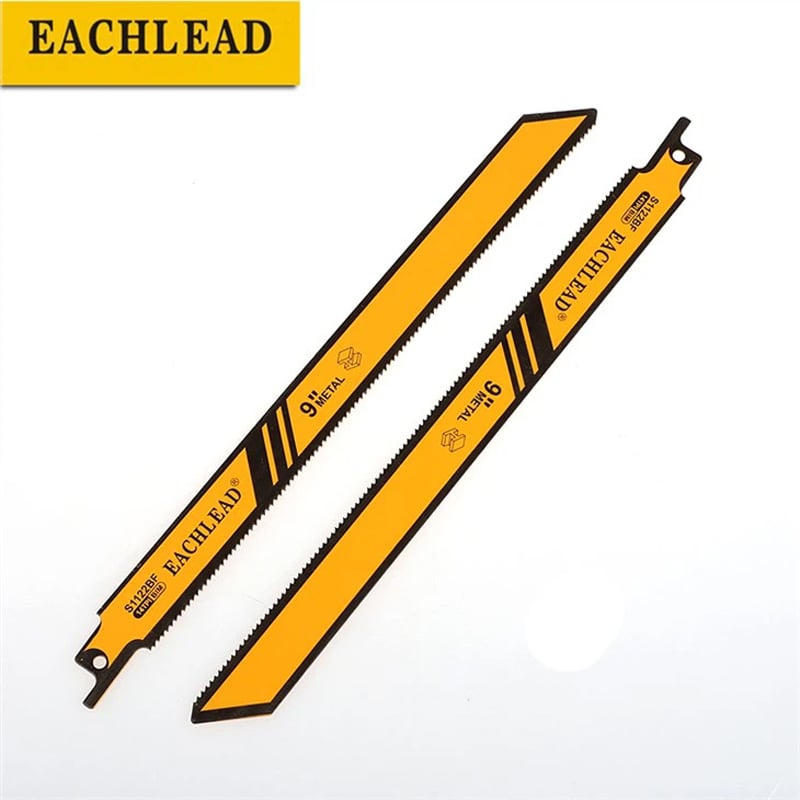
The S1122BF 9 inch bi-metal reciprocating saw blades listing shows BI-METAL 6150+M2, 9 in / 225 mm × 19 mm × 0.95 mm, 14 TPI, for thick sheet metal 3–8 mm. That mid-thickness band fits many sheet and light structural metal cuts after the selection sequence above.
For thinner sheet, compare nearby BIM listings such as S711AF / S922AF at 24 TPI for thin sheet metal 0.7–3 mm, or S711EF / S922EF at 18 TPI for thin sheet metal 1.5–4 mm. Variable-tooth S123XF is published for sheet metal 1–8 mm at 8–14 TPI when one blade must span a wider thickness window.
Browse the bi-metal reciprocating saw blades hub to compare adjacent metal TPI bands. Industry carbide step-up discussion is still valid for hard metal duty, but EACHLEAD’s live carbide family currently lists masonry and concrete TCT blades—not a thick-metal carbide SKU path—so metal buyers stay on BIM listings here.
If an unlisted thickness or duty still needs confirmation after you lock TPI and length, send those fields through the Contact / RFQ page.
FAQ
What blade do I need for metal cutting with a Sawzall / recip saw?
Use a metal-rated bi-metal or carbide-class reciprocating blade, not a wood/HCS tooth set. Match TPI to thickness first, then pick construction for duty.
What TPI should metal cutting Sawzall blades use?
Thin sheet often lands around 18–24 TPI; thicker sections often land around 8–14 or 10–14 TPI. Keep at least three teeth in the cut.
Bi-metal vs carbide — which is better for cutting metal?
Bi-metal is the default for general metal cutting. Carbide-tipped is the step-up when hard or abrasive duty burns bi-metal life—not an automatic upgrade for every cut.
Can a Sawzall cut metal?
Yes, when you fit a metal-cutting blade and control speed, shoe contact, and heat. A wood blade on steel is the wrong class.
Is “Sawzall” the same as a reciprocating saw blade?
Sawzall began as a trademark name and is now common search language for reciprocating saws and blades. Buyers still need a metal-rated recip blade for steel work.
Why do metal recip blades burn out so fast?
Wrong TPI or blade class, excess speed and pressure, missing cutting oil, and dull teeth all cook metal blades quickly. Technique often explains “failed” packs.
How long should a metal cutting blade be?
Choose a length that clears the workpiece with modest overrun—commonly about 2–3 inches longer than material width, and more for thick pipe. Avoid excess length that adds tip whip.
Which EACHLEAD blades fit thin vs thicker sheet metal jobs?
Match published BIM thickness bands: fine 24 TPI listings for about 0.7–3 mm sheet, 18 TPI for about 1.5–4 mm, and S1122BF-class 14 TPI for about 3–8 mm sheet. Confirm adjacent SKUs on the BIM hub.