


What Must You Measure Before Ordering a Replacement Planer Blade?
Measure a replacement planer blade from its true end points, then document its width, thickness, profile, mounting features, cutterhead, and manual. A nominal length or a product photo alone does not confirm that a knife will fit a particular planer or thicknesser.
Part 1. Start with an isolated machine and an identifiable knife
Begin with the machine switched off and handled according to its documented isolation procedure. A removable knife should be measured only when it can be safely identified as the reference sample; the Planer Blades page is a useful family route, but it cannot identify the knife block in a buyer’s machine.
Put a label on each removed knife before it leaves its position. Record the machine make/model, the cutterhead location, and whether the sample came from a portable planer or a thicknesser. That context prevents two similar-looking knives from becoming one unsupported order line.
| First record | Capture method | Why it matters |
|---|---|---|
| Machine identity | Photo of the rating label and manual reference | Connects the knife to a documented machine |
| Knife location | Mark the cutterhead position before removal | Keeps multiple knives traceable |
| Reference condition | Note intact, chipped, bent, or incomplete | Sets the reliability of the measurement |
| Unit system | State mm, in, or both | Prevents an unlabeled conversion |
Part 2. Define the true overall length
Lay an intact knife on a flat reference surface. Measure between the two physical end points of the knife body—not along a bevel, not from the first visible mark, and not from an estimate based on a nominal size. Photograph the rule and the full knife in the same frame.
When a manual gives a nominal dimension, keep that value beside the physical reading rather than overwriting one with the other. The reciprocating saw blade buying guide illustrates the broader purchasing habit of recording blade fields, but it is not evidence for planer dimensions or fit.
The reviewed EACHLEAD listing shows 82 × 5.5 × 1.2 mm as one portable-planer product example. It is useful as a reminder to preserve the whole dimension string; it is not a substitute for measuring the buyer’s knife and checking the cutterhead.
Part 3. Capture width, thickness, and profile separately
Width and thickness answer different questions. Take width across the knife body as specified by the machine documentation, then use an appropriate measuring tool to record thickness separately. Add the profile: straight edge, groove, locating feature, bevel arrangement, or another visible form that the drawing/manual identifies.
| Dimension or feature | Where to capture it | Order-note wording |
|---|---|---|
| Width | Across the knife body at a consistent location | “Body width measured at ___” |
| Thickness | Across the knife body, away from damage | “Body thickness measured at ___” |
| Profile | Full-face and edge photos with scale | “Profile/edge form: see attached photos” |
| Edge condition | Note chips, corrosion, or deformation | “Reference sample condition: ___” |
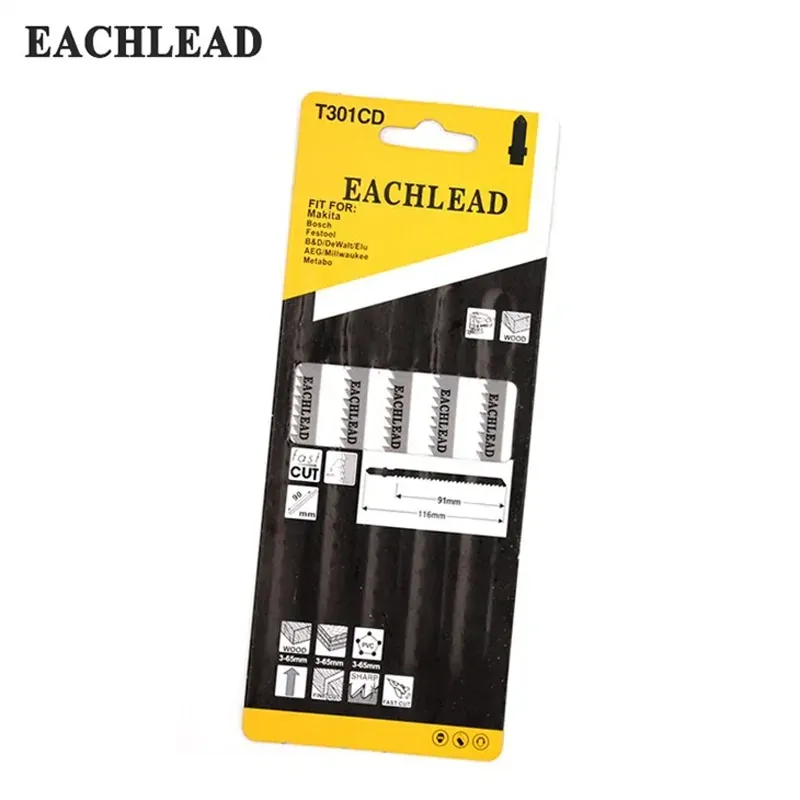
The packaged image above is an EACHLEAD asset used to show why markings and scale photos belong in a record. It does not show a planer blade and must not be used to infer a planer replacement.
Part 4. Record the mounting geometry and cutterhead evidence
An otherwise similar knife can be rejected by its mounting geometry. Look for holes, slots, grooves, notches, locating pins, clamping faces, and any asymmetry. Measure their positions from a stated reference edge, then attach close photos of both ends and the cutterhead seat.
Check the cutterhead and the machine manual together. The manual may name a knife form, while the cutterhead reveals the actual clamp, locating features, and wear or damage that could affect a safe installation. If the two records disagree, pause the recommendation and request the manufacturer’s parts information.
| Verification question | Evidence to send | Default decision |
|---|---|---|
| Does the knife seat match? | Cutterhead-seat photo and manual page | Do not assume |
| Do holes or slots align? | Dimensioned end photos | Require review |
| Is the profile the same? | Face and edge photos or drawing | Require review |
| Is the machine a thicknesser? | Model label and cutterhead/manual record | Use the machine-specific record |
Important: Do not handle or reinstall a knife while relying on an assumed isolation state. Follow the equipment procedure and applicable requirements for hazardous-energy control and guarding; see OSHA 29 CFR 1910.147.
Part 5. Treat damaged samples and thicknesser labels cautiously
A broken, bent, heavily worn, or incomplete knife is supporting evidence, not a complete specification. Use it to photograph profile clues and remaining features, then look for an intact mate, the cutterhead record, a parts diagram, or the machine manual before naming a replacement.
“Thicknesser blade” is a machine-context label, not proof that a knife matches every thicknesser. Thicknessers can have different cutterhead arrangements, retention methods, and knife forms. Record the exact machine context rather than moving a planer measurement into a thicknesser order without verification.
The complete hacksaw buying guide and jigsaw blade TPI explainer are related reading on documenting blade attributes. Neither article determines a planer or thicknesser knife fit.
Part 6. Turn the record into a reviewable replacement request
Build one controlled RFQ line with the physical record, machine record, and uncertainty clearly separated. Ask for a candidate only after the supplier can review the documented evidence against the relevant cutterhead/manual.
| RFQ field | Buyer should provide | Supplier review request |
|---|---|---|
| Knife dimensions | Length, width, thickness, and units | Compare against the documented cutterhead |
| Mounting geometry | Hole/slot/groove dimensions and end photos | Confirm whether geometry needs further evidence |
| Machine evidence | Make/model, cutterhead photos, manual or parts reference | Check the candidate against machine documentation |
| Application boundary | Planer or thicknesser, plus sample-fit criteria | State whether a sample fit is required |
Product recommendation: after those fields are complete, use Planer Blades HCS Material as a conditional family route. Why it fits: it is a live first-party category for a documented follow-up. Why not recommend as a default: the page does not prove the buyer’s profile, mounting geometry, cutterhead, or model. Fit Boundary: use it only with cutterhead/manual verification and a defined sample-fit requirement. Send the record through Contact EACHLEAD for review.
Part 7. Verify before a knife is installed or recommended
Separate a dimensional match from a fit decision. A recommendation should name the evidence used, any unverified geometry, and the next check required. If the manual, cutterhead, or sample says something different, the record needs revision—not a confident substitution.
Powered woodworking equipment has machine-specific guarding considerations. Retain the machine’s required safety provisions and use its documentation for installation steps; OSHA 29 CFR 1910.212 and OSHA 29 CFR 1910.213 provide general regulatory context.
FAQs
How do I measure a planer blade?
Measure an intact knife from true end point to true end point, then record width, thickness, profile, mounting features, cutterhead evidence, and the machine manual reference.
Is overall length enough for a replacement order?
No. Length does not establish profile, thickness, holes or slots, clamping geometry, or cutterhead compatibility.
Should I record millimetres or inches?
Use the unit shown by the measuring tool and label it clearly. If the manual uses another unit, record both values with their sources instead of silently converting an estimate.
Does planer blade thickness matter?
Yes. Thickness is a separate physical field that should be checked against the cutterhead/manual rather than inferred from width or a product image.
Can I order from a damaged planer knife?
Use a damaged sample as supporting evidence only. Add an intact mate, cutterhead photos, a parts drawing, or manual information before requesting a recommendation.
Are planer and thicknesser blades interchangeable?
Do not assume so. Verify the individual machine’s cutterhead, mounting geometry, knife profile, and manual before treating any knife as compatible.
What should a planer blade replacement RFQ include?
Include length, width, thickness, profile photos, mounting-feature dimensions, cutterhead photos, machine make/model, manual reference, planer or thicknesser context, and sample-fit criteria.