


Double Sided Jigsaw Blades: Where Two-Way Teeth Help
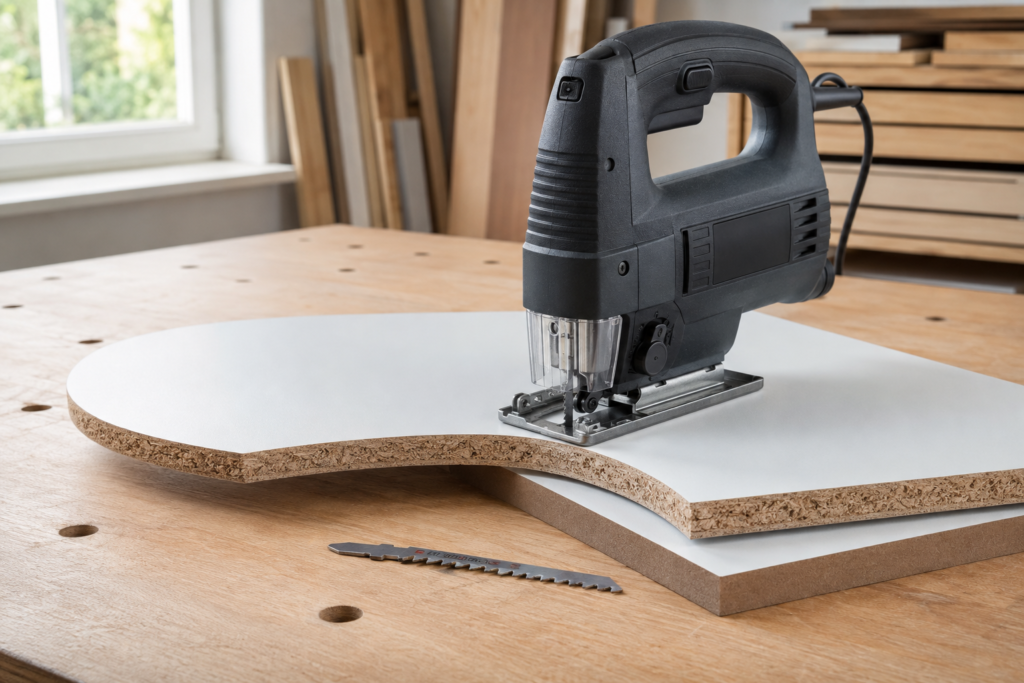
Double sided jigsaw blades use tooth geometry intended to cut during both parts of the jigsaw stroke. On a conventional blade, the dominant cutting action is usually tied to one stroke direction. A bidirectional design distributes cutting edges in opposing directions so the blade can work on the upstroke and the downstroke. The practical reason to consider this design is surface finish on both visible faces of a supported panel.
That description does not make every two-way blade interchangeable. Tooth direction is only one specification. The shank, working length, blade width, tooth pitch, workpiece material, section thickness, and required curve still need to match the tool and the job.
How do double sided jigsaw blades change the cut?
A jigsaw blade moves up and down through the kerf. A standard tooth pattern concentrates the cutting load in its designed direction. Reverse-tooth blades change that dominant direction to protect a particular face. A dual-cut or bidirectional pattern uses cutting edges in both directions. That distinction is why “double-sided” should not be treated as another name for any reverse-tooth blade.
The design goal is not simply faster removal. The goal is control of breakout at two faces. Starrett describes its Dual Cut family as cutting on both the upstroke and downstroke and positions the geometry for finish on both sides of supported wood and coated materials. That is manufacturer evidence for that family, not a guarantee for every blade sold under a similar name.
| Tooth concept | Primary selection question | What still needs checking |
|---|---|---|
| Conventional direction | Which face can tolerate the dominant breakout risk? | Pitch, set, material, shank, and section |
| Reverse tooth | Which face should receive the changed cutting direction? | Tool control, workpiece support, and blade guidance |
| Bidirectional or dual cut | Do both visible faces require a controlled finish? | Exact model limits, curve radius, shank, and working length |
Where can a double-edged jigsaw blade help?
The clearest use case is a panel with two visible surfaces. Laminated board, melamine-faced material, acrylic, and finished wood can make both entry and exit appearance important. A two-way pattern may be worth evaluating when the chosen model explicitly lists the material and section. It does not replace good support, a stable baseplate, or a controlled feed.
The finish problem should be described before the blade is chosen. Record the face coating, whether both faces remain visible, the acceptable edge condition, and whether the cut is straight or curved. EACHLEAD’s guide to reducing laminate chipping covers the wider setup factors. The separate reverse-tooth and standard-blade comparison helps when only one dominant tooth direction is under review.
Curve work adds another constraint. A narrow blade may follow a tighter path more readily than a wide blade, but the allowable radius is model-specific. Do not select a blade from the “double-sided” label and then assume it can follow the drawing. Compare the blade body with the required radius and make a representative sample cut.
What the double-sided label does not prove
Two-way teeth do not prove that a blade fits the saw. Check the shank and the tool’s holder instructions first. The T-shank jigsaw blade guide explains why the interface remains a separate field. The installed blade also needs enough working length for the material while remaining within the tool and blade maker’s limits.
Tooth pitch remains independent of tooth direction. Pitch affects how many teeth engage the material and how chips move through the kerf. A dual-cut product example may use a variable pitch, but that does not create a universal pitch rule. Use the jigsaw TPI guide to keep pitch and direction as separate decisions.
The same caution applies to performance language. “Burr-free,” “chip-free,” or “longer life” can only be repeated within the conditions of a cited model and test. Workpiece support, coating, blade condition, orbital setting, feed, and machine alignment can change the result. A sample cut is more useful than turning a family label into a promise.
Record six inputs before selecting the blade
- Tool interface: saw model, accepted shank, and holder condition.
- Workpiece: base material, coating, and actual section thickness.
- Visible faces: identify whether one face or both faces need a controlled edge.
- Cut path: straight, broad curve, or tight radius.
- Blade fields: model, working length, width, thickness, pitch, and stated cutting direction.
- Trial result: edge condition on both faces, tracking, heat, tooth condition, and any stop reason.
The EACHLEAD T344CB double-sided-teeth jigsaw blade is a relevant product record to review. Treat the model page as the start of verification, not proof of fit. Compare its current specification with the saw and workpiece record, and request missing dimensions or application evidence before release. The broader EACHLEAD jigsaw blade range can help when a different tooth direction, body shape, or material route is required.