


What Do Reciprocating Blade Spec Labels Actually Say?
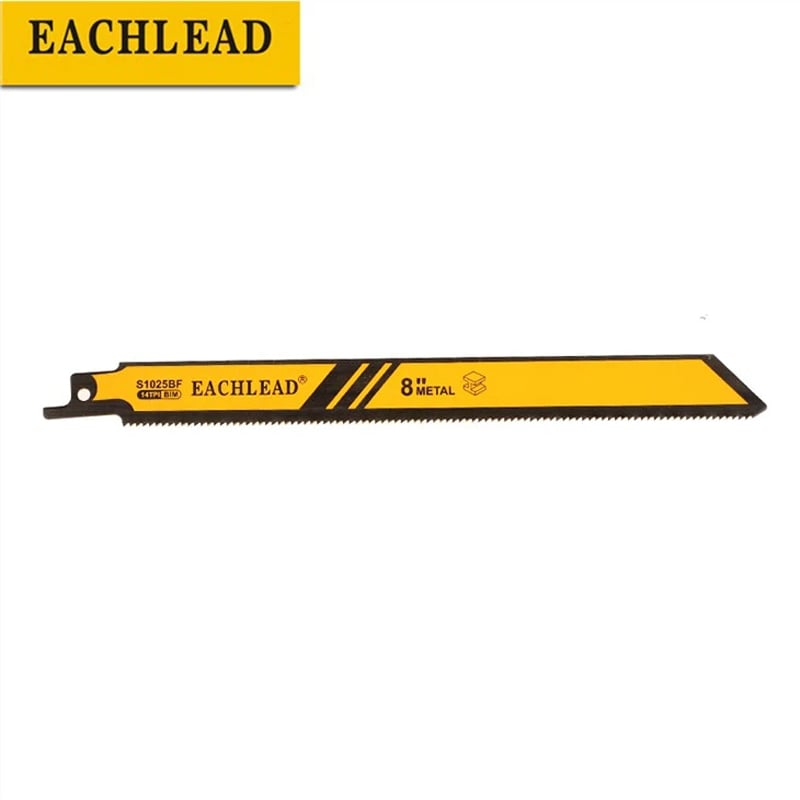
How to Read Reciprocating Saw Blade Spec Labels is a five-field skill: length, width, thickness, tooth spacing, and material, usually closed by an application range. Decode those fields and most of an RFQ writes itself. For the commercial path, review the reciprocating saw blade product category.
Part 1. What fields make up a reciprocating blade spec label?
Labels and listings compress the same five decisions everywhere: how long the blade is, how wide and thick its body runs, how its teeth are spaced, and what its edge and back are made of. An application range usually follows, naming materials and a size window.
Blade naming sits underneath the label fields. Brand words like Sawzall and the shank standard they imply are covered in the blade naming and compatibility explainer; this article decodes the printed specification itself.
| Label field | What it looks like | What it decides |
|---|---|---|
| Length | 9 inch / 225 mm | Reach and whip behavior |
| Width x thickness | 19 mm x 0.95 mm | Body stiffness and tracking |
| Tooth spacing | 1.8 mm / 14 TPI | Engagement and chip clearance |
| Material code | BIM, HCS, SS, TCT | Construction family |
Important: Use the proper blade for the material and follow the tool instructions; see OSHA handheld saw guidance.
Part 2. How is the dimension string decoded?
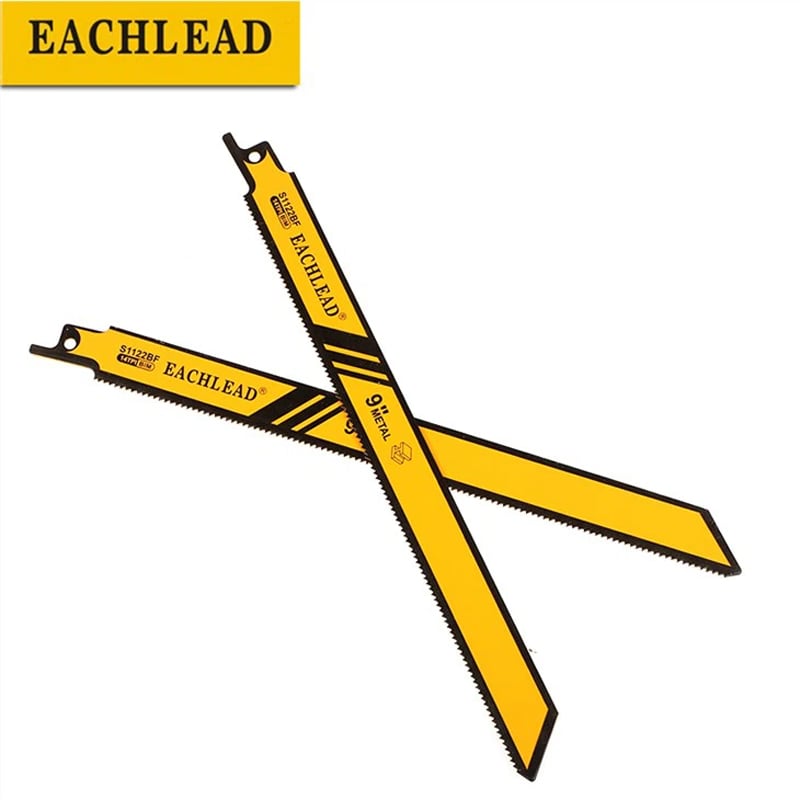
Take a live worked example. The S1122BF listing prints its size as 9 inch / 225 mm x 19 mm x 0.95 mm x 1.8 mm / 14 TPI: read it as length, then body width, then body thickness, then tooth pitch with its TPI equivalent.
Order is the decoding trick. Manufacturers vary separators and units, but the sequence runs large to small – length, width, thickness, tooth spacing – so the field positions identify themselves once you know the pattern.
Millimeters and inches travel together on export labels. The dual length (9 inch / 225 mm) serves different markets; both numbers describe the same blade, not two options.
Part 3. How do TPI and millimeter pitch convert?
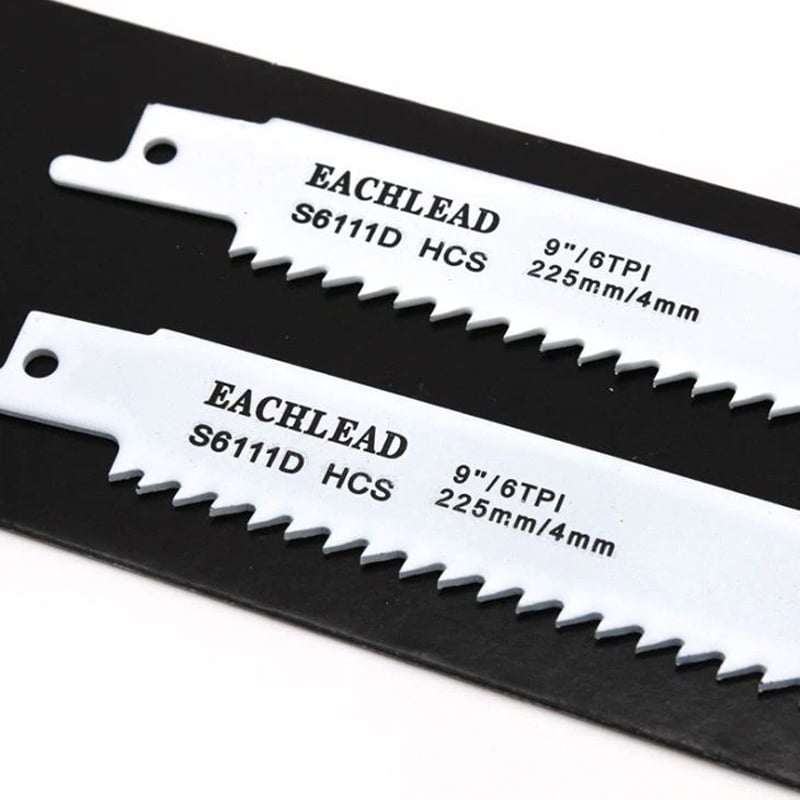
One inch is 25.4 mm, so TPI equals 25.4 divided by the pitch in millimeters. A 2.5 mm pitch is close to 10 TPI, a 1.8 mm pitch close to 14 TPI, and the rounding explains the small mismatches between charts and cards.
Two numbers joined by a dash mean variable pitch. The S1122VF listing shows 14-10 TPI: tooth spacing alternates along the edge so one blade spans a wider engagement window, useful in mixed demolition stock.
For which pitch a given metal thickness needs, the TPI decision guide carries the engagement arithmetic; the label only tells you what the blade has.
| Printed pitch | TPI equivalent | Typical duty on listings |
|---|---|---|
| 4.0 mm | approx. 6 TPI | Coarse wood cutting |
| 2.5 mm | approx. 10 TPI | Nail-embedded wood, mixed work |
| 1.8 mm | approx. 14 TPI | Thicker sheet metal |
| 1.0-1.4 mm | approx. 18-24 TPI | Thin sheet metal |
Part 4. What do the material codes on labels mean?
Material codes name the construction family. HCS is high-carbon steel, common on wood blades; BIM or bi-metal marks a flexible alloy back with high-speed-steel teeth; SS marks a stainless-steel body; TCT marks tungsten-carbide teeth.
Grade pairings extend the bi-metal code. Strings like 6150+M2 or D6A+M42 on this site’s listings name the back alloy and the tooth steel, and the reciprocating blade basics article explains how those parts share the work.
Codes describe construction, not capability. A TCT mark does not license cutting every hard material; the listed application range still rules.
Part 5. How should application ranges be read?
An application range is a catalog boundary. When the S1122BF listing says thick sheet metal at roughly 3-8 mm, it names the duty the model is positioned for, not a promise about any particular alloy or setup.
Read the range against your measured workpiece. Inside the window, the SKU is a candidate to sample; outside it, the label itself is telling you to keep looking.
Part 6. How does label data transfer into an RFQ?
Transcribe, do not paraphrase. Copy the dimension string, the pitch with both units, the material code, and the printed application range into the RFQ exactly, then add your own measured workpiece beside them.
The pairing does the work. A supplier who sees “label says 14 TPI, 3-8 mm sheet; our stock is 6 mm mild steel plate” can confirm or redirect in one reply, which is the entire point of decoding.
| RFQ line | Transcribed from label | Added by buyer |
|---|---|---|
| Dimensions | Full string as printed | Required length window |
| Tooth spec | Pitch and TPI | Measured thickness |
| Material | Code and grade pairing | Family preference |
| Application | Printed range | Actual workpiece description |
Product recommendation: open the S1122BF 9 Inch Reciprocating Saw Blades listing beside this guide as the worked example. Why it fits: the page prints a complete, readable spec string with dimensions, pitch, material options, and an application range. Why not recommend as a default: decoding a label correctly does not make that SKU right for your cut; the fields still must match your material and thickness, confirmed by sample.
Fit Boundary
Buyers, counter staff, and distributors who transcribe specifications into orders will read labels reliably with these fields. Decoding is not application matching: the decoded SKU still needs a sample test against the actual workpiece before a volume order.
Part 7. Which label misreadings cause wrong orders?
Mistaking pitch for TPI is the classic error. A card reading 2.5 mm describes roughly 10 TPI, and ordering “2.5 TPI” or treating the two scales as interchangeable produces blades a job cannot use.
Reading width as thickness follows close behind. The 19 mm figure is body width, the 0.95 mm figure is body thickness, and swapping them in an RFQ specifies a blade that does not exist.
To route a transcribed specification, send the transcribed spec to EACHLEAD: label string, material code, printed range, your measured workpiece, holder type, and target pack quantity.
FAQs
What do the numbers on a reciprocating saw blade mean?
They encode length, body width, body thickness, and tooth spacing, in that order, usually with a material code and an application range alongside.
How do TPI and millimeter pitch relate?
TPI equals 25.4 divided by the pitch in millimeters. A 2.5 mm pitch is about 10 TPI; small chart mismatches come from rounding.
What do HCS, BIM, and TCT stand for on blade labels?
High-carbon steel, bi-metal construction, and tungsten-carbide teeth respectively; SS marks a stainless-steel body. Codes name construction, not capability.
How is the dimension string on a listing read?
Large to small: length first, then width, thickness, and tooth pitch. The S1122BF example reads 9 inch / 225 mm x 19 mm x 0.95 mm x 1.8 mm / 14 TPI.
What does the application range on a label promise?
Nothing beyond a catalog boundary. It names the duty the model is positioned for; fit for a specific alloy or setup still needs a sample cut.
Why do some blades show two TPI numbers?
A dash pair like 14-10 TPI marks variable pitch: tooth spacing alternates along the edge to widen the engagement window for mixed stock.
How should label data be copied into an RFQ?
Verbatim – full string, pitch in both units, material code, printed range – paired with the buyer’s measured workpiece so the supplier can confirm or redirect.