

How to Read Planer Blade Packaging and Specification Labels
A planer-blade carton or sleeve is a useful starting record, not a fit certificate. Read it in two passes: first copy every printed field exactly; then mark the evidence you still need from the machine, cutterhead, physical knife, and supplier. That separation is what keeps a size, material mark, or product code from becoming an unsupported replacement decision.

For a replacement order, preserve the label photograph as evidence. Do not rewrite 82 × 5.5 × 1.2, a material abbreviation, or a part number into a “close enough” equivalent before you know how the source defines it. A category or catalogue can display dimensions in a length × width × thickness pattern, but the printed unit and the seller’s stated order still matter.
Start with a transcription, not an interpretation
Make one record from the package, listing, or knife marking. Copy capitalization, punctuation, decimal places, units, and any hyphens in the code. If a field is absent, write not shown; do not fill it from memory or a similar item.
Then make a second column named confirmation evidence. That column should contain the machine model, cutterhead or knife-seat details, a physical-knife measurement where safe and appropriate, and the relevant manufacturer documentation. EACHLEAD’s guide to measuring a replacement planer blade makes the important point: a nominal length or product photo alone does not confirm fit.
| Printed field to capture | What it identifies when it is printed | What it does not prove by itself | Confirmation evidence to request or compare |
|---|---|---|---|
| Product code, SKU, or part number | The seller’s stated item identity | That another brand’s similarly named item is equivalent | Supplier data sheet, the original part reference, and the machine documentation |
| Dimension string and unit | The source’s stated measured format | That the order of numbers is universal, or that the knife seats correctly | Physical knife measurements, cutterhead/seat record, and the source’s definition of the dimensions |
| Material notation, such as HCS, HSS, TCT, or TC | A stated material or construction label | Fit, edge geometry, service life, or suitability for an unverified duty | Exact material designation, relevant data sheet, and the actual operating requirement |
| Edge, profile, slot, or “double-sided” wording | A stated feature of that item | That the feature matches a particular knife clamp or cutterhead | Clear photos of both sides and the mounting features; machine manual or manufacturer confirmation |
| Pack quantity, date, batch, or other carton marking | The stated contents or traceability field, if present | A universal packing convention or a current supplier policy | Current carton artwork / packing specification and receiving requirements |

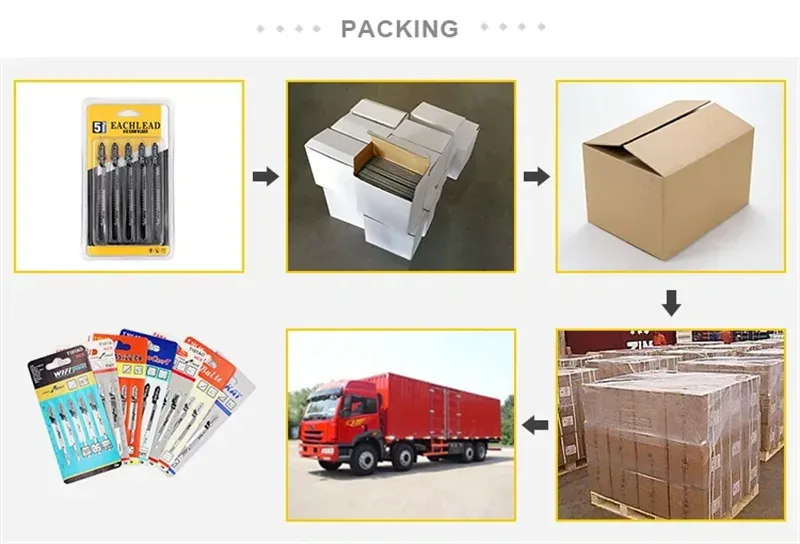
The visual is a product-detail reference, not a universal label diagram. Keep the written field record alongside any image: a photograph can show branding or a product shape, but it may not reveal units, a decimal, the reverse side, or mounting details.
Read the dimensions as a controlled statement
Some supplier catalogues use a clear length × width × thickness format. For example, the Scott+Sargeant standard planer-blade category repeatedly shows entries in an L = … × … × … mm pattern. The Trend Planer Blades category also displays model-specific inch and millimetre dimensions.
Those pages demonstrate a format; they do not create a conversion rule for every carton. Before comparing two labels:
- Copy each printed number, unit, decimal, and separator exactly.
- Keep the source’s field order. Do not assume the first number is length unless the source says so.
- Record whether the numbers came from a carton, a catalogue, the knife itself, or a machine manual.
- Compare the physical knife and its mounting geometry to the cutterhead evidence before approving a replacement.
This is especially important where near-looking values are involved. 82 × 5.5 × 1.2 and 82 × 5.5 × 1.1 are different stated records; do not merge them because the nominal inch description sounds similar.
Keep material notation separate from fit evidence
Material terms are often the most visible words on a label. They are still only one field. EACHLEAD’s related article, What HCS means on a planer blade order, discusses HCS as high-carbon steel and advises buyers to preserve the printed designation next to the machine ID.
Use that discipline for any material mark:
- Copy the designation exactly as printed, including any grade or suffix.
- Do not silently replace HCS with HSS, TCT, TC, or another material term.
- Do not infer cutterhead fit, sharpening method, life, or cutting result from the abbreviation alone.
- Ask for the applicable product data when material is a decision-critical requirement.
The same caution applies to “reversible,” “double-sided,” or a similar edge statement. A retailer page can identify a product as double-sided, but that does not establish the mounting geometry of a different machine. Capture the wording, then verify it against the knife and cutterhead.
Turn the label into a supplier-ready record
Use the following compact record in an inquiry or internal purchasing note. It keeps facts and open questions visible to everyone reviewing the order.
| Record field | Example of how to write it | Status |
|---|---|---|
| Source | Carton photo, side A; date received | Printed evidence |
| Product code | Copy exactly, or not shown |
Printed evidence |
| Dimensions | Copy the exact string and unit, for example 82 × 5.5 × 1.2 only when that is what the source says |
Printed evidence |
| Material notation | Copy exactly, for example HCS if printed |
Printed evidence |
| Quantity / packaging | Copy the stated pack count or write not shown |
Printed evidence |
| Knife-seat and mounting details | Attach photo / measurement / manual reference | Confirmation required |
| Machine and cutterhead | Manufacturer, model, cutterhead or seat reference | Confirmation required |
| Supplier response | Requested data sheet, current packing spec, and fit confirmation scope | Confirmation required |
EACHLEAD currently shows the exact product-title identifier 82*5.5*1.2 HCS in its Planer Blades category. Treat that as a site-specific notation example only. It is not a statement that this item fits every 3-1/4 in. planer or every cutterhead with a similar nominal size.
If this record is one line in a larger purchase request, continue with what belongs in a planer blade bulk order RFQ. It helps keep the label transcription, physical confirmation, and quantity request together without treating a carton field as a fit decision.
What to do when the package and the knife do not agree
Do not force a match. Put the order on hold and resolve the discrepancy in this order:
- Photograph every available package panel and both sides of the physical knife, keeping the code and any unit readable.
- Measure the reference knife only under the machine’s documented isolation and safe-handling procedure; retain the measurement method and reference points.
- Check the machine documentation and match blade length to the cutterhead instead of using the carton’s nominal description as the only fit evidence.
- Ask the supplier to confirm the exact item against the documented machine, cutterhead, profile, mounting features, and your retained label record. Request current carton artwork or a packing specification if packaging fields matter to receiving or traceability.
This route is slower than guessing from a label, but it creates a reviewable trail and stops an unverified material mark or close dimension from becoming an installation decision.
When an EACHLEAD 825.51.2 HCS listing is the right next reference
If your confirmed record calls for the visible EACHLEAD notation and your machine evidence has been checked, review the 825.51.2 HCS planer blade product page alongside the broader EACHLEAD Planer Blades category. This gives a buyer a first-party product reference after—not before—the label, knife, and cutterhead evidence have been assembled.

The listing is not a substitute for a model-fit check. Include the machine model, full measured knife record, mounting details, and any packaging requirement in the inquiry so EACHLEAD can scope a response to the actual item rather than a label fragment.
References
- EACHLEAD Planer Blades category — source for the site-specific
82*5.5*1.2 HCSlisting example. - EACHLEAD guide to measuring replacement planer blades — supports the requirement to verify dimensions and mounting beyond a nominal label.
- Scott+Sargeant standard planer blades — demonstrates one supplier’s explicit length × width × thickness catalogue format.
- Trend Planer Blades category — demonstrates model-specific dimensions and material notation in a product listing.
- RIDGID 13 in. replacement blade listing — demonstrates separate product, set-quantity, and tool-specific fields on a retailer listing.