


What Is a Hand Planer? Manual and Electric Types Explained
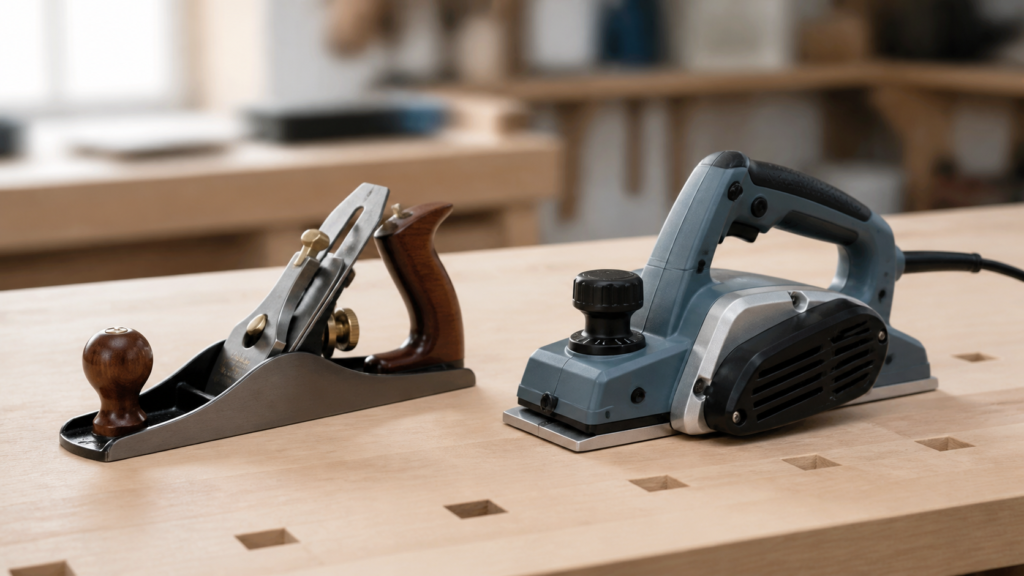
What is a hand planer? The term can mean a manual hand plane that you push across wood or a portable electric planer that removes stock with a motor-driven cutter. A stationary thickness planer is a third, different machine: the board feeds through it while the cutterhead stays in the machine. Choose among them by the surface you need to control, how much stock must be removed, and whether the work calls for local hand control or repeatable board thickness.
The name matters when you buy hand planer blades. A manual plane takes a plane iron matched to its body and adjustment system. An electric hand planer takes model-specific knives, carriers, and mounting parts. A thickness planer uses another cutterhead and knife system. The word “planer” does not make those cutting parts interchangeable.
What is a hand planer? Compare the three tool categories
| Tool | What moves | Primary reference | Typical task | Cutting part |
|---|---|---|---|---|
| Manual hand plane | The operator pushes the plane | The plane sole and the user’s control | Local trimming, flattening, jointing, or finishing | Plane iron fitted to that plane |
| Electric hand planer | The operator guides a powered cutter | Front and rear shoes on the work | Portable edge or surface stock removal | Machine-specific planer knives and mounting parts |
| Thickness planer | The machine feeds the board | The planer bed and cutterhead setup | Bringing boards toward a consistent thickness | Knives or inserts specified for that machine |
This table is a routing guide, not a performance comparison. The exact result still depends on the tool, its setup, the wood, the cutting edge, and the operator. Start with the task and machine identity before comparing blade material or dimensions.
Use a manual hand plane for local, hand-controlled work
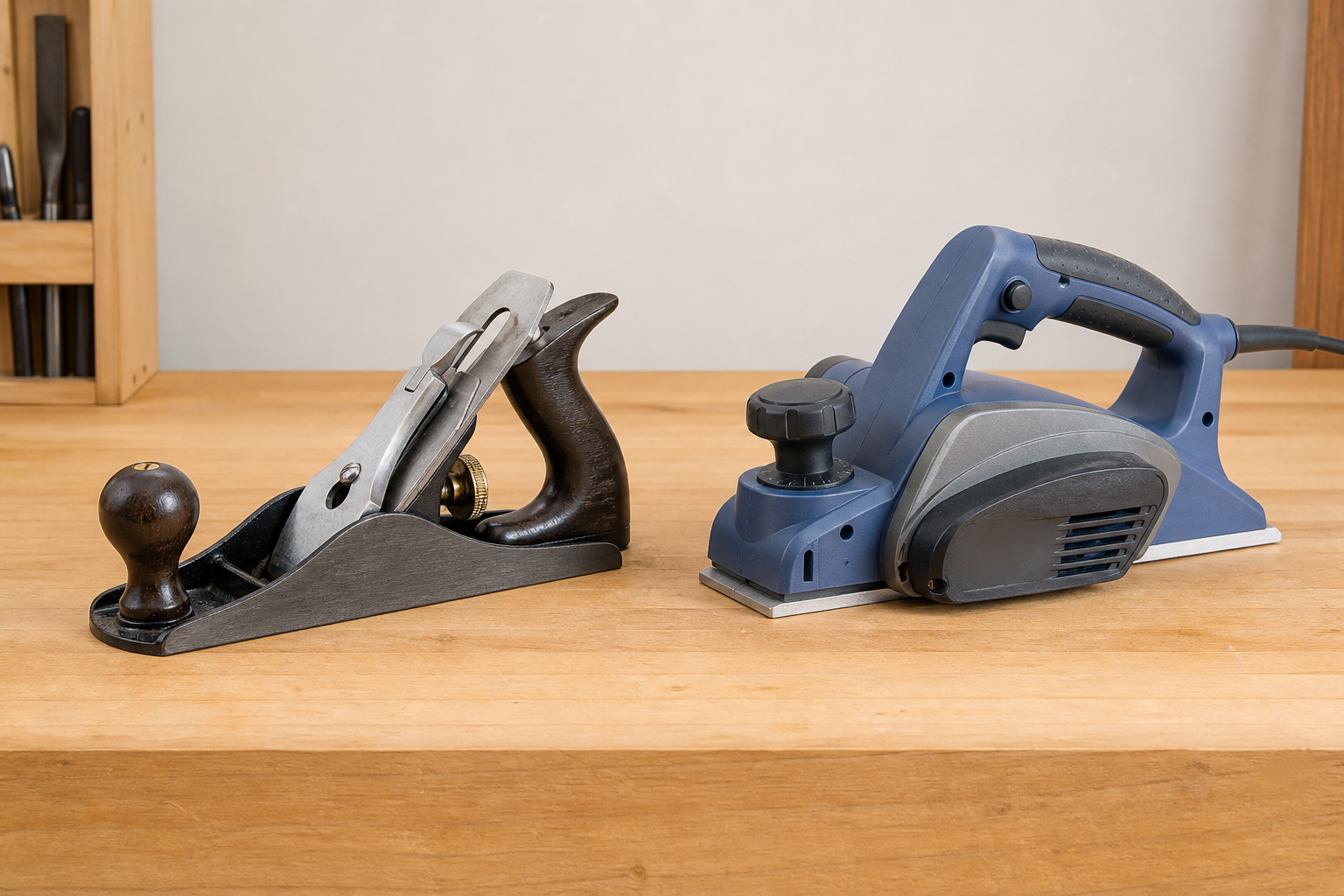
A manual hand plane carries an iron in a rigid body. The sole rides on the wood while the user supplies both motion and control. Bench-plane families are commonly arranged around different jobs: shorter planes are associated with finishing, longer planes with flattening, and intermediate sizes with roughing or general bench work. The plane type, sole length, iron, mouth, and adjustment system work together.
That makes a manual plane useful when the operator needs to feel and correct a local high spot, edge, joint, or surface. It can work without electricity and can take controlled shavings, but the result depends heavily on a sharp, correctly set iron and an appropriate reference surface. A manual plane is not simply an electric planer with the motor removed.
When replacing its iron, record the plane maker and model, iron width and thickness, bevel arrangement, cap-iron or chipbreaker relationship, and adjustment geometry. Do not route that request into a powered-planer knife catalog.
Use an electric hand planer for portable powered stock removal
An electric hand planer uses a rotating cutter and is guided along the work on its shoes. A depth adjustment changes the relationship between the front shoe and the cutter on the named tool. Some models also support edge or rabbet work with dedicated guides. Those features make the tool useful for removing stock along an edge or surface when a portable powered tool fits the job.
The setup is machine-specific. The shoe must stay supported and the work must be stable. Follow the actual tool manual for depth adjustment, blade installation, handling, and allowable work. A model example can explain the category, but its depth range, knife type, or accessories do not automatically apply to another planer.
For replacement knives, start with the machine label and installed parts. The electric planer blade RFQ guide shows how to capture the machine and current knife before requesting a substitute. If a package or stamped part is available, the planer blade specification-label guide helps separate printed facts from assumptions.
A thickness planer controls a different part of the job
A stationary thickness planer feeds the board across a bed and under a cutterhead. Its job is not the same as touching up one edge with a hand-held tool. The machine references the board as it passes through, so stock preparation, support, cutterhead condition, and the machine’s own knife system determine what can be achieved.
Use the stationary machine’s own documentation for stock preparation, pass setup, and knife service. Those procedures are outside this definition article; the comparison here only identifies which tool and cutting-part record the reader needs next.
Identify hand planer blades with a six-field record
Once the tool is confirmed as an electric hand planer, compare blades with a complete machine record. A visually similar knife can still differ in thickness, edge arrangement, carrier, locating features, or mounting method.
Keep a clear photo of the installed knife, carrier, fasteners, and cutter orientation with the record. That view helps a reviewer distinguish an observable mounting feature from a dimension or material assumption.
- Machine identity: manufacturer, model, type or revision, and the exact label photographed clearly.
- Current knife dimensions: length, width, and thickness measured and cross-checked against the manual or part record.
- Edge arrangement: single- or double-edged, reversible or non-reversible, and any stated sharpening route.
- Knife material: record HCS, HSS, TCT, or another marking without assuming the material proves fit.
- Mounting system: holes, slots, notches, carrier, guide bar, screws, and orientation.
- Source evidence: manual, current part number, packaging, and photos kept with the request.
The public EACHLEAD planer blade range includes electric hand-planer knife records, while the HCS planer-blade category narrows the material branch. A current 82 mm HCS planer-blade record shows why dimensions and construction belong in the request. It does not mean every 82 mm knife fits every planer.