


Carbide Reciprocating Saw Blades: When the Edge Construction Matters
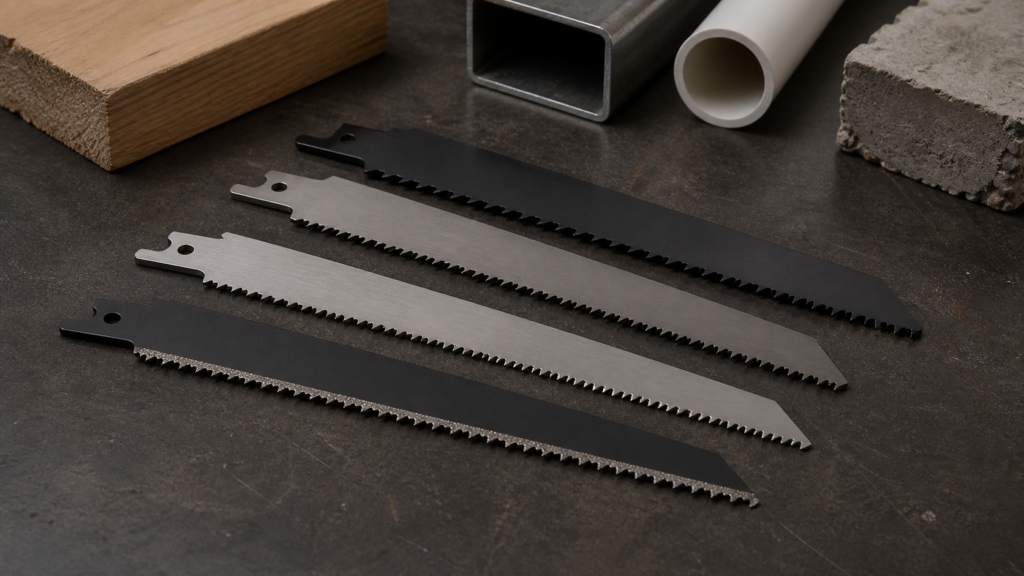
Carbide reciprocating saw blades should be chosen by edge construction and named application, not by the word “carbide” alone. First identify the workpiece and cross-section. Then determine whether the blade uses carbide-tipped teeth or a carbide-grit edge, check the pitch or grit description, choose enough working length and an appropriate body, and verify the shank and the manufacturer’s application statement.
This order matters because carbide blade families cover very different jobs. A toothed model for high-alloy steel, a demolition blade for nail-embedded wood, and a grit-edge blade for ceramics do not become interchangeable because each contains carbide. If the model page does not name the material or application, treat that gap as unresolved.
Buyer shorthand such as “carbide recip blade” or “hard material blade” is therefore only a search starting point. Replace the shorthand with the actual edge construction, workpiece, section, and named application before comparing models.
Carbide reciprocating saw blades start with the edge type
| Edge construction | How it is described | Documented application examples | What still needs checking |
|---|---|---|---|
| Carbide-tipped teeth | Individual carbide cutting tips arranged as teeth | Tough metal, cast iron, embedded wood, or demolition on named models | Material, section, TPI, length, body, and shank |
| Carbide grit | Abrasive carbide particles on the cutting edge | Ceramics and fiberglass in a named special-purpose example | Grit grade, material scope, working length, and tool fit |
The table is not a universal application chart. It shows why the first useful question is “tipped teeth or grit?” A carbide-tipped blade for metal may have no documented role in concrete or ceramic. A carbide grit blade may not supply the tooth geometry needed for a metal-cutting job. Read the named model rather than transferring a material claim from another carbide product.
Match the carbide blade to the actual material and cut
For metal work, record the alloy or at least the best available material description, then note whether the section is solid, tubular, thin wall, cast, or interrupted. One current official guide separates carbide solutions for fine metal, hardened fasteners, and thick cast-iron applications. Another current carbide-tipped family names work that can include cast iron, high-alloy steel parts, embedded wood, and demolition. Those examples prove that specialized carbide models exist; they do not turn every carbide blade into a multipurpose blade.
For wood demolition, identify nails, screws, plates, and other embedded material instead of writing only “wood.” For abrasive non-metal work, distinguish concrete, brick, ceramic, fiberglass, and other composites. A current official application guide, for example, maps a carbide-grit reciprocating blade to ceramics and fiberglass. The public EACHLEAD carbide reciprocating blade category currently shows concrete-focused TCT models, so their published scope should remain separate from metal and embedded-wood examples on other manufacturers’ pages.
Use TPI and tooth pattern with the workpiece section
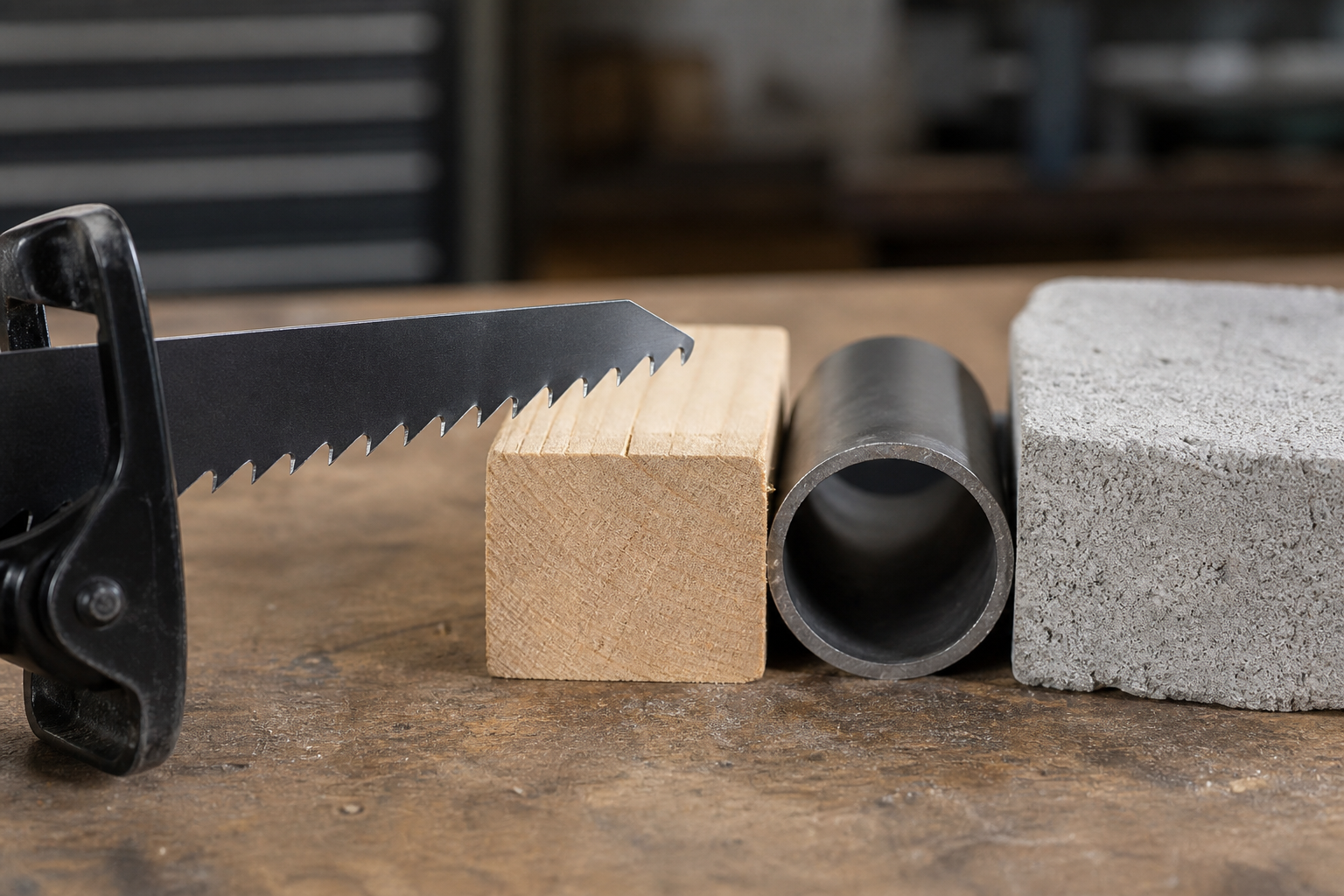
Once a toothed carbide family is appropriate, compare its pitch with the section that will engage the blade. Thin wall and fine sheet present a different engagement problem from a solid bar, a cast-iron pipe, or wood containing nails. A single TPI rule cannot cover all of those conditions. Use the model’s own application and section guidance, and keep several teeth engaged where the manufacturer requires it.
Variable-pitch and fixed-pitch blades should also be treated as named designs, not as marketing synonyms. Record the complete tooth description from the product page or blade marking. If the work is primarily thick metal, the reciprocating-blade TPI guide helps organize the section check. For the broader construction decision, use the carbide-versus-bi-metal guide before narrowing to a carbide model.
Check working length, blade body, and shank separately
The blade needs enough usable length for the full stroke and the maximum workpiece section, with clearance for the shoe and the cut path. More overall length is not automatically better: excess length can reduce control, while an undersized blade can let the tip strike or leave the work during the stroke. Use the saw manual and named blade dimensions together.
Body width and thickness affect stiffness, access, and resistance to bending. A wider, thicker body may support a straighter heavy cut where access permits; a narrower body can reach a restricted path or curve. Treat those as geometry choices, not guaranteed outcomes. Confirm the shank against the actual holder as a separate step. The reciprocating-blade fit guide explains why a familiar blade family does not replace a tool-level holder check.
Compare current EACHLEAD TCT concrete models by record
The current EACHLEAD carbide category provides two useful examples of why the model record matters. Both are presented as a TCT reciprocating blade for concrete cutting, and both are currently labeled 12 in/300 mm and 2 TPI. They remain different model records and should not be collapsed into one item.
| Current model | Visible catalog scope | Visible shared fields | Buyer follow-up |
|---|---|---|---|
| S1617HM | TCT concrete-cutting reciprocating blade | 12 in/300 mm; 2 TPI | Confirm the complete drawing, body dimensions, shank, pack, and target material |
| S1243HM | TCT concrete Sawzall/reciprocating blade | 12 in/300 mm; 2 TPI | Confirm the complete drawing, body dimensions, shank, pack, and target material |
These labels support comparison within the current concrete-focused route. They do not support a claim that either model cuts cast iron, high-alloy steel, embedded wood, ceramic, or every type of concrete. Ask for the current model drawing and application statement before release.
Build an order-ready carbide blade record
- Workpiece: exact material, coating, embedded material, and known hardness or abrasive condition.
- Section: solid size, wall thickness, profile, interrupted features, and maximum cut depth.
- Edge: carbide-tipped teeth or carbide grit, with the full tooth/grit description.
- Blade body: total and working length, width, thickness, and straight/tapered form.
- Tool interface: saw model, holder, shank, shoe position, and manual restrictions.
- Application evidence: current manufacturer page, drawing, or datasheet naming the job.
- Trial and acceptance: representative material, observable stop criteria, and the approved model record.
Use the EACHLEAD reciprocating saw blade range for the broader family view, then move to the carbide category and a named model only after these fields are known. If the buyer still needs a tool-and-blade overview, the reciprocating-blade explanation provides that foundation without repeating this application matrix.