


What Is a Reciprocating Saw? A Practical Guide to the Tool and Blade
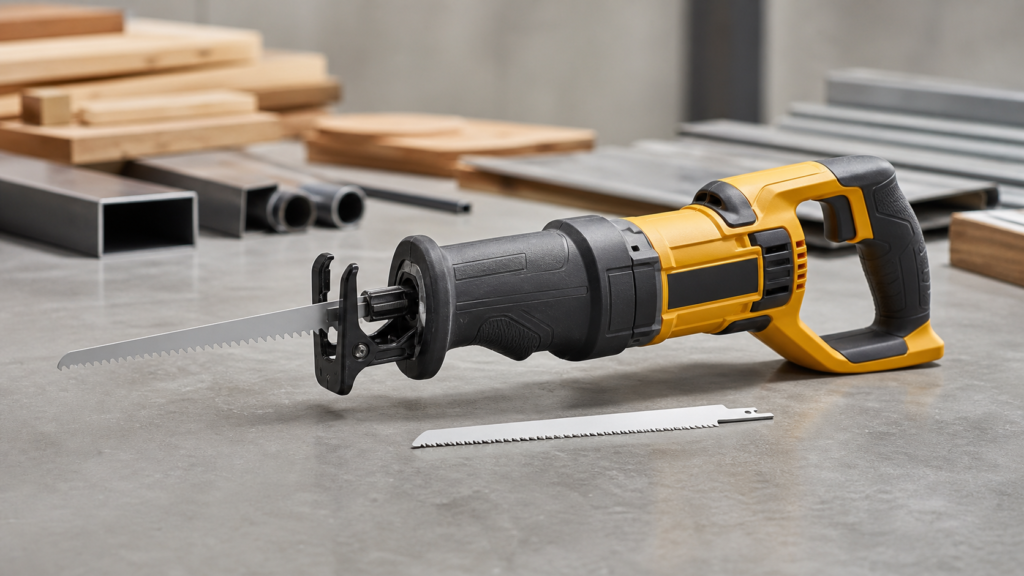
What is a reciprocating saw? A reciprocating saw is a handheld power saw that moves a straight blade in a rapid back-and-forth stroke. Its narrow front end reaches installed work. The tool is therefore common in demolition, renovation, pipe cutting, pruning, and other jobs where access matters more than a finished edge.
The saw supplies the motion, but the blade determines what the setup can cut. Wood, metal, nail-embedded timber, plastic, and pruning work call for different blade bodies and teeth. The tool creates the stroke. The blade and work setup define the application.
How does a reciprocating saw work?
The tool’s drive moves the blade clamp back and forth in line with the housing. The clamp holds the blade by its shank, allowing the cutting section to project forward from the tool.
The shoe sits around or beside the blade at the front of the saw. It provides a contact point close to the cut. Its position and adjustment depend on the tool model, so the selected manual should govern the setup.
These four parts perform different jobs:
- Motor and drive: create the back-and-forth stroke.
- Blade clamp: connects the selected blade to the drive.
- Blade: supplies the length, body, edge, and tooth geometry for the material.
- Shoe: provides a reference and contact point at the workpiece.
Some saws add variable speed, an adjustable shoe, or orbital action. Those features are model-specific. They do not change the basic definition, and they should be used according to the selected tool’s manual rather than a generic article.
What is a reciprocating saw used for?
A reciprocating saw is most useful when the workpiece is difficult to bring to a bench tool or when the material is being removed. The long body can reach between framing members, beside a wall, under a vehicle, or into landscaping work. A suitable blade can also start from an exposed edge without the wide clearance required by a circular blade.
| Job | Why the tool can fit | What still controls the result |
|---|---|---|
| Demolition and remodeling | It reaches installed studs, frames, and mixed assemblies | Hidden fasteners, nearby services, blade material, and access |
| Pipe and conduit removal | The blade can approach round stock from the side | Pipe material, wall thickness, support, and clearance behind the cut |
| Pruning and landscaping | A long pruning blade can reach branches and roots | Blade type, branch size, tool approval, and work support |
| Cutting wood with nails | The tool can work in place during dismantling | A blade designed for mixed wood-and-metal conditions |
The same design is less suited to a long finished edge, a controlled cabinet cutout, or a clean curve in sheet material. In those cases, a jigsaw, circular saw, track saw, or oscillating tool may provide better support or line control. Tool choice should follow the required cut, not the fact that several tools can remove the same material.
Why the blade changes what the saw can do
A reciprocating saw without the right blade is only a source of motion. The blade body has to survive the bending and contact expected in the job, while the cutting edge has to match the material. Coarse teeth that clear chips in wood solve a different problem from finer teeth used on thinner metal. Carbide-edged products belong to narrower applications.
Start with the workpiece, then compare the blade:
- Material: identify clean wood, wood with fasteners, ferrous metal, nonferrous metal, plastic, pruning material, or another documented application.
- Thickness and shape: record solid stock, sheet, tube, profile, branch, or a mixed assembly.
- Reach: check the shoe position, blade stroke, obstruction, and clearance behind the work. The blade must remain suitable through the full stroke.
- Cut objective: distinguish rapid removal from a controlled, low-burr, close, curved, or flush cut.
The DEWALT DCS380 product page, for example, identifies a four-position blade clamp and an adjustable shoe for that model. It shows why the tool configuration belongs in the selection record. Those features do not establish a universal blade position or reach, so the exact saw manual and blade documentation remain the final references.
Readers who want more detail on construction and tooth patterns can continue with how reciprocating saw blades work. The important point here is that a familiar shank shape or a broad material label does not prove full compatibility, useful reach, or the desired cut quality.
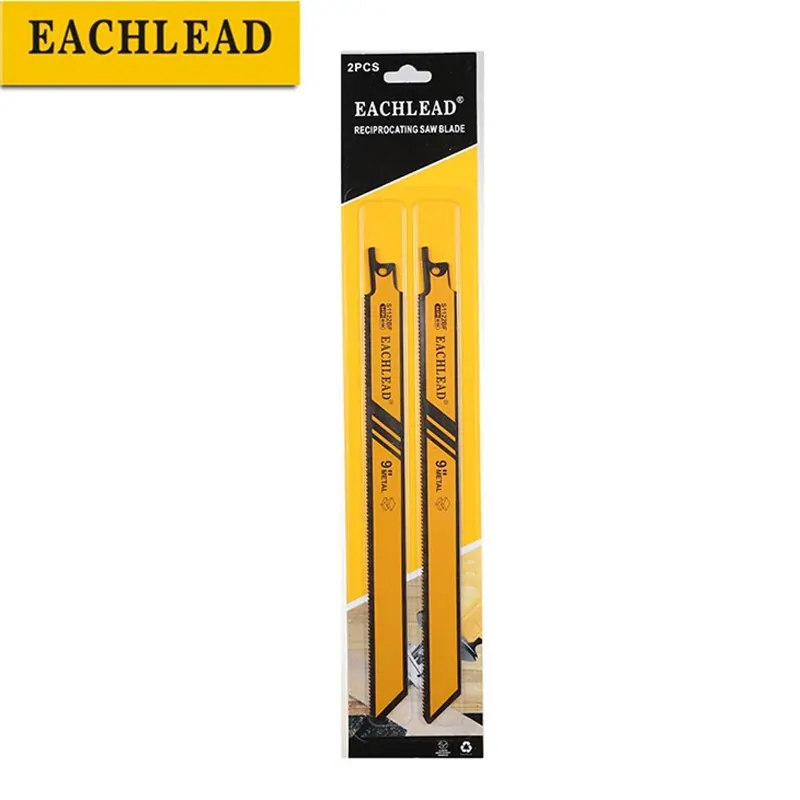
The current EACHLEAD reciprocating saw blade range provides a starting point for comparing published blade families. It does not make every listed blade suitable for every saw or job.
Reciprocating saw vs. jigsaw: what is the difference?
Both tools move a narrow blade back and forth, but they are intended for different cutting tasks. A reciprocating saw commonly handles installed material or removal work. Bosch describes its jigsaws as tools for curved, straight, and intricate cuts.
| Decision | Reciprocating saw | Jigsaw |
|---|---|---|
| Common task | Demolition, renovation, stud removal, and pipe cutting | Curved, straight, and intricate cuts |
| Working priority | Access and removal in installed work | Detail and maneuverability for shaped cuts |
| Blade decision | Match the blade to the material and removal task | Match the blade to the material and desired cut path |
The distinction is a task guide, not a claim that one tool is always more powerful or precise. Blade selection, tool model, work support, and operator method still matter. For the complementary tool-level explanation, see what a jigsaw is and how its blade works.
What to check before choosing a reciprocating saw blade
A clear blade request begins with four groups of information. First, identify the saw brand and model and record the blade interface named by the manufacturer. Second, define the material and thickness rather than using a broad phrase such as “general purpose.”
Third, describe the work envelope: access, shoe position, required reach, nearby surfaces, and clearance behind the cut. Finally, state the result that matters. It may be rapid removal, a close cut, lower burr, a curved path, or a sample that must meet a defined inspection.
This record keeps different decisions separate. The saw model establishes the tool boundary. The workpiece establishes the material demand. The blade establishes the cutting interface. A trial or inspection establishes whether the combination is acceptable for the actual job.
“Sawzall” is a third-party brand term. For a specification, purchase request, or product comparison, reciprocating saw and reciprocating saw blade are the clearer generic terms.
References
- DEWALT DCS380 Reciprocating Saw — model-specific blade-clamp and adjustable-shoe example.
- Bosch: Reciprocating Saws — typical construction, demolition, renovation, pipe, and pruning uses.
- Bosch: Reciprocating Saw Blades — blade families organized by material and application.
- Bosch: Jig Saws — curved, straight, and intricate cutting context for the comparison.