


Types of Power Saws: A Visual Guide to Cuts, Materials and Blade Motion

Common types of power saws include circular, track, table, miter, jigsaw, reciprocating, band, scroll and chain saws. The useful distinction starts with the cutting motion and the work: a long straight sheet cut, a curved outline and a rough removal cut are different tasks.
Some saws share a rotating disc but handle the material differently. Others use a short blade moving back and forth, a continuous band or a linked chain. A category name helps narrow the choice; the actual saw and blade still need to suit the material and required cut.
Types of power saws fall into different motion groups
A circular blade rotates around its center. That motion appears in several families, including handheld circular saws, table saws and miter saws. A reciprocating blade reverses direction repeatedly; jigsaws, conventional reciprocating saws and scroll saws use versions of this back-and-forth action.
A band saw carries a continuous toothed band around wheels. A chain saw carries linked cutting chain around a guide bar. These are different cutting elements, even though both circulate continuously. The distinction does not imply that their blades, chains or accessories are interchangeable.
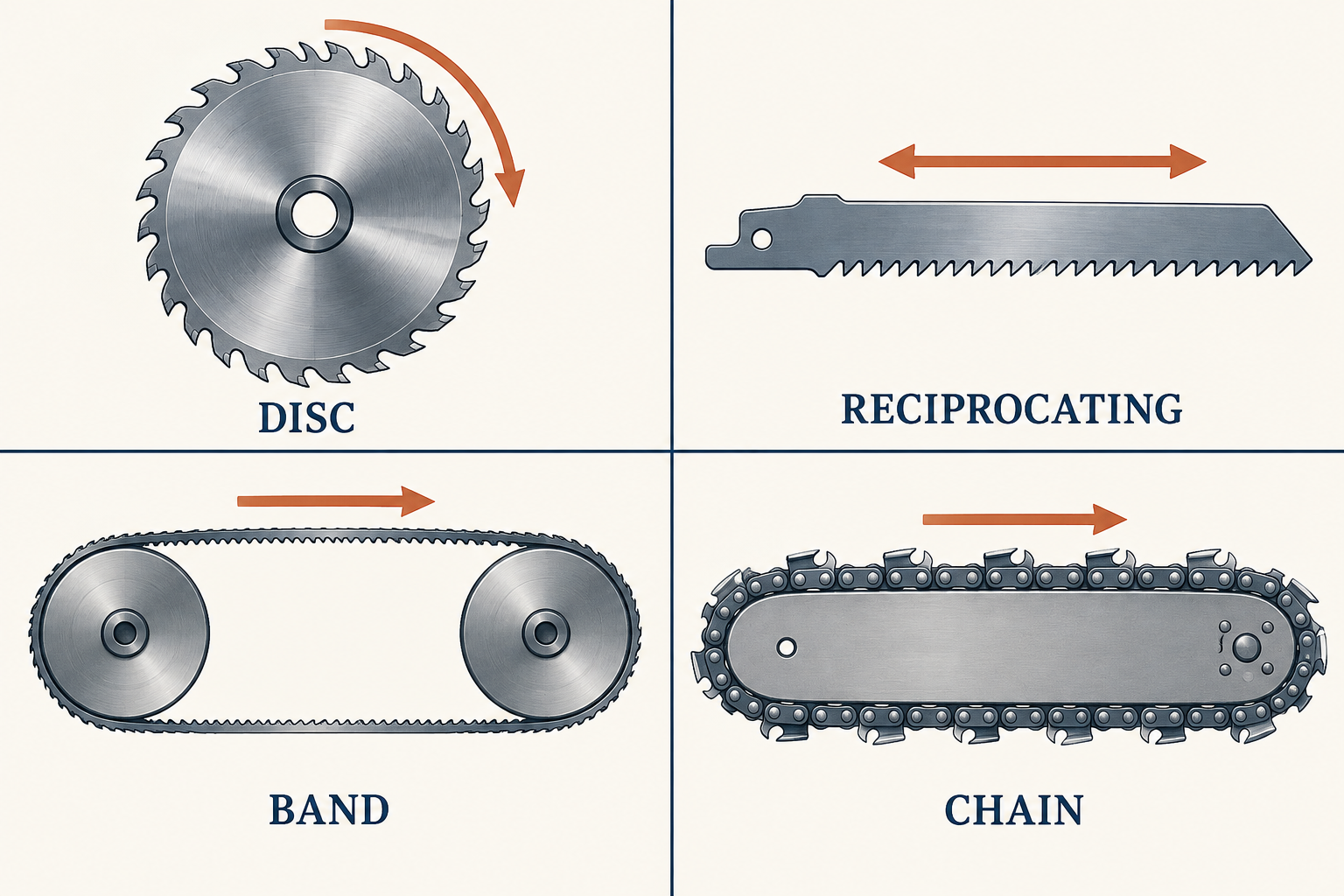
KONETOOL’s family guide distinguishes the basic disc, band and chain forms. For selection, add a second question: does the tool travel across supported work, or does the work move through a cutting station? That relationship separates several tools which otherwise share the same blade motion.
A quick map of common saw families
| Saw family | Useful task starting point | Distinction to check |
|---|---|---|
| Handheld circular saw | Straight cuts in suitable board or sheet stock | The tool travels across the work; model and blade determine material suitability |
| Track or plunge saw | Rail-guided straight sheet cuts | A matching rail, tool and any required adapter form the system |
| Table saw | Rip work and repeated widths at a cutting station | The work is guided relative to the blade; capacity and work handling matter |
| Miter saw | Crosscuts and angled end cuts in suitable stock | The cutting head moves toward the supported work; capacity is model-specific |
| Jigsaw | Curved outlines and suitable shaped cutouts | A slim reciprocating blade follows the required path |
| Reciprocating saw | Renovation, rough removal and access-dependent cuts | Choose the blade for the actual material and task |
| Band saw | Curves or resawing on an appropriate woodworking machine; other models serve metal cutting | A continuous band and machine configuration establish the application |
| Scroll saw | Fine patterns and interior detail | Small up/down blade, work support and model limits |
| Chain saw | Suitable timber and outdoor cutting tasks | Linked chain around a guide bar; separate equipment and operating requirements |
This is a recognition guide, not an exhaustive industrial classification. Panel saws, tile saws and other specialized machines serve additional tasks. Their names should be checked against the actual cutting system rather than folded into a claim that one general saw cuts every material.
Shared blade motion does not mean the same workflow
Compare a circular saw, a miter saw and a table saw. Each can use a rotating disc, but the material path differs. A handheld tool moves over the work; a miter-saw head approaches the work at a cutting station; a table-saw arrangement guides the work relative to the blade.
SawStop’s rip-fence manual explains the fence as a parallel guide and width reference for rip work. Makita’s guide-rail information describes a compatible tool traveling on a rail over sheet material. These descriptions help explain why repeated-width production and initial sheet breakdown may favor different arrangements.
Similarly, a jigsaw and a conventional reciprocating saw both reverse blade direction, yet their common task emphasis differs. Bosch’s DIY guide associates slim jigsaw blades with curved paths. Its professional reciprocating-saw information emphasizes renovation and demolition work with task-appropriate blades.
Corded and cordless describe power supply. They do not create a new cutting motion. Battery voltage alone cannot tell you whether a tool is a circular saw, a jigsaw or a rotary tool, and it cannot establish which blade fits.
Fine detail and rough removal are separate decisions
A scroll saw is associated with small patterns and interior cutouts. Woodcraft’s explanation describes its up-and-down blade movement and detail work. That makes it a different starting point from choosing a band saw for an appropriate resawing task.
Even within one family, blade selection changes with the task. A curved outline needs a different discussion from a rough removal cut in mixed material. The stock’s thickness, composition and any additional material in the cut belong in that discussion.
The jigsaw-blade family and reciprocating-saw-blade family are separate accessory paths. Start with the correct tool family, then check the actual shank, dimensions and intended application. A generic blade photograph cannot establish a particular model fit.
Nor does changing a blade automatically convert a wood-cutting machine into an approved metal, masonry or tile saw. Check the complete machine-and-accessory requirements. This guide supplies no operating sequence, blade-change method or cutting-depth recommendation.
Use the required result to shortlist a saw
Consider a hypothetical workshop with three jobs: divide a sheet into broad panels, produce a curved wooden outline and remove an unwanted member during renovation. Treating all three as “cutting wood” hides the distinctions that matter.
The sheet task calls for a straight path and a workable material-handling arrangement. A compatible track system or another suitable sheet-cutting arrangement belongs on the shortlist. The curved outline points toward a jigsaw or another appropriate curve-cutting machine, depending on detail and stock.
The removal task raises different questions about access and material in the cut. A conventional reciprocating saw may be a relevant family, but the actual blade and machine requirements still need review. The family name does not establish that every hidden or mixed material is acceptable.
For each job, record the material, required path, workpiece size and desired finished result. Use those inputs to compare tool families, then verify the actual model and accessory. That sequence turns a list of saw names into a useful equipment decision.