


Short Reciprocating Saw Blades for Tight Access: What to Compare
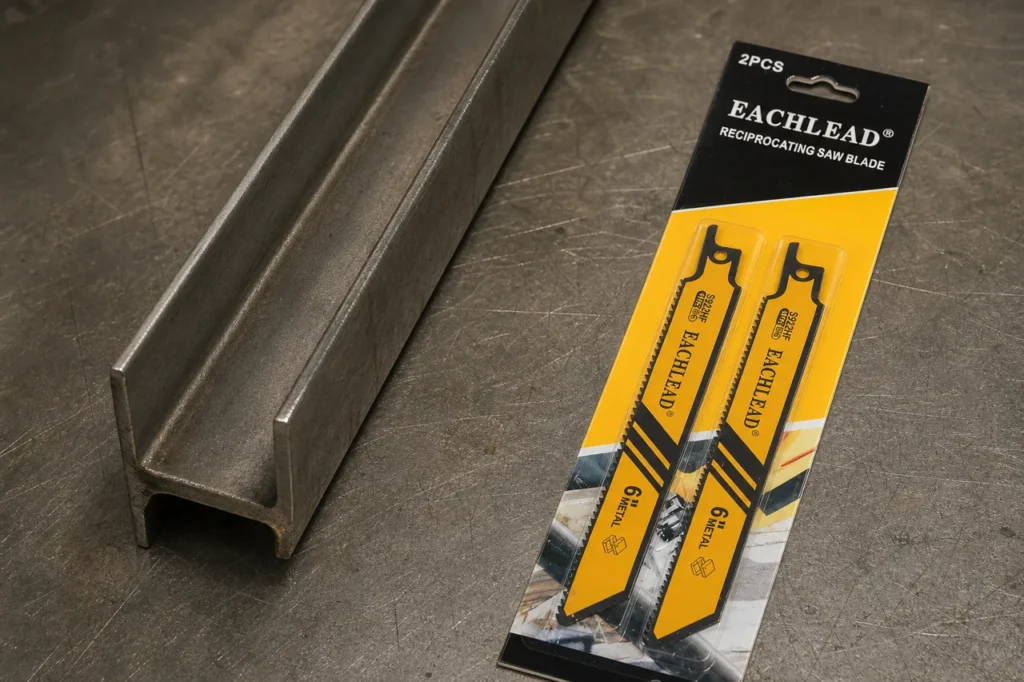
Short reciprocating saw blades are the right starting point when a longer tip would foul on studs, joists, or nearby utilities—choose the shortest length that still exits the cut each stroke, then match TPI and bi-metal construction to the material.
This article compares clearance and overrun, rigidity versus depth, TPI bands, bi-metal bodies, published 150 mm options, and shoe technique for confined cuts.
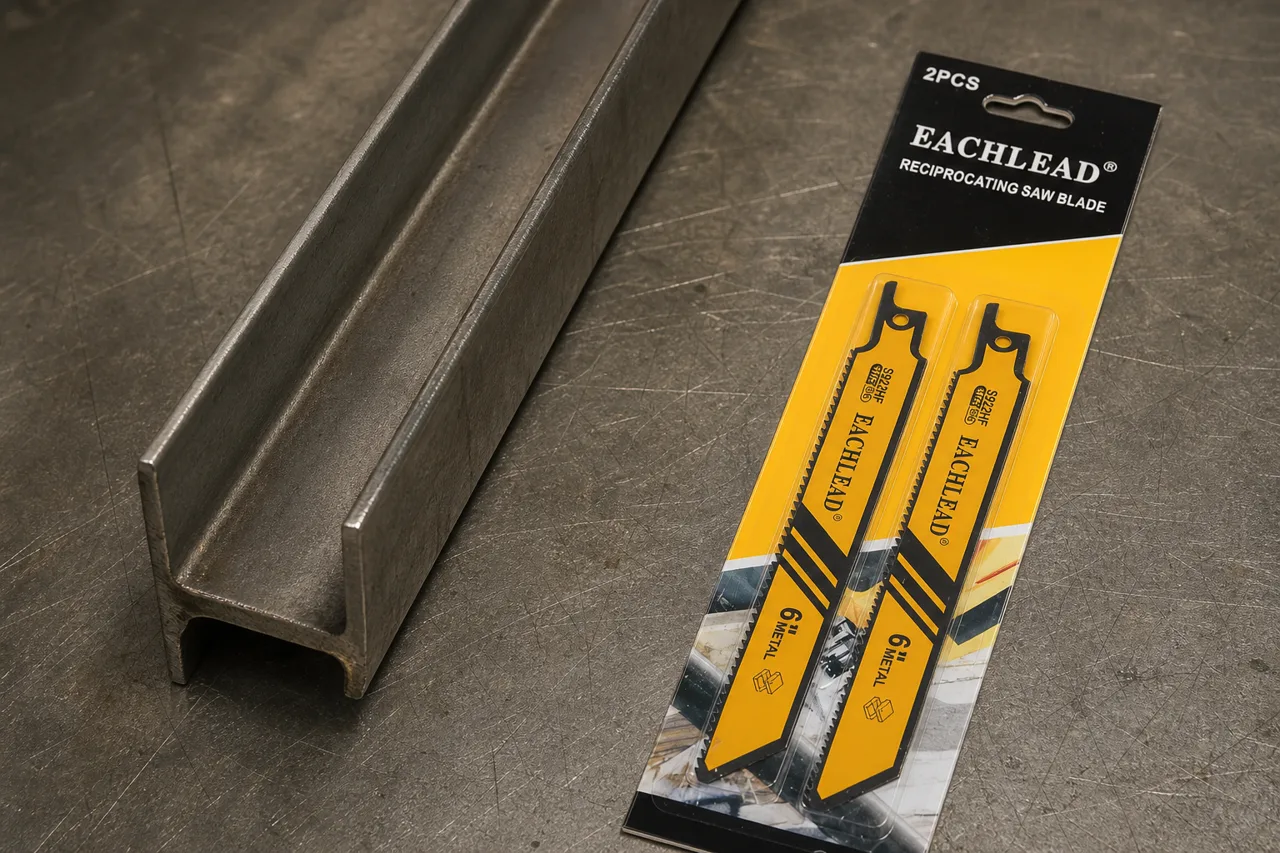
What “Short” Means for Clearance and Stroke
Use the shortest blade that still runs past the workpiece on every stroke.
A reciprocating saw drives the blade in a push-and-pull motion. If the tip never clears the kerf, the blade binds, flexes, or shatters when it hits the shoe or the far face of the cut. Safety education from the Power Tool Institute states the same rule in plain terms: pick the shortest blade that still extends beyond the workpiece throughout the stroke.
Length sizing for metal work often adds tip clearance and machine stroke to the cut section. A common classroom example is a 2-inch tube section that needs roughly 5 inches of blade, so buyers step up to a 6-inch catalog length from the usual 4 / 6 / 8 / 9 / 12-inch set.
| Decision | Prefer shorter | Prefer longer |
|---|---|---|
| Rear clearance in a stud bay or joist pocket | Tip will not slap framing behind the cut | Tip needs deep reach through thick stock |
| Stroke overrun | Blade exits the kerf each stroke | Material thickness exceeds short-blade depth |
| Control | Less whip and easier tracking | Accept more flex for flush or deep cuts |
In general construction guidance, a 6-inch blade fits many tight spaces and roughly limits depth to about 5 inches of useful travel. Treat that as an educational range, then confirm the published length on the blade you buy.
Length, Rigidity, and Cut Depth Trade-offs
Short blades trade reach for control; longer blades trade control for depth.
Shorter blades flex less, so they track straighter and feel more aggressive under the shoe. Longer blades reach deeper cuts and can dissipate heat over more steel, but unused length in a confined bay becomes whip, vibration, and tip strikes against framing.
That is why clearance can override “buy the longest blade.” Contractor threads describe metal cuts where a partner saw is ruled out because of tight space, and crews stay with shorter 6-inch attempts even when the cut is slow. Remodel work between studs shows the same pattern: a 9- or 12-inch tip that cannot finish its stroke is worse than a 6-inch blade that clears the bay.
Buy depth only when the material thickness needs it. For pocket cuts inside shallow cavities, keep the short length and change TPI or body material instead of adding inches you cannot swing.
Match TPI to Material Thickness on Short Blades
Match teeth per inch to thickness so several teeth stay in the cut.
TPI (teeth per inch) is the tooth count along one inch of the cutting edge. Too few teeth on thin metal snag and break teeth; too many teeth on thick wood clog gullets and overheat. Education sources repeat a practical metal rule: keep at least three teeth in the material at all times.
On short blades the travel distance is already limited, so TPI errors show up quickly. Thin sheet and light tube need finer teeth; nail-embedded wood and thicker mixed cuts need fewer, larger teeth with room to clear chips. Buyers comparing reciprocating saw blade TPI should read the published band next to the tooth count, not the paint color alone.
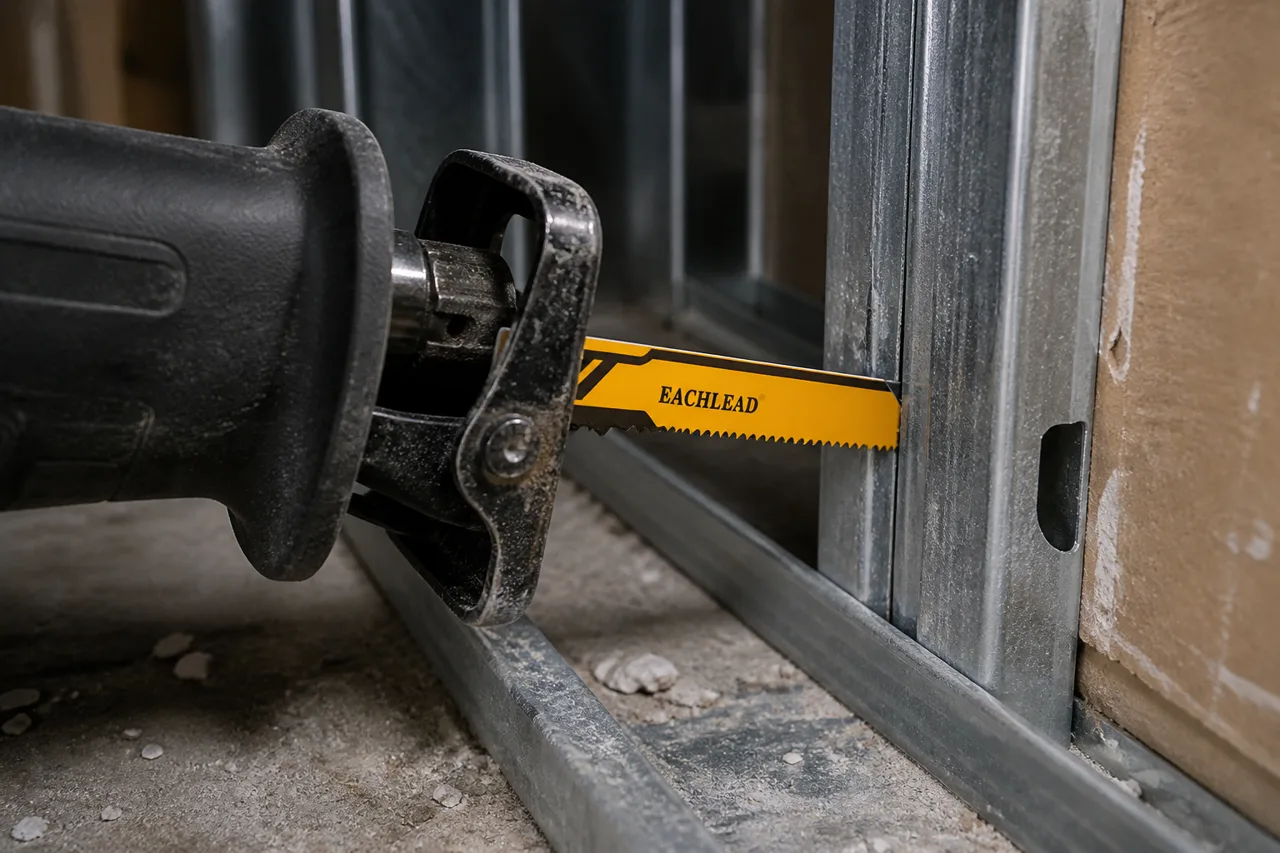
| Material band (educational) | Typical TPI direction | Short-blade note |
|---|---|---|
| Thin sheet / light tube | Higher TPI (often 18–24) | Prevents snagging on thin walls |
| Mid sheet / profiles | Mid TPI (often ~14) | Balances speed and tooth load |
| Wood with nails / thicker mixed cuts | Lower TPI (often 6–10) | Larger gullets clear chips |
Published EACHLEAD 150 mm bi-metal examples follow the same logic: a 24 TPI short blade for thin sheet in the 0.7–3 mm band, a 14 TPI short blade for thicker sheet in the 3–8 mm band, and 6–10 TPI short blades for wood-with-nails bands.
Why Bi-Metal Matters in Tight Mixed Cuts
Bi-metal is the practical short-blade family when wood, nails, and light metal share the same cut.
Bi-metal (BIM) blades join a hard high-speed-steel tooth strip to a more flexible body. That combination resists tooth stripping on incidental fasteners better than plain high-carbon steel, while the body absorbs side load better than brittle all-hard blades. Construction education treats BIM as the default mixed-jobsite choice for nail-embedded lumber.
High-carbon steel can still make sense for clean wood only, where cost matters and metal contact is unlikely. It is a poor default for remodel demolition in confined framing. Carbide families solve different abrasive or hard-metal jobs and sit outside this short bi-metal compare.
For tight access, bi-metal also helps when the shoe angle is awkward and the blade takes side pressure against a stud or pipe. Flex without snapping matters more when you cannot square the saw perfectly in a bay.
Compare Published 150 mm Bi-Metal Options
Compare published length, TPI, thickness, and application bands—not marketing slogans.
EACHLEAD lists multiple 6-inch / 150 mm bi-metal reciprocating saw blades on the bi-metal reciprocating saw blades family page. Use the product tables as the source of truth when any page copy conflicts.
| Model | Published size | TPI | Published application band |
|---|---|---|---|
| S922HF | 150 mm × 19 mm × 0.95 mm | 10 | Wood with nails / metal 5–10 mm |
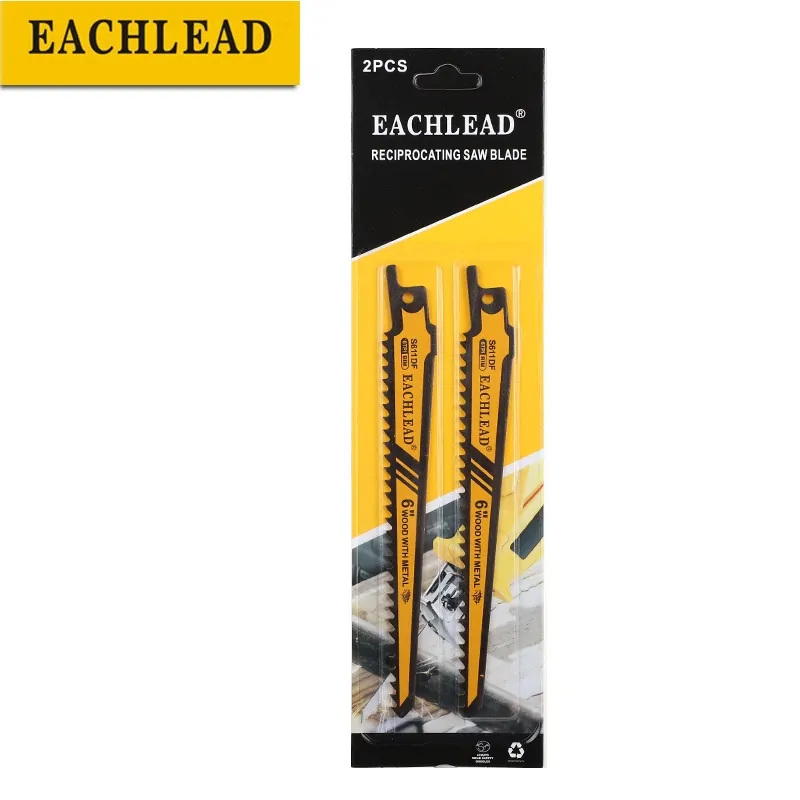
| S611DF | 150 mm × 22 mm × 1.6 mm | 6 | Wood with nails / metal, chipboard 10–100 mm |
| S922BF | 150 mm × 19 mm × 0.95 mm | 14 | Thick sheet metal 3–8 mm |
| S922AF | 150 mm × 19 mm × 0.95 mm | 24 | Thin sheet metal 0.7–3 mm |
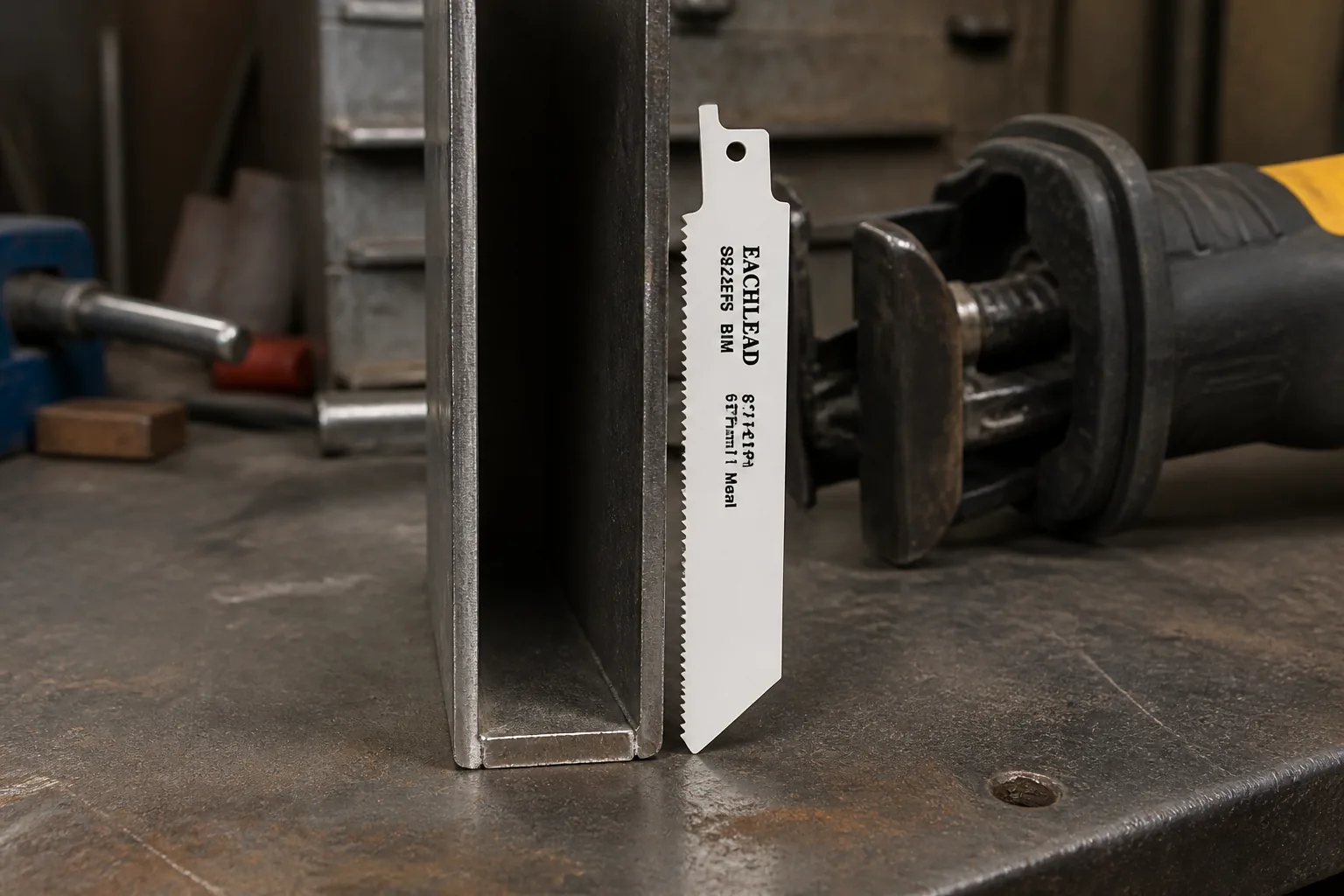
Read the table left to right: lock 150 mm for clearance, then pick TPI for thickness, then confirm the published application line. Do not invent universal shank fit, cut times, or ratings beyond those published lines.
From the field: Pros often stock 6-inch wood, 6-inch mid-TPI, and 6-inch fine-metal blades as separate kit slots instead of one “do-everything” long blade. (Source: Garage Journal Sawzall blade storage discussion)
Tight-Access Technique: Shoe Contact and Hidden Hazards
Keep the shoe planted and confirm what sits behind the cut before you plunge.
The shoe (foot) is the plate at the base of the blade. Pressing it firmly against the workpiece counters the push-pull motion and reduces blade chatter. Lifting the shoe in a cramped bay turns the short blade into a vibrating tip that glances off the work.
Important: Use the shortest blade that still overruns the workpiece, and know what is behind the cut path—hidden water lines, gas lines, or wiring change the job before TPI does. (Source: Power Tool Institute reciprocating and jig saw safety sheet)
For wall or cavity work, locate utilities first, then commit to the cut line. Plunge cuts into wood or drywall need a blade intended for that entry; metal plunge cuts need a starter opening large enough for the blade width. Dull blades raise heat and force—replace them instead of leaning harder in a confined stance.
Product Recommendation: Bi-Metal 6-Inch Blades for Tight Access
Start with published EACHLEAD bi-metal 150 mm blades matched to the material band you actually cut.
After you lock clearance and TPI, the bi-metal reciprocating saw blades hub is the pathway for short 6 inch reciprocating saw blades and other published 150 mm options. Use S922HF or S611DF when the published wood-with-nails bands fit the job, and S922BF or S922AF when the published sheet-metal bands fit.
Skip this short BIM path when the cut needs 9–12 inch reach, when the job is abrasive masonry that needs a different family, or when a specialty ultra-short drywall-only blade is required and not published in this family. Parent category context lives under reciprocating saw blades.
If you need pack print or a custom assortment question after matching a published band, use the contact page once.
FAQ
How short should a reciprocating saw blade be for tight access?
Short enough that the tip clears nearby framing, yet long enough to exit the workpiece each stroke. Many tight construction cuts land on a 6-inch / 150 mm catalog length, but the overrun rule comes first.
Why not always buy the longest blade?
Unused length in a confined bay adds whip and tip strikes. Longer blades help deep stock; they hurt when clearance is the real constraint.
What TPI should I use on thin sheet metal with a short blade?
Use a finer TPI so several teeth stay in the thin wall. A published example is S922AF at 24 TPI for thin sheet in the 0.7–3 mm band.
Are bi-metal short blades needed for wood with nails?
Bi-metal is the practical choice when nails or light metal may appear in the cut. Clean wood-only work can use simpler bodies; mixed remodel cuts should not.
Can a short blade still finish a thick cut?
Only if the blade still overruns the thickness plus stroke. If depth exceeds the short blade’s useful travel, step up in length instead of forcing a tip that never clears.
What should I check before cutting inside a wall cavity?
Confirm utilities and structure behind the path, keep the shoe planted, and start with a blade length that will not over-penetrate into unknown space.
How do published 150 mm EACHLEAD BIM blades differ by TPI?
They share the 150 mm short length and differ mainly by TPI and published thickness bands—for example 6 TPI and 10 TPI for wood-with-nails ranges versus 14 TPI and 24 TPI for sheet-metal ranges.