


Scroll Saw vs Band Saw: Interior Cutouts, Curves and Resawing Compared

A scroll saw is the more natural choice for enclosed interior cutouts and fine fretwork; a band saw is the more natural choice for resawing and larger external contours. In a scroll saw vs band saw comparison, the first question is how the blade reaches the cut. “Both cut curves” leaves out the difference that can decide the project.
A scroll saw uses a short blade that moves up and down. A band saw carries a continuous blade loop around wheels. These designs overlap on some external shapes, but they do not offer the same access or the same stock-handling possibilities.
Scroll saw vs band saw: start with the cut’s entry point
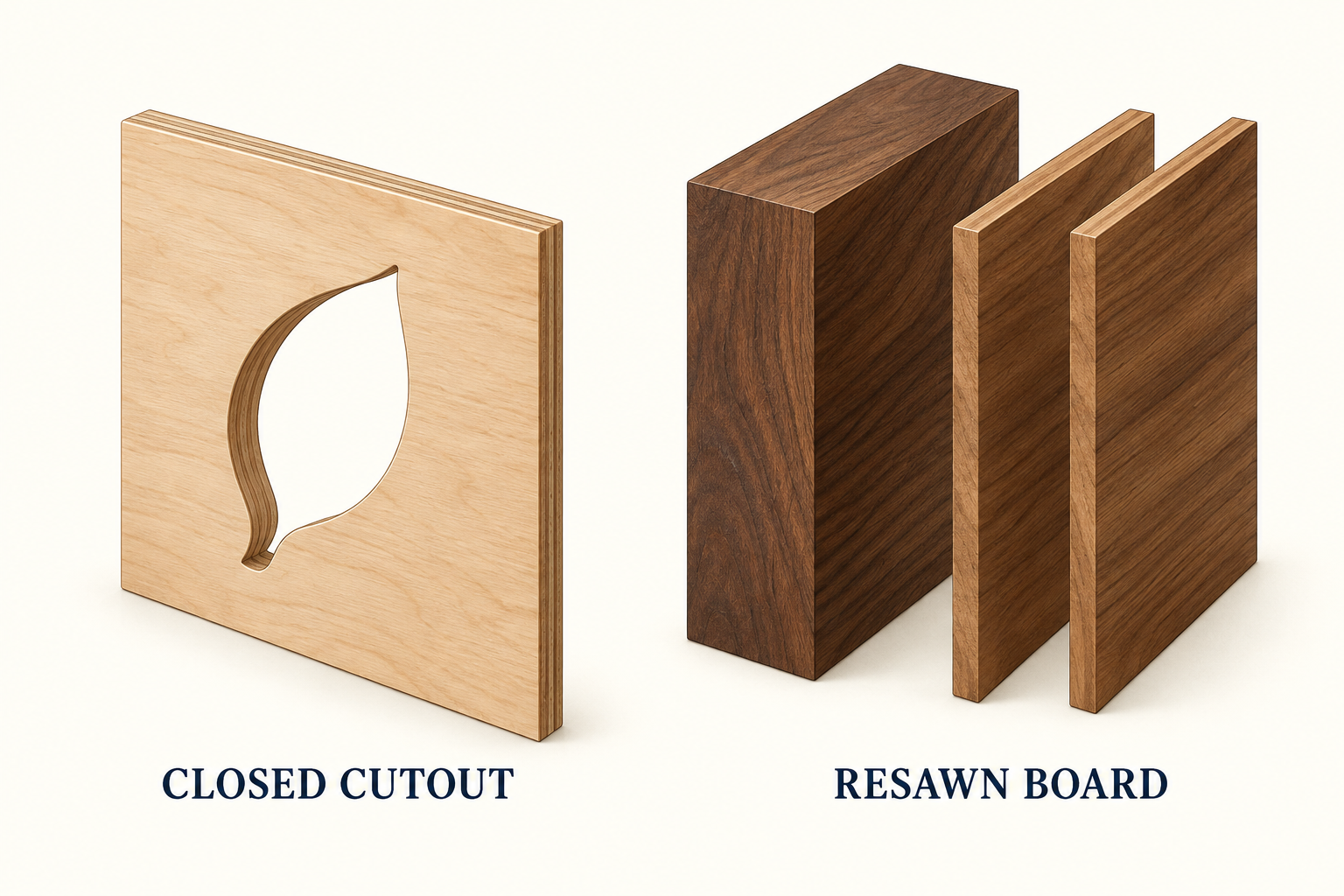
A fully enclosed opening has no connection to the board’s outside edge. Think of the center of a decorative wooden letter. On a suitable scroll saw, a blade can be detached at a clamp and threaded through a starting opening. Woodcraft describes this inside-cut capability in its explanation of scrolling.
A conventional continuous-loop bandsaw blade cannot simply be threaded through that opening in the same way. Cutting from the outside edge would introduce an entry kerf, changing a design that needs an uninterrupted perimeter. This access question comes before comparisons about finish or cutting speed.
For an external curve, either family may be worth considering. Now the questions change: how tight is the turn, how thick is the stock, and can the complete workpiece move through the machine’s available space?
Compare the job before comparing the machines
| Project requirement | Starting point | What still needs checking |
|---|---|---|
| Enclosed decorative opening | Scroll saw | Blade threading, workpiece access and supported material |
| Fine exterior fretwork | Scroll saw | Blade size and the particular curve |
| Broad contour in heavier stock | Band saw | Rated capacity and blade width |
| Divide a board into thinner leaves | Band saw configured for resawing | Usable cutting height, blade and work support |
This is a task map, not a list of guaranteed machine capabilities. “Scroll saw” and “band saw” each describe families containing different models. A general comparison cannot replace the actual machine’s specifications.
Resawing changes thickness rather than the outline
Resawing divides a board into thinner pieces while retaining broad faces. That differs from cutting a decorative shape out of the board’s face. A bandsaw can serve this task when its capacity, blade and setup support the workpiece.
RIKON’s dedicated resaw bandsaw blade is one manufacturer example of this application. Its model-specific claims do not establish that every bandsaw blade is a resaw blade, or that every machine accepts that blade.
A useful project description therefore names the desired result. “Make thinner leaves from this board” is clearer than “cut thick wood.” The latter could also mean crosscutting a short piece or following an outside profile—different demands hidden inside the same phrase.
Blade choice sets another boundary
The machine name alone does not determine the tightest possible curve. The cited bandsaw manual links contour radius to blade width and tells readers to follow the particular machine’s blade requirements. A blade that suits straighter work does not automatically suit a small-radius contour.
Similarly, a fine scroll-saw blade does not turn its machine into a substitute for a resawing bandsaw. Access, stock dimensions and blade support remain separate constraints. Avoid a universal thickness cutoff or a claim that one family always leaves a finished surface.
The comparison guide from Pittsburgh Spray also distinguishes these blade motions and common tasks. Its broad categories are useful starting points; actual ratings remain model-specific. For a purchase decision, record the model, intended material and cut geometry together.
A practical choice for two different projects
Suppose a hypothetical project is a thin decorative panel with several enclosed leaf shapes. Its defining requirement is the unbroken outside frame. A scroll saw’s inside-cut access addresses that requirement directly. A broad claim about a bandsaw being more powerful does not answer the access problem.
Now suppose the project changes to producing thinner walnut leaves from a thicker board. The decorative opening disappears from the task. Resawing capability becomes the relevant question, so a suitable bandsaw moves to the front of the comparison. This does not make the scroll saw inferior; the required result has changed.
If the real alternative is a portable tool following curves on a larger panel, that introduces another machine family. EACHLEAD’s jigsaw blade category provides a separate cutting-accessory pathway. Jigsaw, scroll-saw and bandsaw blades should not be treated as interchangeable simply because their tasks can include curves.
Describe the cut first: enclosed opening, external contour or thickness subdivision. Then compare the actual machine and blade against that description. That sequence produces a more useful answer than selecting one universal winner.