


Reciprocating Saw Blades for Aluminum: Match Wall Thickness and Cut Quality
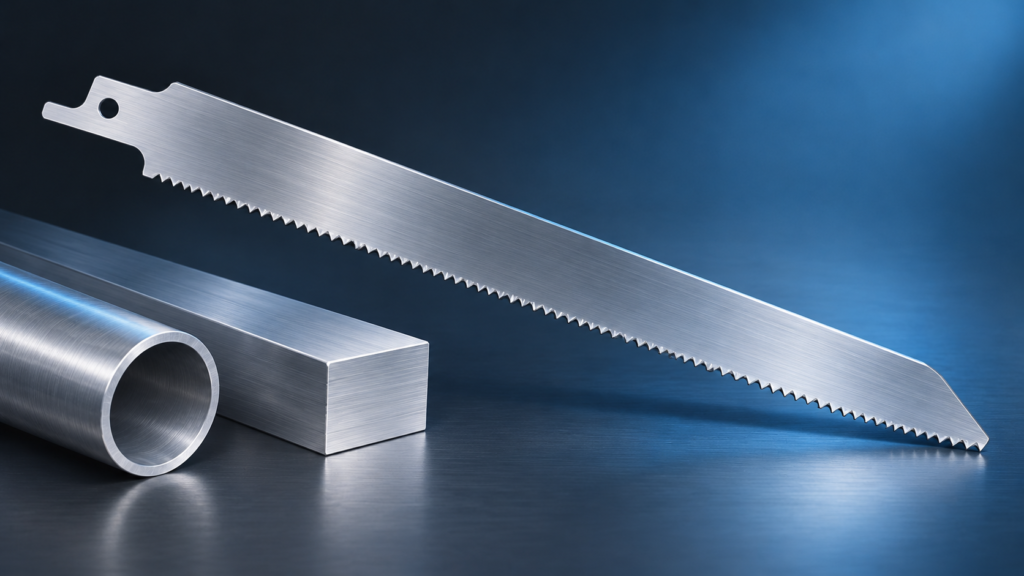
Select reciprocating saw blades for aluminum by the actual section and required edge, then confirm a named blade for that application. Tooth pitch matters, but it is not a complete specification. A hollow profile, a solid bar and a sheet can all be aluminum while presenting different selection questions.
A useful shortlist keeps the alloy, wall thickness, outside dimensions and cut geometry together. It also identifies the saw model and the edge condition the buyer will accept. A general “metal cutting” label should start that discussion rather than settle it.
Read pitch recommendations in their model context
Use a pitch guide to find candidates, then read the application of the actual blade. MPS’s material guide includes aluminum in its metal section and points to 14 or 18 TPI blades in named series. That is a starting point within its guidance, not proof that every blade with either tooth count suits every aluminum job.
A different manufacturer illustrates the limit of a single-number rule. Eclipse lists its EC-S922HF at 10 TPI with an aluminum-profile application of 3–12 mm. That is a specific model entry with its own blade construction and stated uses. It does not contradict a selection method that checks the whole product specification; it shows why that method is needed.
For procurement, keep the model code attached to the pitch and application band. Do not copy the aluminum range from one maker’s catalog onto another maker’s similarly named blade. If a quotation gives only TPI, ask which configuration and section it covers before comparing its price with another offer.
Compare blade geometry separately from the workpiece
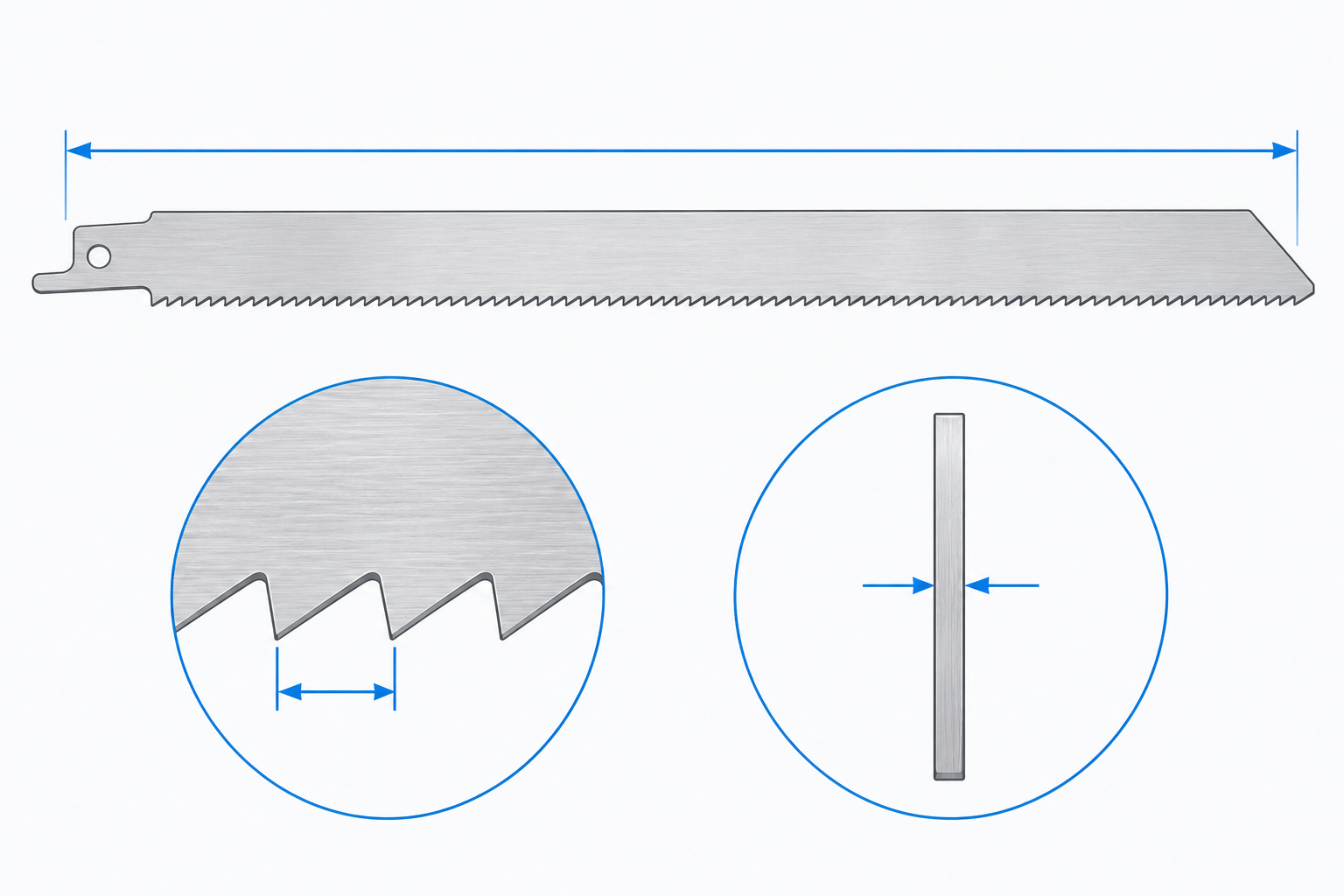
Blade length, blade-body thickness and tooth spacing describe different features. Record each separately when comparing candidates. An overall-length figure does not establish usable cutting capacity, and a tooth-count match does not establish that two blade bodies are identical.
The workpiece needs its own description. For a tube or hollow extrusion, supply wall thickness as well as the outer section. The open interior is not solid metal; outside size alone leaves out the wall the blade must encounter. For a solid bar, identify that it is solid instead of sending only an outline that could also describe a tube.
Include the intended path and available access in the same drawing or photo. Ask the supplier to assess the proposed blade against that job and the saw’s requirements. This separates selection from an unsupported assumption that a longer blade automatically solves an access or depth problem.
Use the metal catalog to shortlist reciprocating saw blades for aluminum
The EACHLEAD bi-metal reciprocating blade catalog contains metal-oriented models with different pitches and application bands. It provides a practical starting point for a specification discussion.
For example, the S1122BF structured listing gives 14 TPI and thick sheet metal in a 3–8 mm band. Those are published metal-catalog fields. They do not, by themselves, confirm an aluminum alloy, every profile geometry or a required finish. Ask EACHLEAD to identify the current configuration and confirm its application against the workpiece.
This distinction matters when buying a range rather than one sample. Record which customer job each candidate is intended to cover. Keep general metal, aluminum-profile and mixed-material requests separate until the supplied model has been assessed for each. A model’s appearance or familiar code cannot fill a missing application confirmation.
Keep the supplier decision attached to the sample
Send a short decision record with the request so the supplier can address the missing information directly. The following fields connect a blade offer to the aluminum job.
| Buyer provides | Supplier response to request |
|---|---|
| Alloy and stock condition | Confirm the proposed material application. |
| Wall and outside section drawing | Identify the applicable section range. |
| Cut path, access and saw model | Confirm blade geometry and tool fit. |
| Accepted edge and finishing allowance | Identify a sample to evaluate against that reference. |
| Required quantity and candidate model | State the supplied configuration and quotation terms. |
Consider a hypothetical maintenance buyer replacing aluminum hollow profiles. A solid offcut with the same outside width is not an adequate description of that job. The request should show the profile wall and cut direction, then ask for a named candidate to evaluate on representative stock. Record the sample identity and observed edge with the resulting decision.
Before approving a repeat order, check that the quotation still names the same configuration. If the material, section or edge requirement changes, flag the change instead of carrying the earlier approval forward automatically.
Send EACHLEAD your aluminum reciprocating-blade decision record to request a suitable model and quotation. Include the drawing and edge reference so the response can address the intended cut, rather than only the words “blade for aluminum.”
References
MPS: Reciprocating blade selection by material
Eclipse: Model-specific wood and metal blade applications