


Ferrous vs Non-Ferrous Metals: Identification and Cutting Considerations
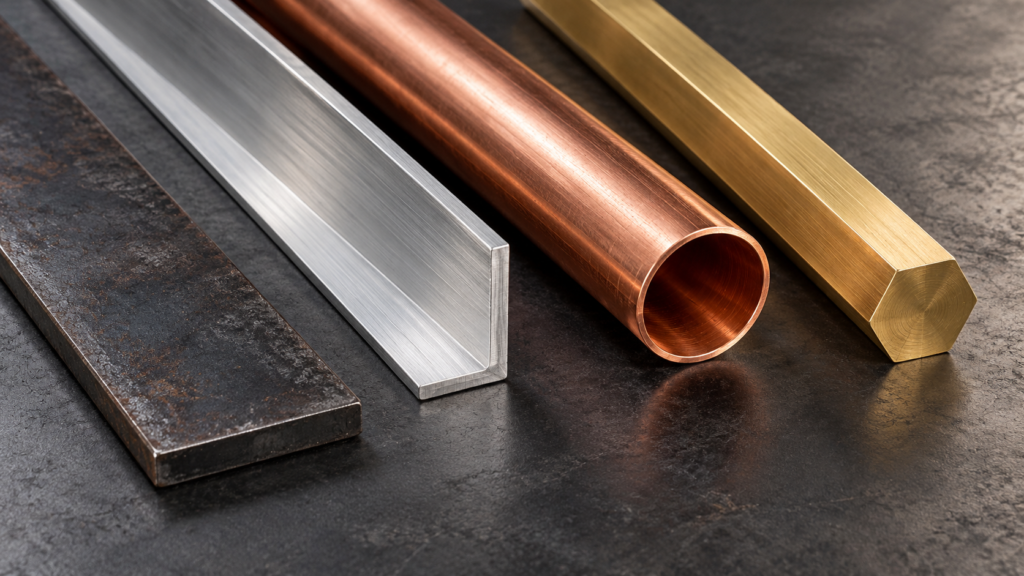
Non ferrous metals are metals and alloys that are not iron-based. Aluminum, copper, brass, bronze and titanium are common examples. Ferrous metals, including carbon steel, stainless steel and cast iron, have iron as their base. The distinction concerns composition: it does not tell you, by itself, how heavy, corrosion-resistant, magnetic or easy to cut a particular piece will be.
For identification, use the material grade and supplier documentation before relying on a magnet or surface appearance. For cutting, go one step further: confirm the alloy, its condition and the stock section. A label that says only “non-ferrous” leaves too much information missing for a reliable blade choice.
What separates ferrous and non-ferrous metals?
The useful question is whether iron is the principal base of the metal or alloy. “Non-ferrous” should not be read as a guarantee that an alloy contains absolutely no trace iron. TWI describes the class in terms of no appreciable iron, while Xometry describes iron not being a major constituent.
| Comparison | Ferrous metals | Non-ferrous metals |
|---|---|---|
| Composition | Iron-based metals and alloys | Metals and alloys not based on iron |
| Common examples | Carbon steel, alloy steel, stainless steel, cast iron | Aluminum, copper, brass, bronze, zinc, titanium, nickel |
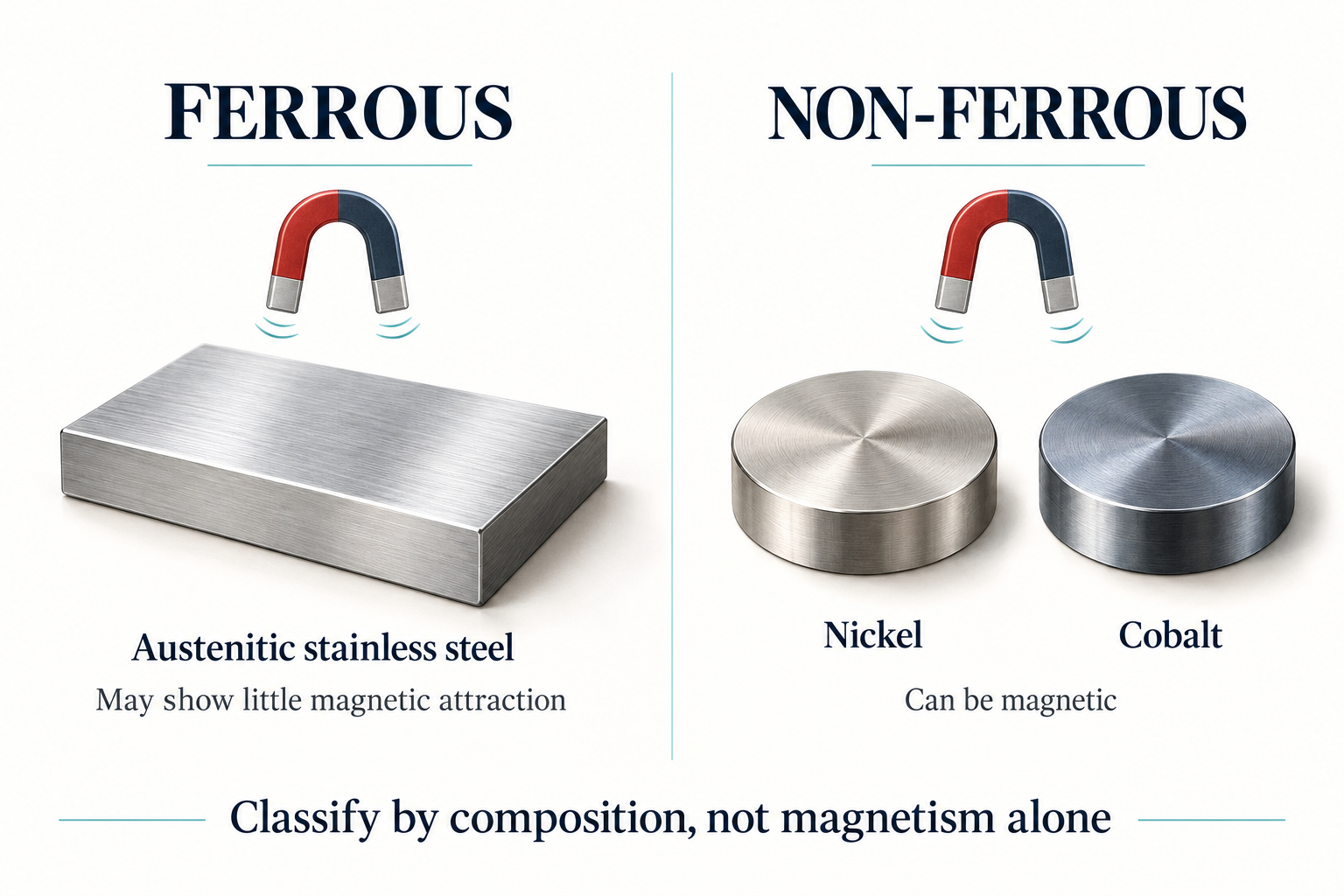
| Magnet test | Often useful as a clue, but some stainless steels show little attraction | Many common examples show little attraction, but nickel and cobalt are exceptions |
| Corrosion | Depends on grade and exposure; stainless is not equivalent to bare carbon steel | Also depends on alloy and environment; “non-ferrous” does not mean corrosion-proof |
| Cutting decision | Identify grade, condition, section and tool | The same checks are needed; the category alone is not a blade specification |
The terms are useful for organizing materials, not ranking them. There is no universal winner in ferrous vs non-ferrous selection. A lightweight component, an electrical conductor and a wear part have different requirements; the appropriate alloy must satisfy its own application.
Likewise, a bright silver surface does not prove aluminum, and a lack of visible rust does not prove a non-ferrous metal. Stainless steel remains an iron-based material even when its corrosion behavior differs from ordinary carbon steel.
Common non ferrous metals and why their differences matter
Aluminum is associated with low-weight components and is widely used as the base of engineering alloys. The alloy designation still matters: “aluminum” is a family description, not a complete specification for fabrication.
Copper is valued for electrical and thermal conductivity. It appears in conductors, heat-transfer equipment and plumbing. Those uses describe the material’s role; they do not establish the condition or grade of an unknown copper-colored item.
Brass and bronze are copper-alloy families. Brass commonly combines copper and zinc; bronze commonly combines copper and tin, although actual alloy specifications are more varied. A purchase order should name the intended alloy rather than asking for a generic yellow metal.
Zinc, titanium and nickel also belong to the non-ferrous group. They are a useful reminder that the group is broader than aluminum and copper. Properties that make one member desirable cannot simply be assigned to every other member.
Xometry’s materials guide explicitly describes this diversity. Lower density is not universal, and corrosion resistance depends on the alloy and service conditions. For a buyer, the practical action is to compare the specified materials, not assume that one broad classification guarantees better performance.
Why a magnet cannot identify the metal by itself
A magnet can narrow a question, but it cannot establish a grade or even reliably divide all metals into the two groups. Two exceptions are especially important.
Some ferrous metals show little attraction. Austenitic stainless steels can be predominantly non-magnetic while remaining iron-based. TWI also explains why a weld in these steels may show magnetic attraction. A change near a weld is not proof that the part belongs to a different metal class.
Some non-ferrous metals are magnetic. Nickel and cobalt are examples. An attracted sample therefore does not automatically prove ordinary steel.
Use an identification route that separates evidence from clues
- 1. Find the documented identity. Match the stock marking, purchase record or material certificate to the actual piece. Record the grade, not just the product’s color or previous use.
- 2. Check for disagreement. A magnet response or unexpected surface appearance can flag a question. It should not overrule a verified grade without investigation.
- 3. Resolve unknown stock. Ask the supplier or a competent material-identification service when documentation is missing or contradictory. Keep an uncertain sample identified as uncertain rather than guessing an exact alloy.
This route is an editorial decision aid, not a substitute for laboratory identification. It is particularly useful when a stockroom contains several visually similar materials and the next step depends on the grade.
What changes when you need to cut the material?
Material identity comes first, but it is not the whole cutting specification. The saw also encounters a particular section: a thin wall, a sheet, a solid bar or a changing profile. A description such as “non-ferrous tube” omits both the alloy and the wall the teeth must engage.
Starrett’s band-saw guidance explains why softer materials can fill the spaces between teeth, called gullets. Its selection guidance considers the actual section and the material together. That principle is useful when framing a supplier question; its band-saw pitch and feed examples should not be transferred directly to a hand hacksaw.
For a blade recommendation, supply the following information:
- Material: alloy grade, any known heat treatment or hardness condition, and whether that identity is documented.
- Stock: sheet, tube, angle or solid; actual thickness, wall or cross-section dimensions; single piece or bundle.
- Equipment: hand hacksaw, jigsaw or another saw, with the blade interface and machine restrictions.
- Result needed: rough separation or a controlled finished edge, and any later finishing allowance.
For manual cutting, the EACHLEAD hacksaw blade range is a relevant starting point. Confirm the specific model and tooth pitch against the material and section rather than assuming that every metal-cutting blade suits every alloy.
For a sheet or contour job using a jigsaw, compare the jigsaw blade options instead. Check the exact application rating, material thickness range and shank. Neither category page replaces the operating instructions for the tool or a grade-specific recommendation.
A useful cutting request names the alloy and section
Instead of asking for a blade for “non-ferrous metal,” describe the actual task: documented alloy grade, tube or solid form, wall or section size, saw model and required edge. If the grade is unknown, say so and resolve that uncertainty before treating the request as complete.
For example, two copper-colored pieces could be listed separately as “documented copper tube” and “unidentified copper-colored solid bar.” The first still needs wall dimensions and a tool choice. The second needs material verification as well. Grouping both as non-ferrous would conceal the different missing information.
The classification answers a composition question. A good cutting decision then adds the stock, tool and required result without pretending that a magnet test or a broad material label can supply them.