


Reciprocating Saw Blades for Wood: Selection Guide
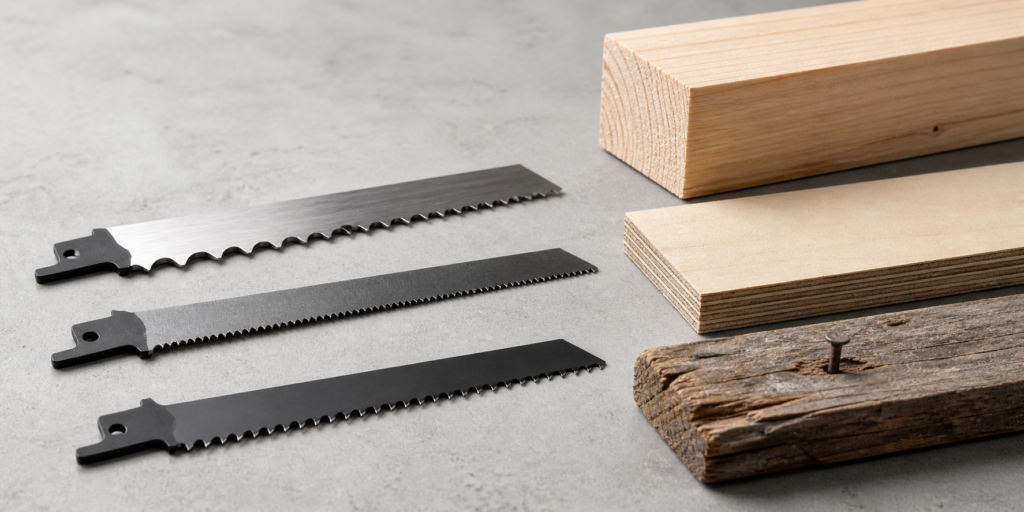
The correct choice of reciprocating saw blades for wood starts with the wood condition, not the species. Clean construction timber, green branches, and reclaimed lumber with hidden nails do not belong on one blade specification. After that first branch, the decision moves to TPI, blade length, body dimensions, tooth process, and the required cut.
For clean timber and panels, an HCS wood blade is a practical starting point. Green wood needs a pruning pattern with enough chip clearance. If nails or screws may enter the kerf, a bi-metal or carbide-tooth blade should carry a listed nail-wood application. Some buyers search for “wood cutting Sawzall blades” or “Sawzall blades for wood”; SAWZALL is Milwaukee’s brand term, while this guide uses the generic reciprocating-saw blade specification.
| Workpiece condition | Starting blade family | Published EACHLEAD example | Confirm before ordering |
|---|---|---|---|
| Clean construction timber, plywood, or panels | HCS wood blade | S644D, 6 TPI | Material thickness, straight or plunge cut, edge requirement |
| Thick, clean rough wood or fuel wood | Longer HCS wood blade | S6111D, 6 TPI | Maximum depth and full-stroke clearance |
| Branches, green wood, or pruning | Dedicated pruning pattern | S1531L, 5 TPI | Branch diameter, chip clearance, blade length |
| Reclaimed lumber or wood with hidden nails | Bi-metal nail-capable blade | S611DF, 6 TPI | Fastener risk, body thickness, listed application band |
How to choose reciprocating saw blades for wood
Clean, dry lumber gives the widest choice. An HCS reciprocating saw blade can flex with the cut and is commonly listed for wood, plywood, chipboard, and similar soft materials. The specification still needs a thickness band. A blade listed for a 75 mm panel is not automatically approved for a 175 mm timber section.
Green wood changes the chip load. Wet fibers and sap can fill a tight tooth space, so pruning blades use coarse patterns and deep gullets to clear material. Milwaukee’s published 5 TPI pruning example and EACHLEAD’s 5 TPI S1531L show that design direction. They do not establish one universal pruning TPI for every branch or saw.
Hidden fasteners change the blade family. A clean-wood HCS blade should not be expected to absorb repeated nail strikes because it cut the surrounding lumber. The order should specify a model whose application line states wood with nails or mixed wood and metal. This distinction matters more than whether the lumber is pine, oak, or a pallet stringer.
Choose TPI around chip clearance and cut control
TPI means teeth per inch. A wood cutting reciprocating saw blade should not be selected from TPI alone. A coarse pattern gives each tooth and gullet more room to remove chips, but tooth form, set, grinding or milling, blade stiffness, feed pressure, and work support also affect the result.
Published 5 and 6 TPI models appear across clean-wood, pruning, and nail-wood examples. The same number can still represent different blade bodies and applications. S1531L lists 5 TPI for pruning, while S611DF lists 6 TPI on a thicker bi-metal body for wood with nails. The application and construction make those products different.
A purchasing record should state the actual TPI or tooth pitch and the tooth process. A line that says only “coarse wood blade” leaves the key geometry undefined. When the cut edge matters, sample approval should use the real panel, timber, or reclaimed stock. A catalog label cannot replace that test.
Set blade length from work depth and full-stroke clearance
A longer blade is not automatically a safer choice. The Power Tool Institute advises using the shortest blade that still extends beyond the workpiece throughout the saw’s stroke. This reduces unnecessary flex while preventing the tip from striking the work or shoe.
The specification should record the maximum work depth, the saw stroke, and the free space behind the cut. Access limits also matter when a pipe, wall, or fixture sits nearby. A 150 mm blade may suit a panel or shallow timber cut, while a 225 mm or 300 mm blade can cover deeper work. The model’s published application band still controls the final choice.
Body width and thickness also deserve their own fields. A narrow body can enter tighter work, while a wider or thicker body may provide more support. A photograph cannot establish those results. Buyers should compare the listed dimensions and verify them on the intended tool and workpiece.
Compare verified EACHLEAD wood-blade examples
The examples below use the structured Product Description fields on EACHLEAD’s pages. They are selection references, not a performance ranking.
S644D for clean construction wood and panels
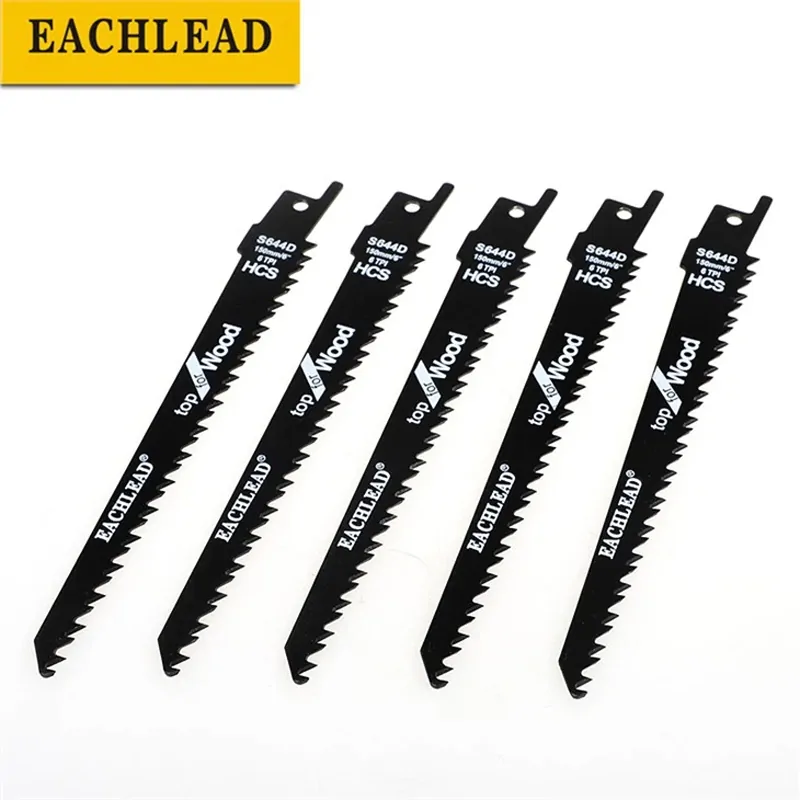
The S644D product table lists HCS 65MN or SK5, a 150 × 19 × 1.2 mm body, and 6 TPI ground teeth. Its listed applications include construction timber from 6–100 mm and wooden panels up to 75 mm. That makes it a relevant short clean-wood example when those dimensions match the job.
S6111D for deeper clean rough wood
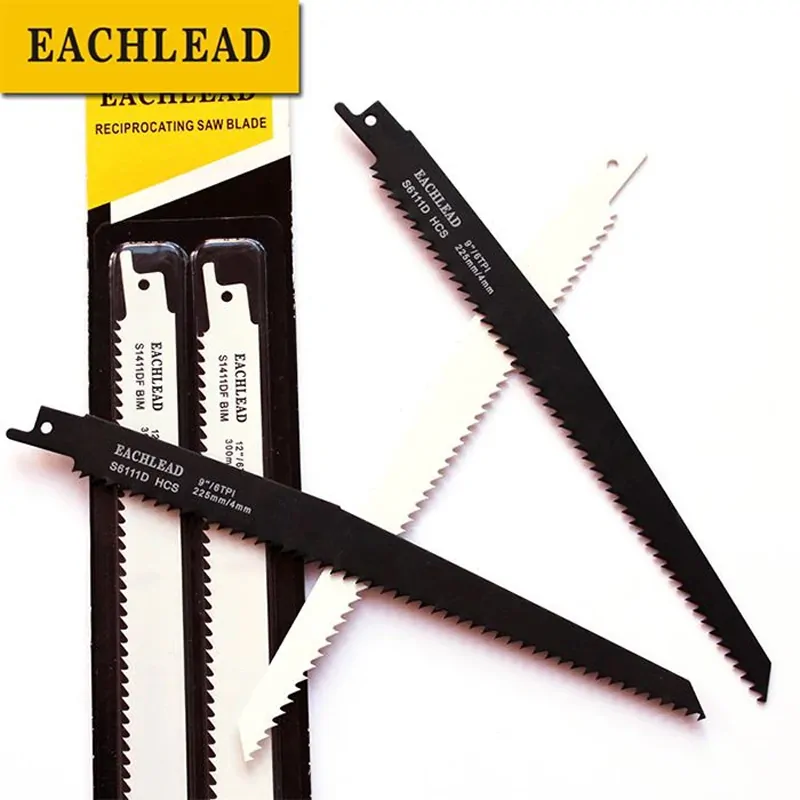
The S6111D product table lists HCS 65MN or SK5, 225 × 19 × 1.2 mm, and 6 TPI milled teeth. The application line covers coarse wood free of nails and fuel wood from 20–175 mm. It should not be moved to a nail-wood order without separate evidence.
S1531L and S611DF cover different risks
S1531L lists 240 mm and 300 mm HCS versions at 5 TPI for tree cutting and pruning from 15–150 mm in diameter. S611DF moves to bi-metal, a 150 × 22 × 1.6 mm body, and 6 TPI for wood with nails or metal and chipboard from 10–100 mm. Green wood and hidden metal therefore need separate order lines.
Turn the selection into a buyer-ready specification
A comparable quote starts with the same technical record for every supplier or sample. A short technical line is useful, but a product nickname should not hide the selection inputs.
- Work material: clean construction timber, plywood, green wood, or wood with known fasteners.
- Thickness range: minimum, normal, and maximum section in millimeters.
- Cut task: straight rough cut, plunge entry, pruning, demolition, or another defined operation.
- Blade construction: HCS, bi-metal, or another approved family; TPI; tooth process; length × width × thickness.
- Tool and access: clamp interface, stroke, free space behind the work, and any flush-cut limit.
- Commercial record: pack count, label language, quantity, and the drawing or sample revision being approved.
Sample approval should use representative stock. The approval record should include material condition, thickness, saw, stroke setting, support method, number of cuts, edge result, tooth damage, and any bending. Each candidate should use the same record. This does not guarantee service life, but it makes the purchasing decision traceable and repeatable.
Change the blade family when the task changes
A wood selection guide should not absorb every reciprocating-saw task. A metal-specific blade belongs on the order when metal becomes the main workpiece. Pruning blades belong on a separate line when green-wood chip clearance drives the cut. A listed nail-capable bi-metal or carbide option is required when hidden fasteners are routine rather than accidental.
To build a shortlist of reciprocating saw blades for wood, browse the EACHLEAD reciprocating saw blade range. The next comparison should cover material family, TPI, body dimensions, application band, and tooth process. A complete specification is more useful than asking for the “best wood blade” without a workpiece.