


Heavy-Duty Reciprocating Blade RFQ: What to Define First

Define material family, reciprocating saw blade TPI against workpiece thickness, and blade body thickness / gauge before you treat heavy duty reciprocating saw blades as a finished line item. The sections below turn the “heavy-duty” label into comparable fields, then point to a published bi-metal pathway when the cut is metallic or mixed.

What “Heavy-Duty” Should Mean on Your Spec
“Heavy-duty” should name a thicker, more rigid blade body—and the job that needs that stiffness—not stand alone as a marketing adjective.
Buying guides commonly sort recip blade blanks into thickness classes around 0.035″, 0.042″, 0.050″, and 0.062″, with the 0.050–0.062″ band labeled heavy or ultra-heavy duty. Catalogs that sell “thick metal” or demolition profiles also push wider or taller bodies for straighter tracking under heavier feed.
If a distributor RFQ only says “heavy duty reciprocating saw blades,” quotes arrive with mixed gauges and tooth systems. Write the heavy-duty blade thickness class, target width, and duty (thick metal, demolition, mixed) on the same line.
Lock the Material Family Before Tooth Count
Choose the steel system first—HCS, bi-metal (BIM), or carbide-tipped—then debate tooth count.
Bi-metal (BIM) pairs a flexible spring-steel body with harder high-speed-steel teeth, which is why trade buyers treat it as the default for metal and nail-embedded work. High-carbon steel stays cheaper and more flexible for clean softwood or plastics, but it dulls quickly on hard stock. A carbide-tipped recip blade is the usual escalation when bi-metal life collapses on tough alloys or abrasive thick sections.
Locking the family early stops suppliers from quoting incompatible constructions under one “heavy-duty” label. For most metallic or mixed RFQs, start the shortlist inside a bi-metal reciprocating saw blades family, then confirm TPI and body size.
Match Reciprocating Saw Blade TPI to Thickness
Match reciprocating saw blade TPI to workpiece thickness so several teeth stay in the cut at once.
Teeth per inch (TPI) is the tooth density along the cutting edge: fewer teeth cut more aggressively, while more teeth leave a finer, slower cut.
Educational guides repeat a practical rule: keep at least three teeth engaged in the material. Thick plate, pipe, and structural shapes usually sit in a coarser metal band around 10–14 TPI.
Mid sections often move toward 14–18 TPI. Thin sheet, duct, and light tubing commonly need 18–24 TPI so individual teeth do not snag.
| Workpiece thickness situation | Typical TPI direction | Why it matters on an RFQ |
|---|---|---|
| Thick metal plate, heavy pipe, structural shapes | About 10–14 TPI | Larger gullets clear chips; fewer teeth share the load |
| Mid-thickness metal / mixed sections | About 14–18 TPI | Cleaner edge without jumping to sheet-metal fineness |
| Thin sheet, duct, light tubing | About 18–24 TPI | More teeth in thin walls reduce snagging |
| Wood with nails / rough demolition | About 6–10 TPI (often bi-metal) | Aggressive clearance; teeth must survive fasteners |
Write the thickness band beside the TPI so vendors cannot substitute a fine sheet blade for plate work—or the reverse.
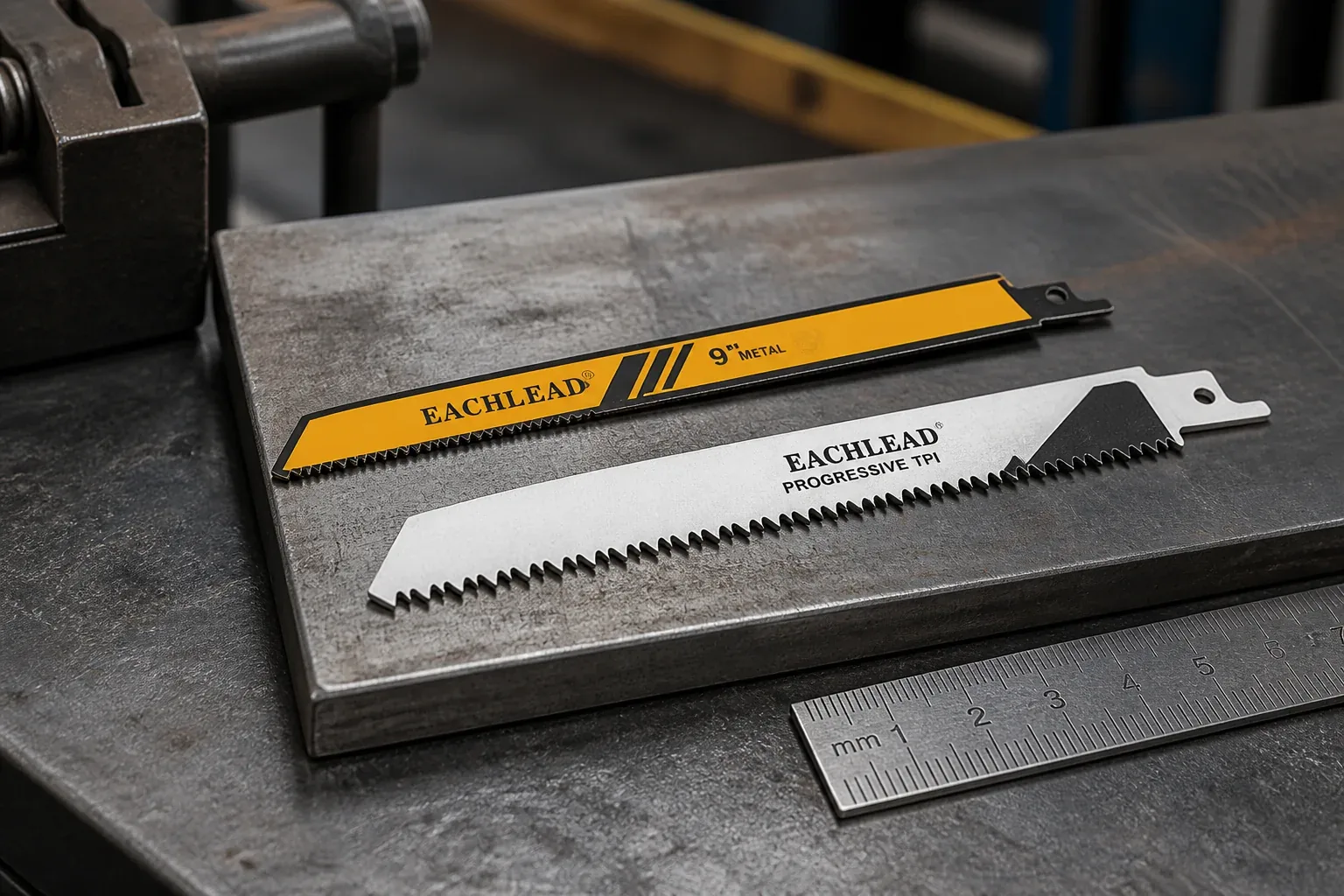
Spec Length, Width, and Blade Thickness Together
Spec blade length, blade width / tall profile, and blade body thickness / gauge as one package, because they trade reach against stiffness.
Guides advise choosing a blade longer than the section you cut through—often about one to three inches of overhang—so the tip does not bind inside the work. Longer blades flex more; if the RFQ needs stiffness at 9″ or 12″, pair length with a thicker blank or wider body. Manufacturer “heavy metal” pages repeatedly sell tall or thick profiles for straighter cuts in dense stock.
A 1/2-inch universal shank is common on modern recip blades, but still confirm the tool clamp before you freeze a SKU list. Put length × width × thickness on the RFQ line next to TPI so “heavy-duty” is no longer a guess.
Map the Job to a Short Blade Set
Group the RFQ into a short set by job type instead of one catch-all “heavy duty” SKU.
Thick sheet metal and profiles need a metal-oriented tooth count and a body stiff enough to stay straight. Wood with nails or mixed chipboard cuts want a coarser bi-metal demolition pattern and enough beam strength to survive fasteners. Progressive or dual-range TPI blades help when one crew faces thin-to-thick sheet in the same day.
On EACHLEAD’s live hub, published examples include a 9″ / 14 TPI bi-metal listing aimed at thick sheet metal around 3–8 mm, a 6″ / 8–14 TPI bi-metal listing for sheet metal about 1–8 mm, and a thicker-body 6 TPI bi-metal listing for wood-with-nails / metal / chipboard in a wide 10–100 mm band. Use those published ranges as templates for your own thickness notes—not as universal performance guarantees.
A fabrication buyer cutting 6–10 mm plate should not share the same line item as an HVAC crew trimming thin duct. Keep those jobs on separate RFQ rows even when both are labeled “heavy duty” in a catalog brochure.
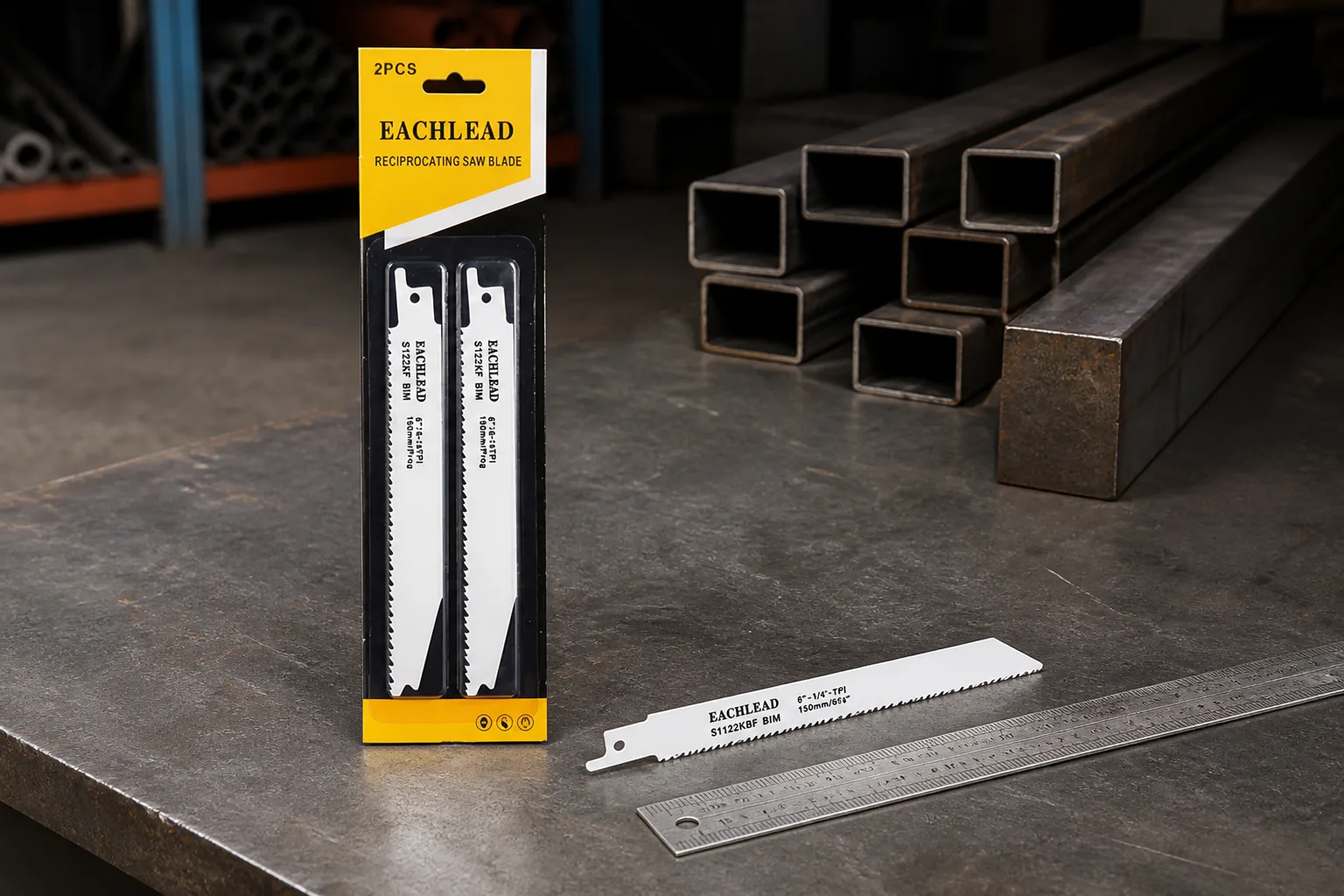
The progressive pack covers thin-to-thicker sheet in one tooth system. Keep wood-with-metal demolition patterns on a separate RFQ row rather than bundling them under the same “heavy duty” catch-all.
RFQ Fields That Keep Quotes Comparable
Comparable quotes need the same field set on every line, whether you buy retail packs or a distributor assortment.
| RFQ field | What to write | Example direction |
|---|---|---|
| Material family | HCS / bi-metal (BIM) / carbide-tipped | Bi-metal unless carbide is justified |
| Application | Thick metal, thin sheet, wood with nails, mixed | “Thick sheet metal 3–8 mm” |
| TPI or TPI range | Single value or progressive band | 14 TPI or 8–14 TPI |
| Length × width × thickness | Millimetres or inches | 225 × 19 × 0.95 mm |
| Heavy-duty meaning | Thickness class and/or width | 0.050″ class or “tall demolition body” |
| Shank | Confirm tool interface | Universal 1/2″ shank |
| Pack / labeling notes | Pack count, private label if needed | Pack size only—no invented MOQ |
Skip empty marketing words. If two vendors answer the same table, you can compare price and lead assumptions later without reopening the technical argument.
A Heavy-duty reciprocating saw blade line that lists family, TPI, and body size can be priced as a pack assortment or as discrete SKUs. The technical row stays identical either way, which is the point of the table.
From the field: Forum users report blades snapping even when the teeth still look sharp—especially when the saw shoe / foot loses contact or the work binds and the operator forces the cut. Keep shoe support and binding control in the job note beside the blade spec.
Wider-body demolition patterns for wood-with-nails or mixed chipboard sit in a coarser tooth band than metal sheet packs. Publish that duty on its own line so quotes do not collapse both jobs into one SKU.
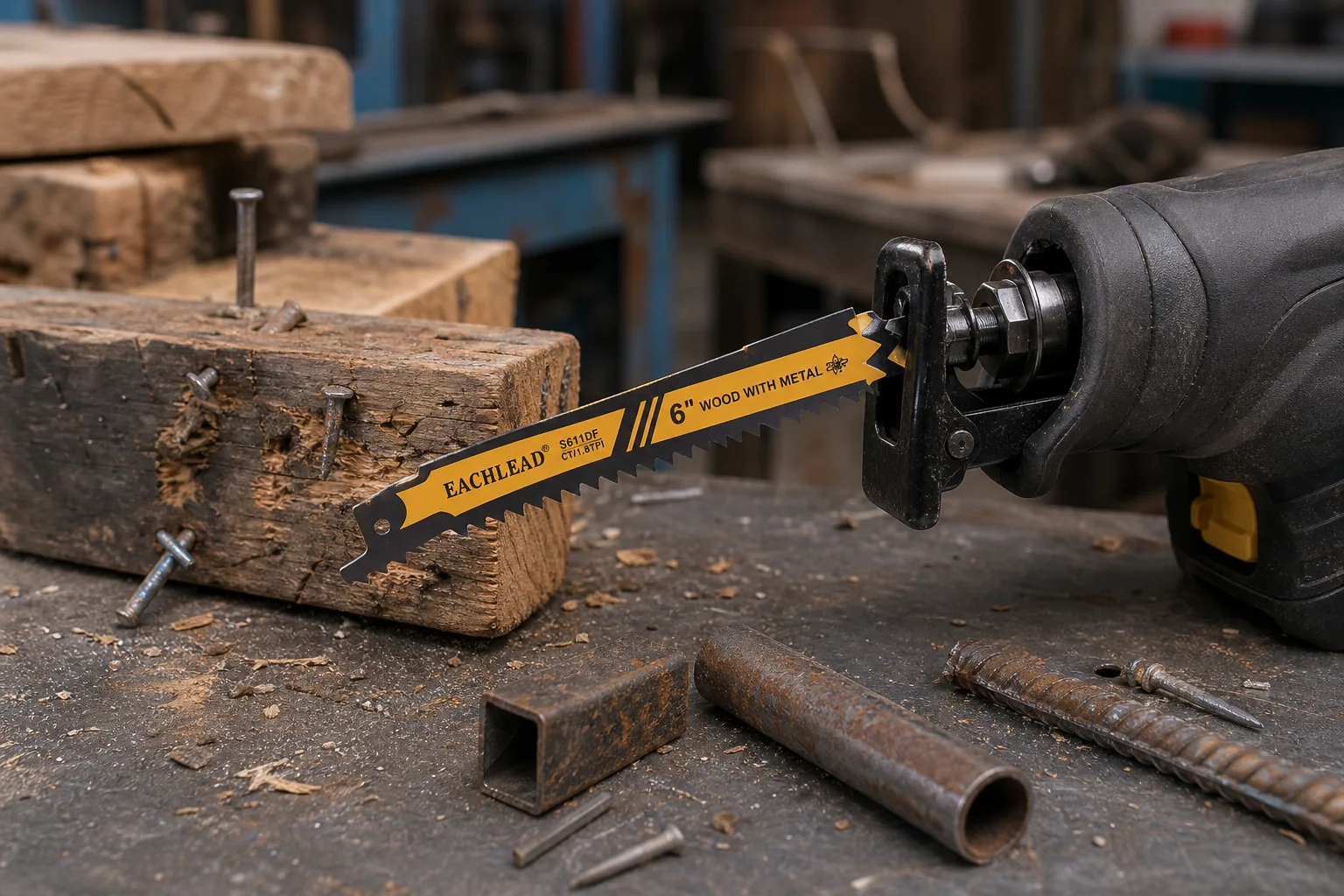
Product Recommendation: Start With Bi-Metal When the Cut Is Mixed or Metallic
When the RFQ is metallic or mixed, open the shortlist with bi-metal reciprocating saw blades, then pick a published length/TPI that matches your thickness band.
EACHLEAD S1122BF is listed as a 9-inch, 14 TPI bi-metal blade for thick sheet metal in the 3–8 mm range on the live product page. That makes it a concrete example of the metal-oriented line items described above, not a claim that one SKU covers every heavy-duty job.
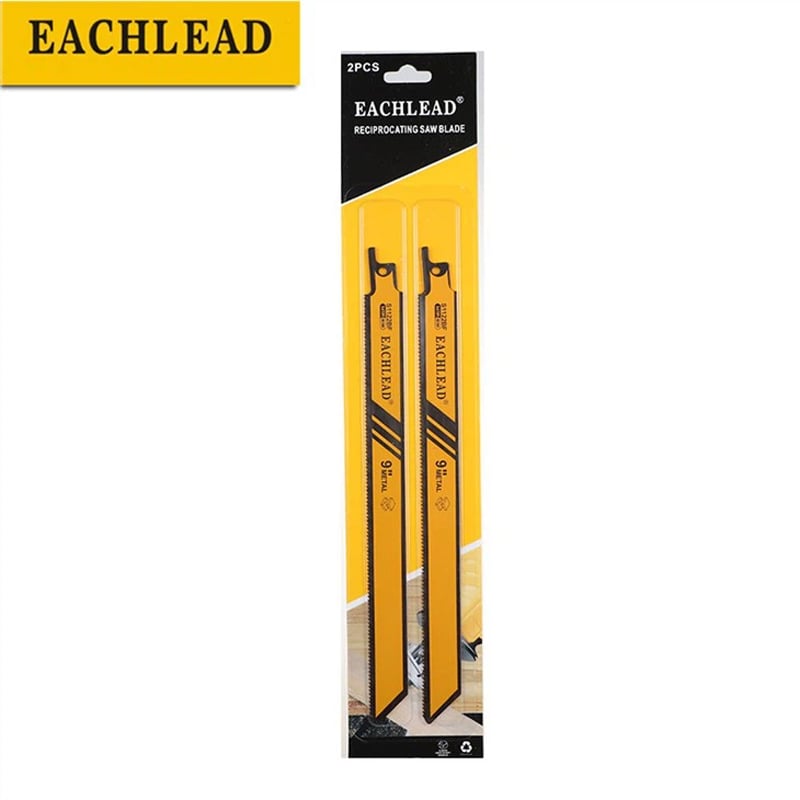
Browse the S1122BF 9-inch 14 TPI listing, the parent reciprocating saw blades hub, and the BIM material family when you need adjacent lengths or tooth patterns.
Skip S1122BF when the work is clean softwood pruning only, or when the metal duty clearly needs a carbide-tipped recip blade beyond the published sheet-metal band. If your assortment needs a custom mix after the RFQ table is filled, use the site contact page once with those fields attached.
FAQ
What should I define first on a heavy-duty recip blade RFQ?
Define material family, workpiece thickness with TPI, and length × width × thickness before any brand or pack talk. Those three locks make “heavy-duty” comparable across suppliers.
What TPI fits thick metal vs thin sheet?
Thick metal commonly lands near 10–14 TPI; thin sheet often needs 18–24 TPI so enough teeth stay in the wall. Always write the thickness next to the tooth count.
Are reciprocating saw blades universal?
Most modern blades use a universal 1/2″ shank, so many brands fit many saws—but confirm the clamp on the exact tool before you freeze the RFQ. Jigsaw T-shank blades are a different interface.
What does bi-metal mean on a recip blade?
Bi-metal (BIM) means a flexible body with harder high-speed-steel teeth. It is the usual family for metal and nail-embedded cutting when you need both toughness and some flex.
How thick is a “heavy-duty” blade body?
Buying guides often call about 0.050–0.062″ heavy or ultra-heavy duty. Treat that as a thickness class on the RFQ, not as a performance promise.
Why do blades snap even when teeth look sharp?
Community threads point to overfeeding, awkward cuts, and losing shoe contact so the blade binds. Spec the blade correctly, then keep the shoe planted and the work supported.
When should I step up to carbide-tipped blades?
Step up when standard bi-metal life collapses on tough alloys, cast sections, or abrasive thick metal that exceeds a published bi-metal sheet-metal band. Carbide is an escalation family, not the default first quote for every “heavy-duty” line.