


Hacksaw Wood Blades: Tooth Pitch and Cut-Control Checks
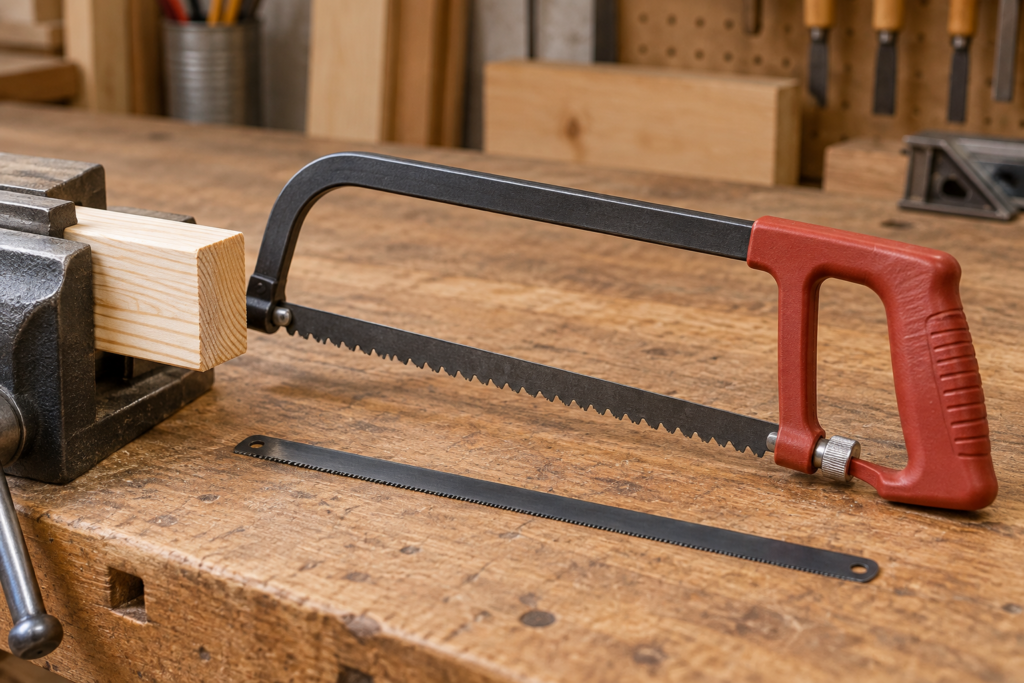
A hacksaw wood blade can cut wood when the manufacturer specifically designs and documents it for that job. That qualification matters. A dedicated junior wood blade, a specialist multidirectional blade, and an ordinary fine-tooth metal-cutting hacksaw blade are not interchangeable descriptions.
For occasional small sections, the right wood-capable blade may be practical. For long straight cuts, deep sections, rapid stock removal, or finish-sensitive work, a wood-oriented hand saw, coping saw, jigsaw, or another suitable tool will usually give a more appropriate cutting geometry and working envelope.
Identify which “hacksaw wood blade” you mean
| Blade case | What to verify | Selection boundary |
|---|---|---|
| Dedicated junior wood blade | Frame length, mounting holes, published wood application, and TPI | Suitable only for the specified junior frame and task |
| Specialist spiral or multidirectional blade | Holder type, length, material list, tooth geometry, and manufacturer instructions | Do not treat specialist geometry as a standard flat hacksaw blade |
| Ordinary metal-cutting blade | Published application, pitch, and chip space | Metal labeling does not establish clean or efficient wood cutting |
A current IRWIN product table gives a useful model-scoped contrast: its junior wood blade is listed at 150 mm and 14 TPI, while a junior metal blade of the same length is listed at 32 TPI. That does not create a universal wood-versus-metal pitch rule, but it demonstrates that equal length does not mean equal application.
This distinction should stay visible in the purchasing record. If a request lists only “150 mm junior blade,” it leaves the application unresolved even though the nominal length may match the frame. Add the manufacturer’s wood designation, the exact tooth count, and the intended frame or product reference. When a supplier proposes an alternative, compare those fields separately instead of accepting equal length as equivalence. The IRWIN example supports that catalog discipline for the named products; it does not prove that every 14 TPI blade is suitable for wood.
Specialist products create another branch. Bestway describes a round-wire spiral tooth that can cut wood and other materials from multiple directions. Its geometry, holder needs, and behavior are distinct from a conventional flat blade. Confirm the exact product instead of using “hacksaw blade” as the full specification.
How tooth pitch changes the cutting decision
Tooth pitch is a product-selection field, not a guarantee of finish. Compare the exact blade’s published wood application, pitch, and tooth geometry with the workpiece section. A manufacturer may offer separate wood and metal variants at the same nominal length, so read the application line instead of inferring it from appearance.
If the manufacturer provides section or pitch guidance, follow that model-specific information. Do not turn a general tooth-count preference into a universal clean-cut or chip-clearance claim.
Do not select only by the largest or smallest TPI number. First verify that the blade is actually identified for wood, then confirm frame fit, then match the pitch to section thickness and desired finish. A product page or datasheet should control over an unlabeled marketplace photo.
Fit and setup checks before cutting wood
- Confirm the saw format. Record whether the frame is full-size, junior, coping-style, pad-style, or a specialist holder.
- Match the interface. Check nominal length, mounting holes or clamps, blade width, thickness, and permitted tensioning method.
- Read the application. Look for an explicit wood or relevant mixed-material statement for the exact blade.
- Install in the documented direction. Tooth direction and stroke convention depend on the blade and frame; do not reverse it by guesswork.
- Support the work. Clamp the wood securely without crushing it and keep the cut clear of the vise or bench.
- Test on scrap. Watch for wandering, excessive clogging, splintering, or a frame that cannot clear the section.
Blade tension should follow the frame instructions. More tension does not turn a mismatched blade into the correct one. Stop if the blade cannot seat fully, the frame reaches the end of its adjustment, or the blade twists significantly under a light test stroke.
When another saw is the better choice
Change tools when the frame limits cut depth, the blade is not documented for wood, the cut needs a woodworking finish, or the production volume makes chip clearing inefficient. A coping saw is designed for curved hand cuts; a conventional wood hand saw suits many straight cuts; a jigsaw can serve powered straight or curved work when the correct blade and setup are used.
For procurement, write the requirement as a task rather than a nickname. Record the wood species or board type, section thickness, straight or curved cut, finish expectation, quantity of cuts, saw format, mounting interface, nominal length, and preferred pitch range. That gives a supplier enough context to confirm whether a real wood-capable blade exists for the frame.
The current EACHLEAD hacksaw blade category should be treated as a metal-oriented blade verification route; it does not by itself establish a dedicated wood SKU. If the task is better handled by another saw, choose that tool from its own manufacturer documentation and match its interface, blade geometry, and workpiece limits.
The useful answer is therefore conditional: a hacksaw wood blade is a valid category only when the exact blade is documented for wood and matches the frame. Otherwise, use a wood-oriented saw instead of forcing a fine metal blade into a job it was not specified to perform.