


Hacksaw Blade Dimensions: Length, Width, and Thickness to Confirm
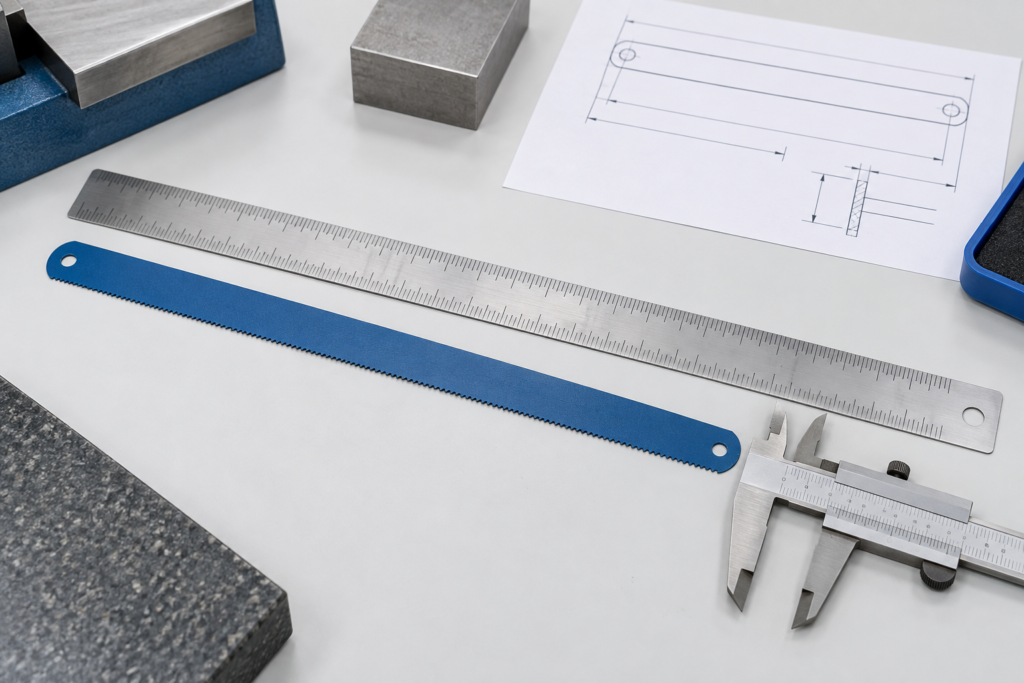
Hacksaw blade dimensions are a set of specifications, not one number. A useful replacement record separates nominal blade length, the relationship between the mounting holes, blade width, blade thickness, and tooth pitch. The frame must accept the blade mechanically; the tooth pitch and construction must then suit the workpiece.
This distinction prevents a common purchasing error: treating “12 inch” or “300 mm” as proof of complete compatibility. Those descriptions narrow the search, but the exact frame, mounting interface, and blade cross-section still need confirmation.
Hacksaw blade dimensions and fields to record
| Field | What it describes | Why it matters |
|---|---|---|
| Nominal blade length | The manufacturer’s stated blade length | Matches the blade family to the intended frame size |
| Mounting span and end detail | Position and form of holes, slots, pins, or clamped ends | Determines whether the holder can engage both ends |
| Blade width | Distance from the back edge to the tooth line | Affects clearance and whether the blade fits guides or guards |
| Blade thickness | Material thickness through the blade body | Must suit clamps, guides, and frame geometry where specified |
| TPI | Teeth per inch along the cutting edge | Selects tooth spacing for the workpiece section; it is not a frame-length measurement |
Keep blade construction as a sixth product field. High-carbon steel, high-speed steel, and bi-metal describe how the blade is made; they do not replace the dimension record. Likewise, a color, coating, or package photo is not a reliable substitute for published specifications.
How to measure a replacement blade
Start with the frame record
Look for a model number, manual, label, or manufacturer product page. That record is stronger than measuring a worn or distorted blade. Note whether the tool is a full-size hand hacksaw, junior hacksaw, pad saw, or powered machine. These are different formats even when the blades are all straight.
Remove tension before measuring
Follow the frame instructions, release the tension fully, and remove the blade without prying against the pins. Clean loose debris from the blade and mounts. If the old blade is bent, cracked, or has elongated holes, do not use the damaged area as a precision reference.
Record the published length and the interface
Measure the blade consistently from end to end, but label that value as a field measurement unless the manufacturer defines the same method. Also record the center-to-center relationship of the mounting holes or the exact end form. Do not silently convert one method into another. A supplier needs to know whether a value is nominal, overall, or mounting-related.
Measure width and thickness separately
Use a rule or caliper appropriate to the required accuracy. Take width away from visibly damaged teeth or a burred back edge. Measure thickness on a clean, flat portion of the body. If a coating is present or the blade is heavily worn, compare the measurement with the product datasheet rather than inventing a tolerance.
Keep units beside every value. A mixed record such as “12 × 12.5 × 0.63” is ambiguous unless it states which value is inches, which values are millimeters, and which dimension each number represents. Preserve the unit used by the frame or blade manufacturer, then add a converted value only as a clearly labeled convenience. Do not round a converted mounting dimension and use it as a fit tolerance.
Count or read TPI
Read the marked TPI when available. If it must be checked manually, count teeth over a known distance and state the method. TPI belongs to the cutting specification. Two blades can have the same length but different pitch, and two blades with the same TPI can have different lengths or constructions.
What current size examples actually prove
Current manufacturer listings show why one-size shorthand is risky. IRWIN lists 300 mm bi-metal hand-hacksaw blades in 18, 24, and 32 TPI, while its junior examples are 150 mm and include a 14 TPI wood blade and a 32 TPI metal blade. A government cutting-tool specification provides one hand-blade example of 300 mm length, 12.5 mm width, 0.63 mm thickness, and 18 TPI.
These values show how specifications are recorded; they are not universal limits. Current manufacturer catalogs also separate hand-hacksaw frames from power-hacksaw blade families. Even when a length looks familiar, the mounting points, cross-section, tension travel, and intended tool type still control.
Turn measurements into an order-ready record
For a replacement request, provide the following information in one line or table:
- frame manufacturer and model, or a clear statement that the model is unknown;
- hand, junior, pad, or powered hacksaw format;
- published nominal blade length and the measurement method used;
- mounting-hole or end detail, including a photo where appropriate;
- blade width and thickness with units;
- TPI and tooth direction;
- blade construction and the workpiece material/section.
The EACHLEAD hacksaw blade category currently provides 12-inch bi-metal examples in several tooth pitches. Use those pages to compare listed specifications, not to assume a frame fit. Keep hacksaw, jigsaw, reciprocating, and planer blade families separate before dimensions are compared.
For repeat purchasing, save both the supplier part number and the verified field record. A part number speeds reordering, while the dimensions allow the next buyer to detect a substitution or catalog change. Where a drawing is available, attach its revision instead of relying on a cropped product photo.
A supplier can verify a complete dimensional record. It cannot reliably verify “standard blade,” “normal 12 inch,” or a photo with no scale. Keeping nominal values, measured values, and mounting details separate reduces that ambiguity.