


Brushed vs Satin vs Mirror Finish: How to Compare Metal Surfaces
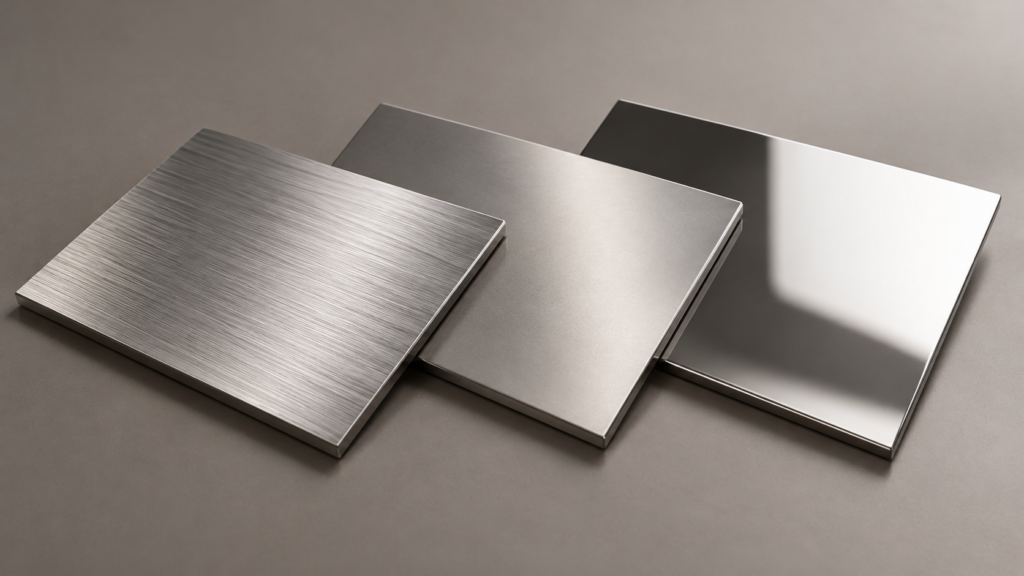
Brushed usually describes a directional texture, satin describes a subdued sheen, and mirror describes a highly reflective appearance. Brushed and satin can overlap: a supplier may call the same surface “brushed satin.” A brushed vs satin vs mirror comparison therefore needs more than three labels before it becomes a useful material specification.
The practical question is whether the supplied surface matches the intended appearance and agreed acceptance requirements. Neither a finish name nor a photograph, by itself, identifies the alloy grade or establishes suitability for a particular environment.
Brushed vs satin vs mirror: what the names describe
Brushed commonly points to visible grain running in a direction. Satin suggests a softer, less reflective appearance, although suppliers use the term for different textures. Mirror emphasizes image clarity and a bright reflection rather than a visible directional grain.
White Metal’s own description uses the combined expression “brushed satin.” That is a useful reminder that these are not always three mutually exclusive categories. Its appearance description helps explain the overlap; the final requirement still needs to be agreed for the actual supplied surface.
| Description | Typical visual emphasis | What to clarify |
|---|---|---|
| Brushed | Directional grain or lines | Grain character and direction on the part |
| Satin | Soft sheen and subdued reflection | The supplier’s sample and meaning of satin |
| Mirror | High reflectivity and image clarity | Required appearance on the specified face |
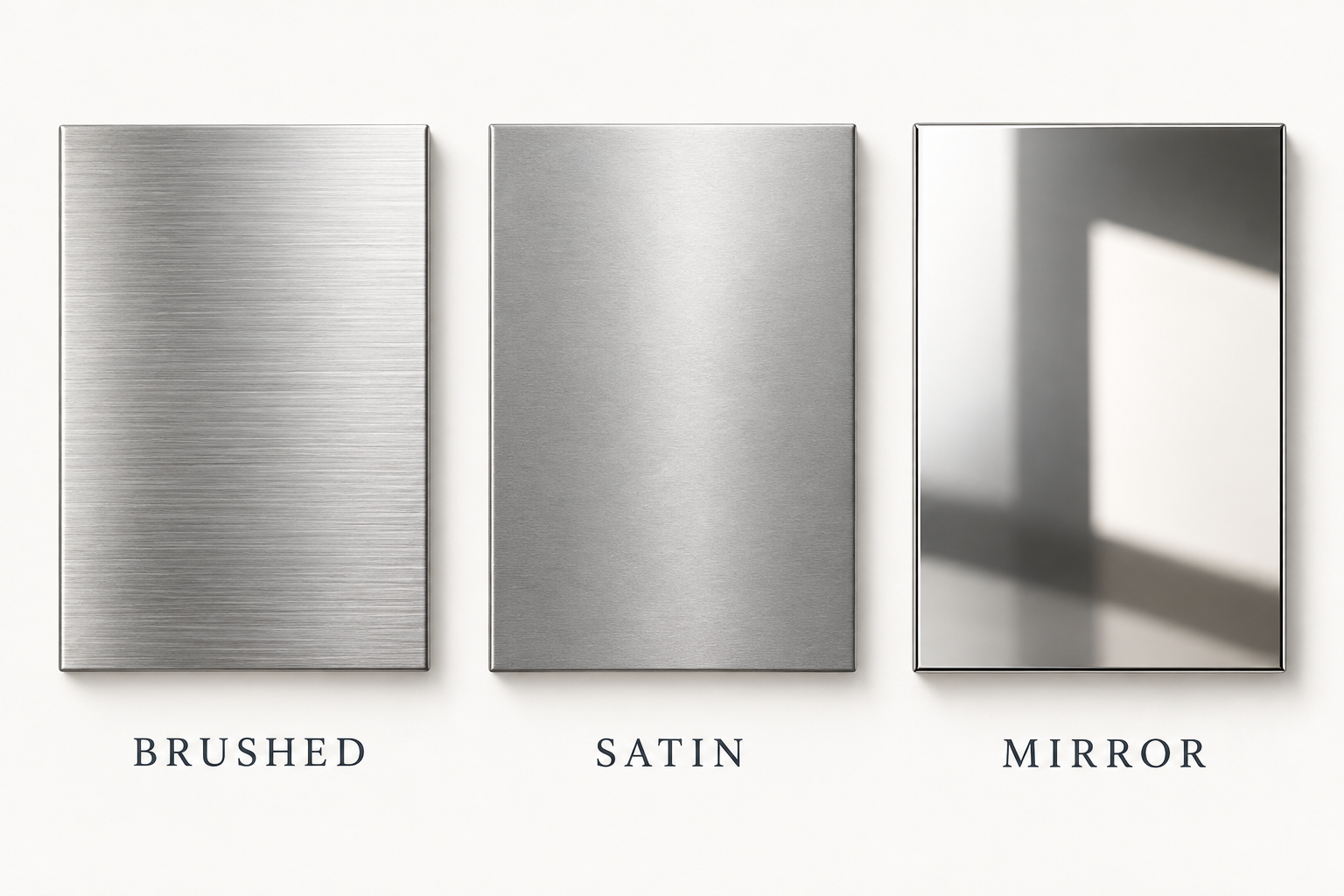
worldstainless distinguishes brushed, softer satin-polished and highly reflective mirror finishes in its surface-treatment guidance. Those descriptions explain a visual direction. They should not be treated as proof that every supplier’s surface with the same everyday name will look identical.
Grain direction is part of the comparison
A directional finish introduces a question that “silver” or “satin” cannot answer: which way should the grain run on the finished part? Outokumpu describes how polishing, brushing and combinations of these processes produce a range of surface appearances.
Record that direction relative to the part, not just to an unmarked photograph. For example, “grain along the long edge of the visible panel” is more useful than “horizontal grain” when the panel may be rotated during handling or installation.
That example is an enquiry convention, not a universal manufacturing rule. Its purpose is to make the intended orientation clear to both sides. A matching discussion can otherwise focus on sheen while overlooking the direction that makes two adjacent surfaces look different.
Agree a sample before relying on the name
The British Stainless Steel Association notes that mechanical finishes described as satin, polished, bright or mirror can vary significantly between finishing contractors. Its specification guidance calls for agreed samples alongside the written finish description.
A sample gives the supplier and buyer a shared appearance reference. The written record can then identify which face is controlled, how the sample is identified and how the comparison will be made. It should also distinguish a reference sample from a casual photograph used only to communicate an initial preference.
For a hypothetical pair of adjacent panels, both quotations might say “satin stainless steel.” One quotation may refer to a directional brushed sample and the other to a different subdued texture. The word satin has not resolved that mismatch. Asking both suppliers to address the same identified reference makes the remaining differences easier to discuss.
Finish, grade and measured roughness are different fields
Surface finish and alloy grade belong in separate parts of an enquiry. BSSA discusses grade selection as well as finishing practice. Choosing a mirror appearance is not equivalent to identifying the material, and choosing a grade does not describe its final visual texture.
Measured surface roughness is another field. worldstainless describes it as a measure of surface texture. A finish photograph is not a roughness measurement, and an appearance word is not enough to supply an agreed roughness value or measurement basis.
If a project needs both visual matching and measured roughness, identify both requirements. Do not invent a conversion from an abrasive description, a sample image or a familiar finish label. The enquiry should preserve any supplied measurement requirement exactly and ask the supplier to confirm how it will be assessed.
This also prevents a cosmetic preference from becoming an unsupported performance claim. “More reflective” describes appearance; it does not, on its own, establish corrosion resistance, wear life or suitability for every service condition.
A practical finish-matching record
A short matching record can separate five inputs that are easily bundled into one vague request. The following is an original way to organize the discussion, not a quoted inspection standard.
Material and supplied form: Keep the specified alloy and product form with the order. If either is unknown, record the gap rather than assuming it from a polished surface.
Controlled face: Mark the surface or surfaces that need the agreed appearance. Avoid letting an unmarked image imply that every hidden edge or reverse face has the same requirement.
Reference sample: Identify the agreed sample so the supplier and buyer know which reference is being discussed. A sample name without a shared identity can recreate the same ambiguity as an undefined finish word.
Grain and appearance: State the required direction where grain matters. Discuss reflection and texture as separate observations rather than expecting one adjective to cover both.
Acceptance basis: Agree how appearance will be compared and retain any separate dimensional or measured-texture requirements. Do not add an arbitrary tolerance simply to make the description look more technical.
In the adjacent-panel example, that record turns “match the satin finish” into a defined comparison of material, visible face, reference and orientation. It helps reveal missing information before the part reaches the stage where a visual mismatch must be resolved.
Separate cutting the blank from specifying the surface
A cutting-accessory enquiry answers a different question from a surface-finishing enquiry. When reviewing EACHLEAD’s hacksaw blade range, describe the workpiece and cutting task. Keep the required final surface in the fabrication specification rather than treating a blade category as evidence of a particular brushed, satin or mirror result.
The useful choice is the finish that meets the defined appearance and material requirements. A shared sample and clear description make that choice reproducible; an unconditional ranking of the three names does not.