


Concrete Sawzall Blades: Match the Blade to the Cutting Task
A concrete Sawzall blade is a specialized reciprocating saw blade for a defined masonry task. It may fit a small, controlled cut in concrete, block, brick, or a related abrasive material when the selected blade and saw are approved for that work. A concrete Sawzall blade is not a universal substitute for a dedicated concrete saw, grinder, or other equipment used for long, deep, or high-volume cuts.
For a buyer, the word “Sawzall” does not complete the specification. In this article, it is used as a search synonym for a reciprocating saw, not as a claim of affiliation with the Sawzall brand. The order record still needs the material, workpiece thickness, required cut, blade construction, length, shank, saw model, quantity, and inspection method.
When a concrete reciprocating saw blade makes sense
A reciprocating saw can be useful when access is limited and the cut is local rather than continuous. A masonry blade with a carbide or diamond abrasive edge removes material differently from a standard toothed blade. The job still depends on the tool, the blade, the material and the operator’s work method.
| Task condition | What to evaluate | Decision direction |
|---|---|---|
| Small opening, trim, or local cut | Access, cut depth, blade reach, and workpiece support | A specialized reciprocating blade may be worth evaluating |
| Brick, block, or lightweight masonry | Material scope stated by the blade supplier and abrasive edge construction | Compare a masonry-rated carbide or diamond option |
| Long, deep, or repeated concrete cutting | Cut volume, dust control, cooling, stability, and required straightness | Compare dedicated concrete equipment before choosing a reciprocating saw |
| Concrete containing reinforcement or embedded metal | Material changes along the cut and the blade’s stated application | Do not assume one masonry blade covers both concrete and metal |
The boundary matters because “concrete” covers different materials and work conditions. A blade listed for aerated concrete or blockwork should not automatically be treated as suitable for a thick reinforced slab. A masonry saw blade listing may cover brick or block without covering every concrete condition. Likewise, a product title that contains “concrete” does not establish the cutting depth, compatibility, service life, or approval of a particular project.
What to check in a concrete Sawzall blade
1. Confirm the material before comparing the blade
Write down whether the workpiece is concrete, brick, block, aerated concrete, plaster block, cement board, tile, or a mixed assembly. Suppliers often separate these applications because the abrasive edge, body design and working dimensions can differ. If the cut may encounter rebar, wire, fasteners, or another embedded material, record that condition instead of describing the job as plain concrete.
Buyers may also see the phrase concrete reciprocating blade in product catalogs. It normally describes a reciprocating saw blade with an abrasive cutting surface rather than ordinary wood or metal teeth. Carbide grit, carbide segments, and diamond grit are not interchangeable labels. The selected product page should name the construction, while the supplier should confirm the intended material range.
2. Match the blade length to the work envelope
Blade length is not the same as guaranteed cutting depth. The useful length depends on the saw stroke, shoe position, access, material shape, and the amount of blade that must remain engaged. A longer blade can help reach a deeper section, but excessive unsupported length can make control harder. A shorter model may suit a compact cut while leaving too little reach for a thick block.
An order record should include the overall length and the usable length when the supplier provides both. It should also include the workpiece thickness and the direction of the cut. This gives the supplier a real envelope to review instead of a request for a “long concrete blade.”
3. Verify the shank and saw model
The blade must lock into the saw’s holder, but a similar-looking connection is not proof of fit. The buyer should record the saw model, the manufacturer’s stated shank requirement, and whether the machine is corded or cordless. The tool and product documentation should confirm the combination before ordering.
EACHLEAD publishes a reciprocating saw blade range and a separate carbide reciprocating saw blade category. These pages are useful starting points for reviewing the current product family. They do not make every listed blade compatible with every saw.
4. Record TPI, body dimensions, and the required cut
For abrasive masonry blades, TPI may be less informative than it is for a conventional toothed blade, but it still appears in some product markings. The order record should list the stated TPI, width, thickness, overall length, working length, and edge construction as separate fields. TPI alone cannot establish whether the blade fits concrete.
The cut description should identify a through-cut, flush trim, opening, notch, or removal cut. It should state whether the edge only needs to clear material or whether the finished line has a defined tolerance. The blade choice and the machine method may change when the cut must stay straight, reach a corner, or avoid damaging an adjacent surface.
How to read the Eachlead concrete blade examples
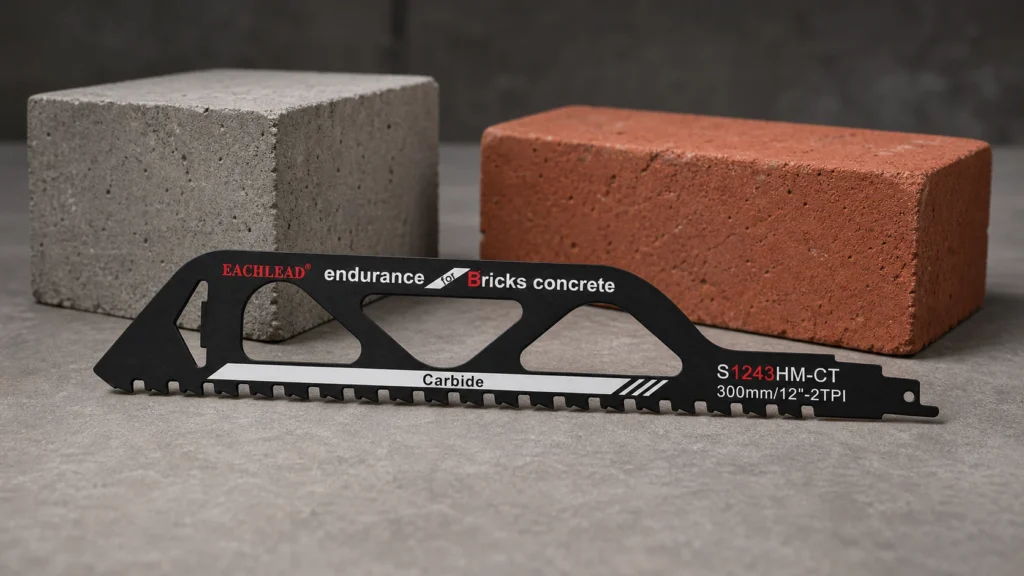
The official product visuals show why a buyer should keep model data separate from general application language. The supplied S1243HM-CT image is labeled for bricks and concrete and shows 300 mm/12 in and 2 TPI. Those labels identify the pictured configuration; they do not promise a 12-inch concrete cutting depth or universal material coverage. The S1243HM concrete Sawzall blade listing provides the current model record to review before a quotation is requested.
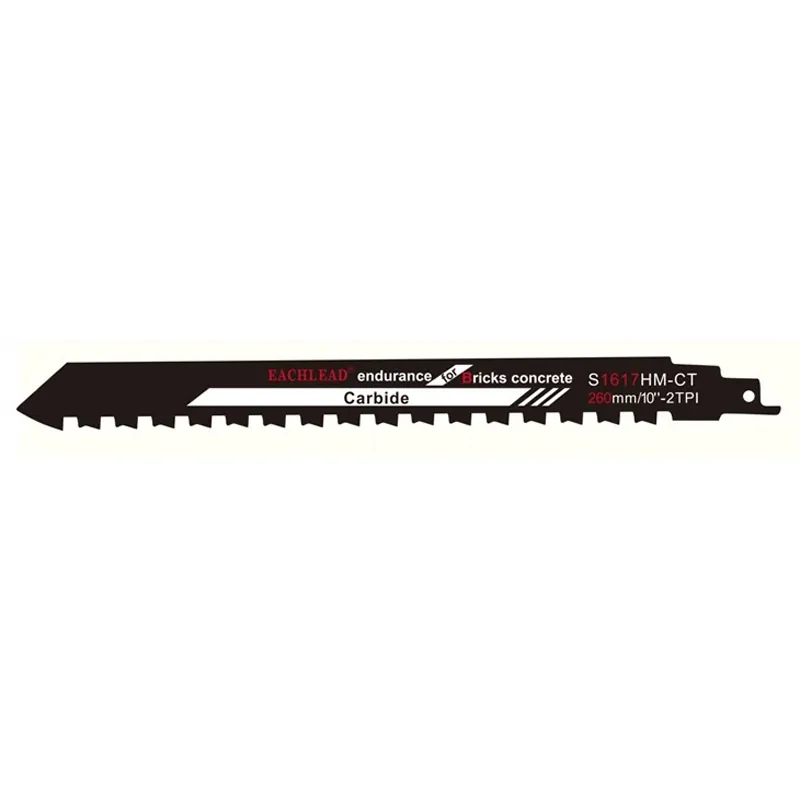
The supplied S1617HM-CT image is also labeled for bricks and concrete. It shows 260 mm/10 in and 2 TPI. That shorter catalog length may be relevant when access or control matters, but it does not prove that it is the right choice for a particular wall, block, slab, or saw. The product page and the workpiece information need to be reviewed together.
| Official model example | Visible catalog labels | What still needs confirmation |
|---|---|---|
| S1243HM-CT | Carbide; bricks/concrete; 300 mm/12 in; 2 TPI | Saw interface, actual work envelope, material condition, quantity, and approval method |
| S1617HM-CT | Carbide; bricks/concrete; 260 mm/10 in; 2 TPI | Saw interface, actual work envelope, material condition, quantity, and approval method |
These examples are useful for building a comparison request, not for choosing a model from a title alone. A masonry saw blade listing may cover brick or block without covering every concrete condition, so the material scope still needs confirmation. If the job is reinforced, unusually thick, exposed to water, or subject to a site safety procedure, those conditions belong in the request. The supplier can then confirm whether the listed model remains within its documented scope.
What a buyer should send to the supplier
A concise request gives the supplier enough information to review the blade without guessing. Include:
- Material: concrete, brick, block, aerated concrete, plaster block, cement board, or a mixed assembly.
- Workpiece: thickness, shape, access, embedded metal, and whether the cut is through, flush, internal, or a removal cut.
- Tool: saw brand and model, stated shank/interface, power source, and any operating restriction from the tool manual.
- Blade requirement: abrasive construction, model or family, length, width, thickness, TPI or pitch marking, and quantity.
- Acceptance check: sample quantity, inspection points, required cut result, and the information that must be confirmed before a repeat order.
For current product scope, start with the S1617HM carbide reciprocating saw blade listing and review the model-specific information before placing an order. A useful inquiry should name the material and work envelope rather than ask for the “best concrete Sawzall blade.”
References
- Hilti: Light concrete reciprocating saw blades — example of material scope, shank, TPI, length, thickness, and lightweight-concrete applications.
- Engineer Fix: Can You Cut Concrete With a Sawzall Blade? — controlled-cut limits, abrasive cutting method, heat, dust, and when dedicated equipment is more appropriate.
- SIMA: How to cut brick with a reciprocating saw — masonry blade selection by material, tooth spacing, length, width, and thickness.