


When Does a Curved Reciprocating Saw Blade Help?
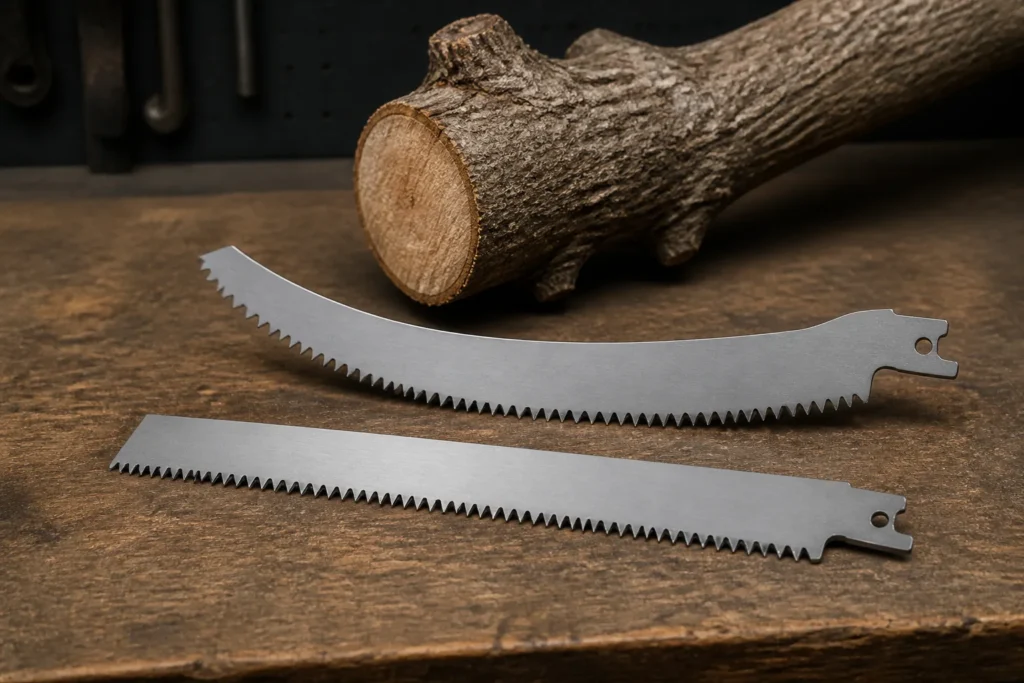
A curved reciprocating saw blade helps most when the workpiece is round, when you need a controlled plunge cut or plunge start, or when a straight edge would skate across bark before the teeth bite. For flat lumber, sheet metal, and mixed wood-with-nails demolition, a straight bi-metal profile is usually the faster, more predictable choice. The sections below compare job signals that favor curvature against straight EACHLEAD pruning and BIM blades, then cover TPI, length, and material rules that still govern chip clearance when the profile changes.
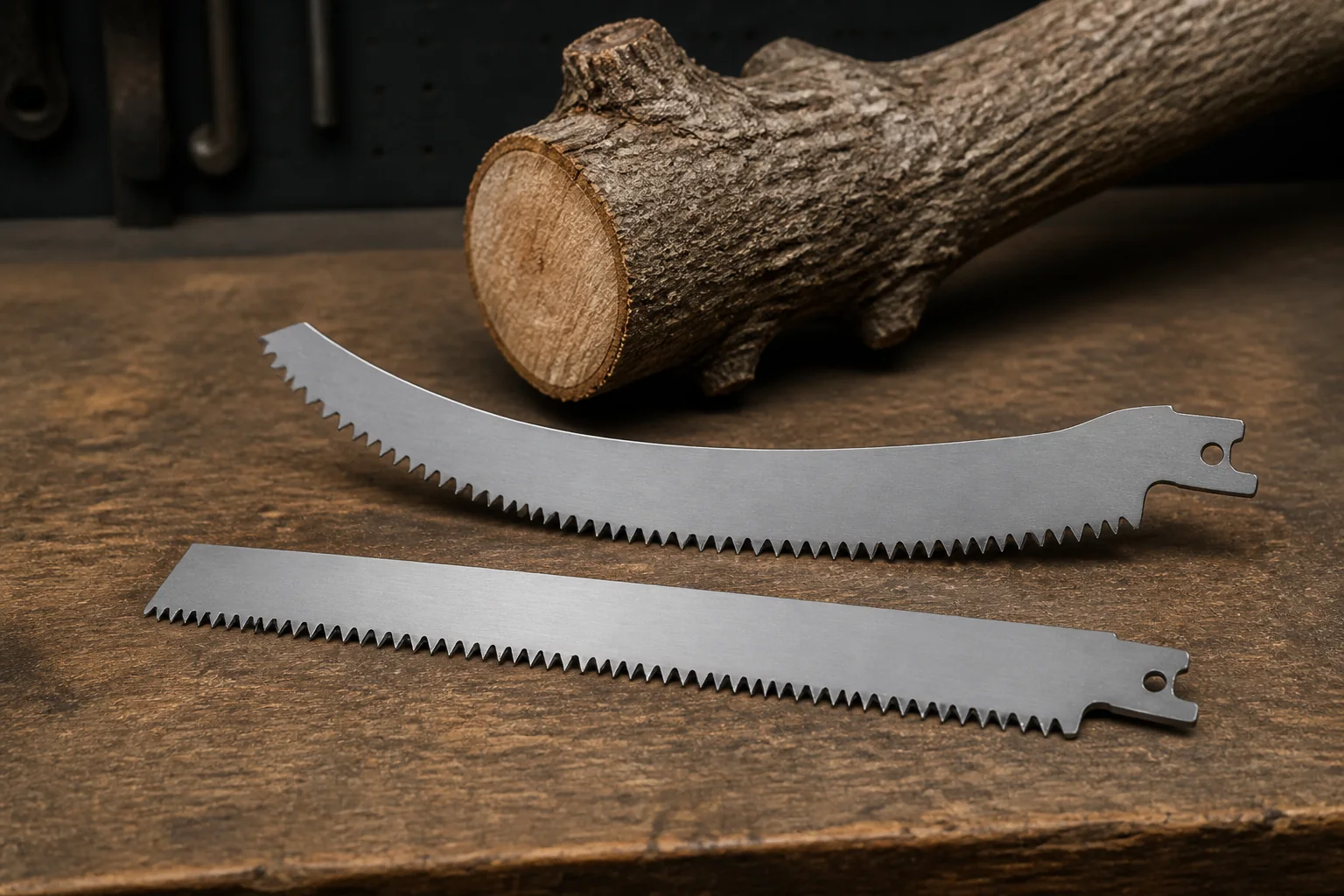
What Changes When the Blade Profile Is Curved
Curvature changes how the teeth meet the work: instead of presenting a flat line of teeth, an arc-edge blade lets engagement build progressively along the cutting edge. Independent technical writing on reciprocating blade design describes that progressive contact as a more aggressive angle of attack, which can steady the cut on surfaces that are not flat. Patent literature on curved reciprocating edges adds that combining tang angle with edge curvature increases the effective cutting angle at the point of contact.
That geometry shift is separate from tooth count or steel grade. A curved pruning reciprocating saw blade can still be coarse HCS, while a curved demolition blade may be bi-metal — the profile answers contact, not material family alone. If the stock is flat plate or tube with a consistent face, a straight reciprocating saw blade often feels more neutral because you are not fighting side load from the arc.
Tip: On green-wood pruning cuts, a light rocking motion helps clear packed gullets so middle teeth keep cutting — a field practice echoed in Garage Journal pruning threads. (Source: Garage Journal — Sawzall pruning blade discussion)
Rounded Branches, Pruning, and Landscape Work
Round limbs are the classic win for curved geometry because the blade can wrap its contact line around bark instead of touching at a single tangent point. Landscape crews cutting storm-damaged branches, fence-line saplings, or orchard limbs overhead often fight blade walk on the first stroke; an arc profile can settle into the curve of the wood faster than a straight demolition blade meant for flat 2× stock.
Storm cleanup adds another layer: tensioned branches can bind the kerf if you cut from the wrong side, so geometry that bites faster on the first stroke matters when you cannot reposition the saw twice on a ladder. Curved aftermarket profiles are common in dedicated pruning pouches; EACHLEAD’s published straight pruning line targets distributors who need a factory SKU with verified length and TPI bands instead of an arc-body specialty import.
Coarse TPI formats dominate pruning discourse — think 3 TPI to 8 TPI class blades with deep gullets for chip clearance in green or damp wood. Length still matters: the active tooth line should reach past the branch diameter with room for the saw body to clear side growth. EACHLEAD’s published straight pruning SKU, the S1542K, lists a 9.5 in (240 mm) blade with about 8.5 TPI for damp wood diameters from 15 mm to 190 mm — a straight-profile option when you are stocking EACHLEAD rather than an aftermarket curved line.
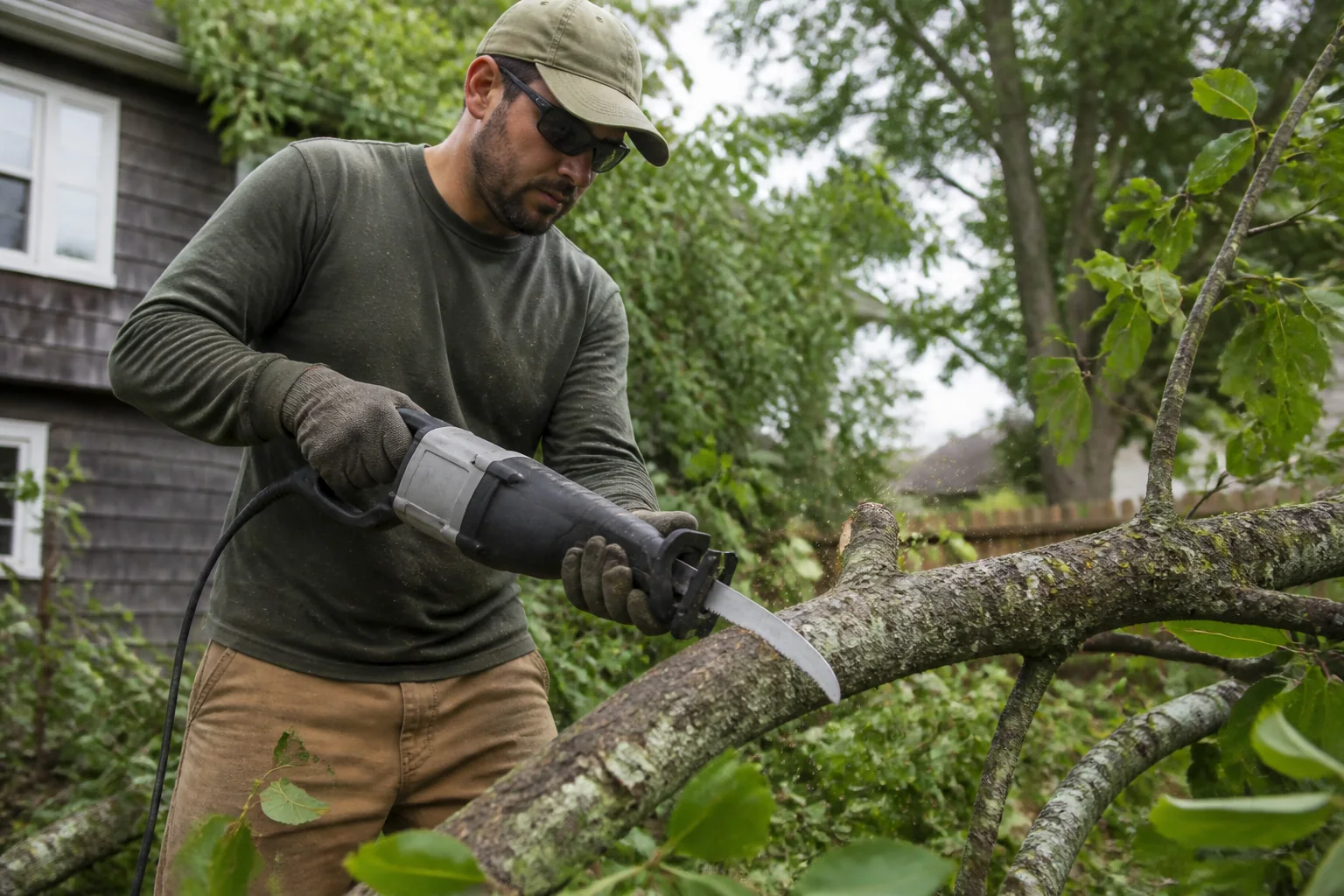
Plant the reciprocating saw shoe against the branch when the shape allows. Forum veterans on Garage Journal stress that the metal shoe should bear on the work so the blade is not free-floating in mid-air on overhead cuts. Where the branch is too small for a stable shoe placement, shorten the stroke and let teeth establish a groove before adding pressure.
From the field: Experienced forum users rock the saw slightly on wood cuts to move debris through the kerf — especially when only 3/4 in to 1-1/4 in of stroke is actively clearing chips. (Source: Garage Journal — Sawzall safety thread)
Orbital action — the up-and-down oval path some reciprocating saws add to the stroke — is designed to speed wood and branch cuts on many tools. Pair orbital mode with a pruning-appropriate TPI rather than a fine metal blade, and keep expectations realistic on limbs thicker than about twice the stroke length, where a chainsaw or handsaw may finish faster.
Plunge Starts and Awkward First Contact
Curved geometry helps plunge starts and awkward first contact because the tip engages at a defined point instead of skating along a long straight edge. A plunge cut starts without a pilot hole: the tip bites into sheathing, roofing, or laminated assemblies and the blade sinks straight in.
Awkward first contact also shows up when only a corner of the work is reachable — think a pipe tight to a stud or a branch emerging at a shallow angle. A curved profile can reduce the “skate” phase before the kerf forms. The trade-off is control: if the arc pulls the cut off-line, switch to a shorter straight blade and re-establish the shoe on a flatter bearing surface.
Demolition Cuts Where Curve Geometry Earns Its Place
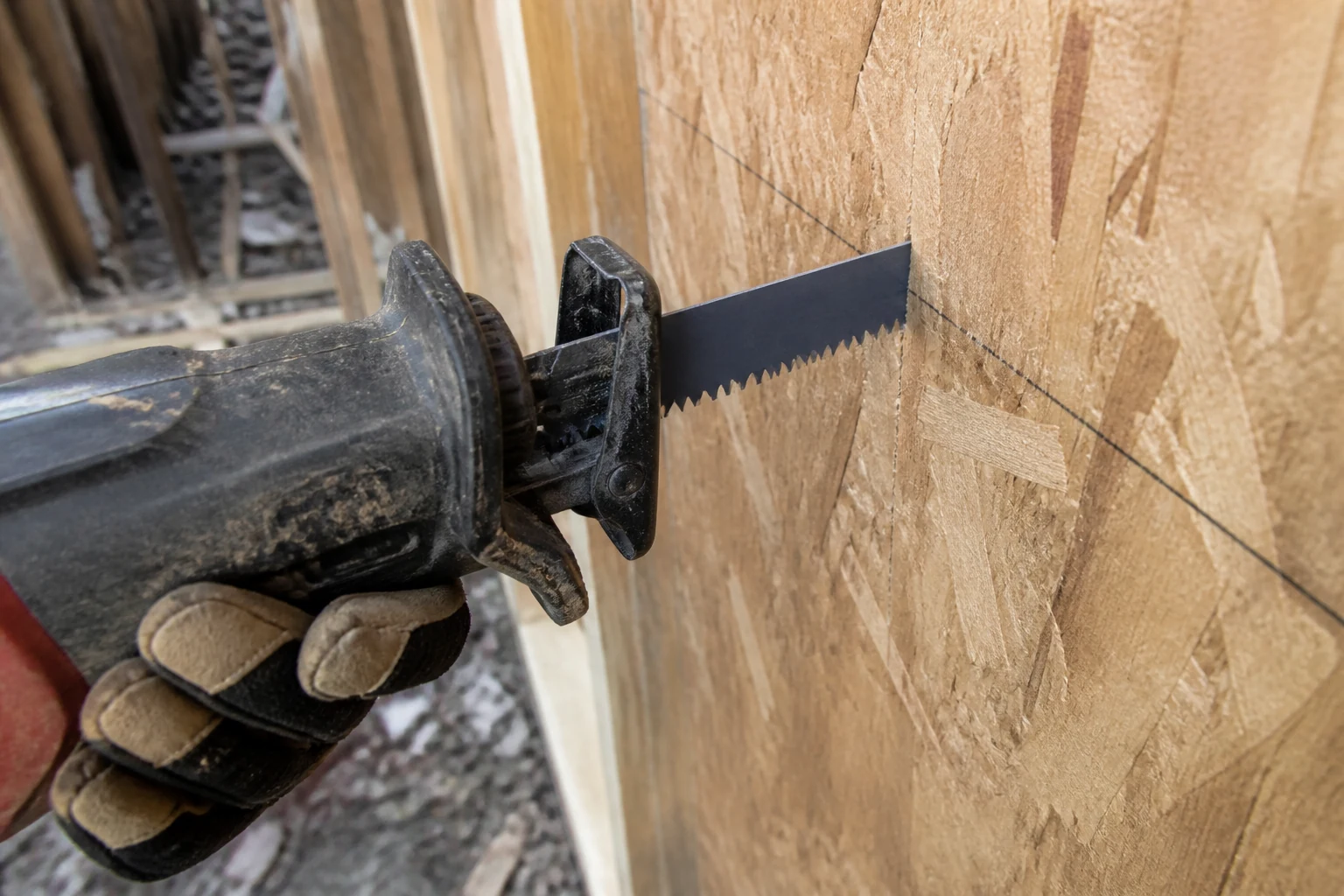
Straight EACHLEAD bi-metal blades remain the fleet default on flat demolition lumber, but curved bi-metal profiles still earn a slot when nail-embedded wood vibrates under a flat edge and progressive engagement might steady the kerf. Demolition mixes dirty lumber, nails, and partial thicknesses — progressive tooth engagement along a curved edge can reduce chatter in nail-embedded wood per Build-Construct curved-blade design writing.
Straight EACHLEAD bi-metal blades remain the catalog anchor for demo fleets. S611DF and S922HF cover nail-embedded cuts on flat stock at published 6 TPI and 10 TPI formats. Curved aftermarket demo blades may still earn a slot in a personal pouch; distributors aligning to EACHLEAD’s published straight BIM hub reduce SKU sprawl while covering the majority of flat framing and mixed wood-metal tasks.
Important: Use a sharp blade, keep the shoe on the work, and choose the shortest blade that still extends past the workpiece through the stroke — dull or over-long blades increase heat, binding, and breakage risk per Power Tool Institute reciprocating-saw guidance. (Source: PTI — Reciprocating (Saber) Saws & Jig Saws PDF)
When Straight BIM Blades Win on Flat Stock and Metal
A straight bi-metal (BIM) recip blade is the better default when the bearing surface is flat and you need predictable tracking — dimensional lumber, pallet dismantling, sheet metal in published thickness bands, and most shop metal cuts. EACHLEAD S611DF at 6 TPI covers coarse nail-embedded wood in published ranges; S1122BF handles thin sheet metal bands.
EACHLEAD’s bi-metal reciprocating saw blades hub groups straight-profile wood, nail-embedded, and metal models by TPI and published thickness ranges. For thin sheet metal, S1122BF at 9 in length and 14 TPI lists 3 mm to 8 mm application on its product page. For wood with nails, S611DF’s 6 TPI coarse format clears larger chips in demolition lumber.
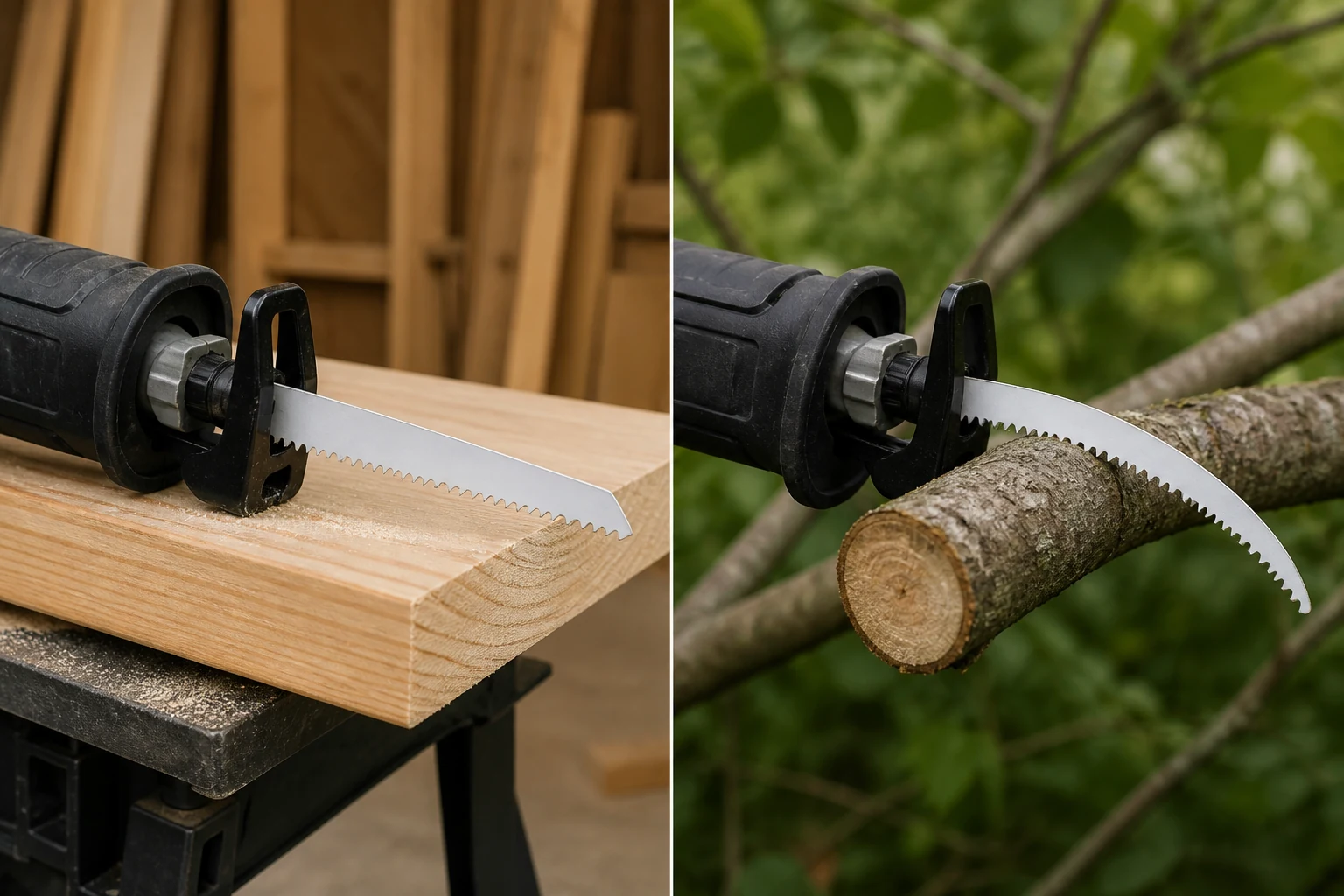
Curved profiles do not replace those straight BIM roles. Naming matters in catalogs: EACHLEAD “curve cut” BIM SKUs such as the S711 series describe blades for following curved cut paths in stock, not necessarily an arc-shaped pruning body. Treat them as cut-path tools, not automatic substitutes for aftermarket arc-edge pruning blades.
| Job signal | Curved profile tendency | Straight profile tendency |
|---|---|---|
| Round branch or vine | Often easier first contact | Can skate on bark |
| Flat lumber or sheet goods | Side load from arc | Even tracking |
| Plunge into thick panel | Can track tip-in | May need careful shoe setup |
| Nail-embedded flat lumber | Specialty curved demo lines exist | EACHLEAD BIM straight lines (e.g., S611DF, S922HF) |
| Thin sheet metal | Poor default | High-TPI straight BIM (e.g., S1122BF) |
Matching TPI, Length, and Material to the Job
TPI rules do not change when the profile curves: fewer teeth per inch for fast, coarse work in soft or green wood; more TPI for thinner or harder materials where heat buildup is the enemy. Deep gullets on coarse pruning reciprocating saw blade formats carry green-wood chips; fine metal blades trade gullet volume for tooth count.
Length is a clearance and control variable. PTI reciprocating-saw guidance favors the shortest blade that still protrudes past the work throughout the stroke.
Pruning buyers should compare branch diameter to published blade length and application bands — EACHLEAD’s S1542K page cites damp wood diameters from 15 mm to 190 mm for that SKU. Aftermarket curved pruning blades often run 9 in to 15 in for reach; match reach to overhead access, not just tooth spec.
Distributors building a mixed pruning plus demo kit should pair one coarse straight pruning SKU with one straight BIM nail-wood blade rather than duplicating TPI classes across curved and straight profiles. When crews insist on arc-edge pruning for round stock only, keep straight BIM demolition blades in the same case so flat tear-out does not force a pruning blade into nail plates.
| EACHLEAD straight SKU | Published length | Published TPI | Published application (page text) |
|---|---|---|---|
| S1542K | 9.5 in (240 mm) | ~8.5 TPI | Damp wood diameters 15 mm to 190 mm |
| S611DF | 6 in (150 mm) | 6 TPI | Wood with nails/metal, chipboard 10 mm to 100 mm |
| S922HF | 6 in (150 mm) | 10 TPI | Wood with nails/metal 5 mm to 10 mm |
| S1122BF | 9 in | 14 TPI | Thick sheet metal 3 mm to 8 mm |
The straight EACHLEAD SKU snapshot table lists published length, TPI, and application bands for S1542K, S611DF, S922HF, and S1122BF.
Material family still crosses geometry: HCS straight blades like S1542K flex for wood pruning; BIM straight blades add nail and metal tolerance. A curved aftermarket pruning blade is still usually HCS or specialty ground steel — do not run it into thick structural steel expecting BIM life.
Product Recommendation: EACHLEAD Straight Blades for Mixed-Duty Fleets
EACHLEAD’s live reciprocating catalog emphasizes straight-profile blades across HCS pruning and BIM wood/metal families. No EACHLEAD product page in the current catalog markets a dedicated arc-body curved pruning blade comparable to aftermarket “Power Arc” style lines. Distributors answering curved-blade RFQs should explain the geometry choice honestly, then stock verified straight EACHLEAD SKUs for the workloads the catalog already covers.
Primary pruning stock: EACHLEAD S1542K — HCS/SK5 straight pruning blade, 9.5 in (240 mm), about 8.5 TPI, published for damp wood diameters 15 mm to 190 mm. Pair with coarse-TPI expectations for landscape crews who may also carry aftermarket curved profiles for round-limb specialists.
Mixed demolition / metal: Start from the EACHLEAD bi-metal reciprocating saw blades hub — S611DF for coarse nail-embedded wood, S922HF for mixed wood-and-nail cuts, S1122BF for sheet metal in the 3 mm to 8 mm band published on-product. These straight BIM lines cover flat-stock demo and metal service calls without implying a curved EACHLEAD geometry.
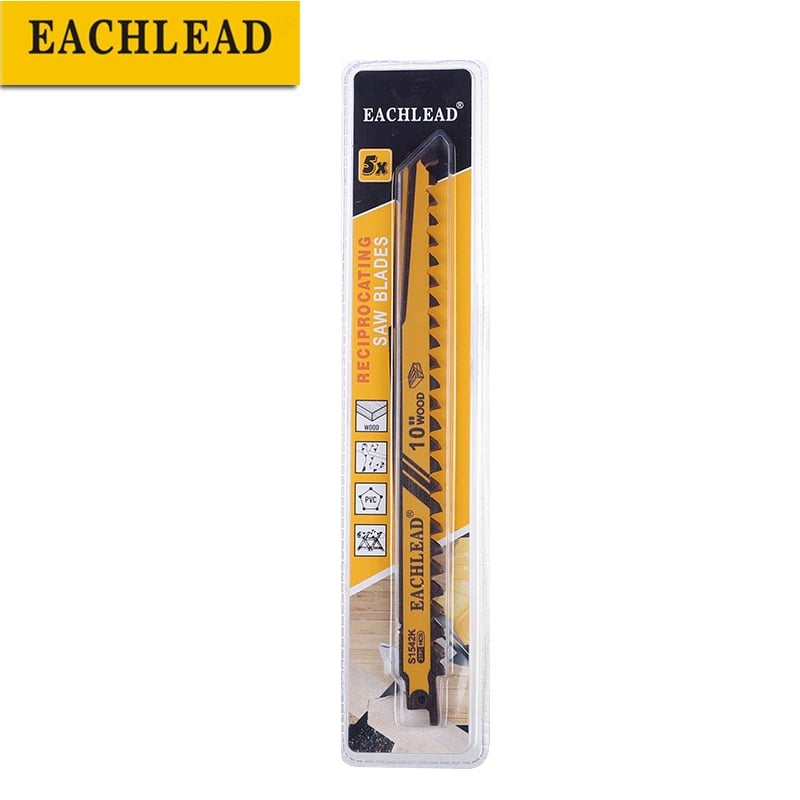
When curved geometry is still required: Stock or source aftermarket arc-edge pruning blades for crews that only cut round stock, and keep EACHLEAD straight pruning plus BIM blades as the published EACHLEAD pathway. Confirm shank compatibility and pack quantities (S1542K lists 2-pc blister / 5-pc double blister options on its page) before quoting.
Questions on custom geometry, private-label curved profiles, or fleet mixes can go through EACHLEAD inquiry.
FAQ
What is a curved reciprocating saw blade used for?
It is used when round stock, plunge entry, or irregular first contact would let a straight edge walk before teeth bite. Typical jobs include landscape pruning, storm cleanup on branches, and some nail-embedded demolition cuts where progressive engagement helps — not flat sheet-metal rips.
Are curved blades better for pruning tree branches?
They can be better on rounded limbs because the arc follows bark curvature, but straight coarse-TPI pruning blades still work when technique and shoe placement are solid. EACHLEAD’s published straight S1542K targets damp wood pruning when you are stocking factory blades rather than aftermarket arc profiles.
When should I use a straight reciprocating saw blade instead?
Use a straight profile for flat lumber, pallets, published EACHLEAD BIM metal cuts, and any job where you want even tracking along a plane. Straight bi-metal blades like S611DF and S1122BF remain the EACHLEAD default for demo and metal.
What TPI works for pruning with a reciprocating saw?
Coarse TPI — often in the 3 TPI to 8 TPI class with deep gullets — suits green and damp wood. EACHLEAD’s S1542K publishes about 8.5 TPI for damp wood diameters 15 mm to 190 mm. Match TPI to chip size, not just branch hardness.
Does EACHLEAD sell a curved reciprocating saw blade?
The live EACHLEAD catalog does not show a marketed arc-body curved pruning SKU. EACHLEAD publishes straight HCS pruning (S1542K) and straight BIM wood/metal blades; “curve cut” BIM model names refer to cut-path applications, not arc-shaped pruning bodies.
What blade length do I need for branch cuts?
Pick a length that clears the branch diameter with room for the saw body — EACHLEAD’s S1542K at 9.5 in (240 mm) lists applications to 190 mm damp-wood diameter. Longer aftermarket curved pruning blades (12 in to 15 in class) help overhead reach but flex more if pushed.
Are curved blades safer on a reciprocating saw?
Geometry alone does not remove kickback risk. Sharp blades, shoe contact, two-hand control, and avoiding bind points matter more — the same PTI themes forum users repeat for branch tension and compression. Replace a blade at the first sign of heavy vibration or tooth damage.
References
- Reciprocating saw — Wikipedia
- Reciprocating saw blade design: curved cutting edges — Build-Construct
- Reciprocating (Saber) Saws & Jig Saws — Power Tool Institute (PDF)
- Reciprocating saw blade with curved cutting edge — CA2845968A1 (Google Patents)
- Sawzall pruning blade — Garage Journal forum
- Sawzall safety — Garage Journal forum