


T-Shank Jigsaw Blades: Types and Selection Guide
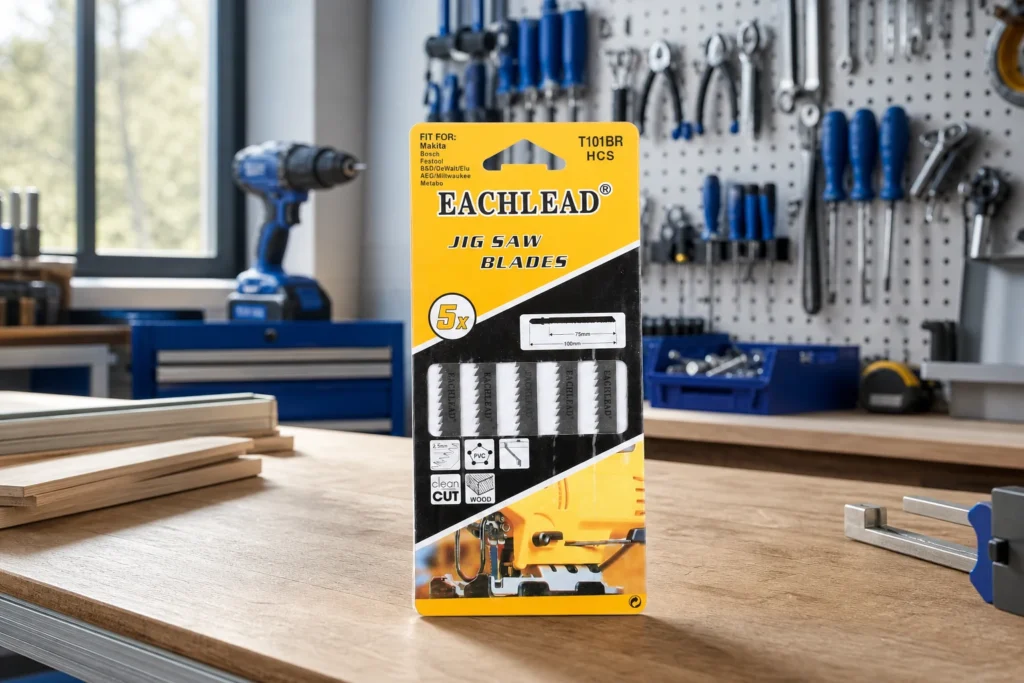
T shank jigsaw blades dominate modern cordless and corded jigsaws with tool-less blade change—yet rental returns still mix U-shank packs, and Makita-type tools need matched tang geometry. Importers should label shank type, TPI, and tooth material on every blister card so counter staff can refill wood, metal, and laminate bays without opening cartons.
Part 1. What T-Shank Jigsaw Blades Are
T-shank (bayonet) blades use a tang that slides into the tool chuck and locks without an Allen key—Bosch popularized the format and most current jigsaws accept standard T-shank geometry.
The shank carries load in plunge and curve cuts; a mismatched tang slips or cracks the clamp jaws on older U-shank-only tools.
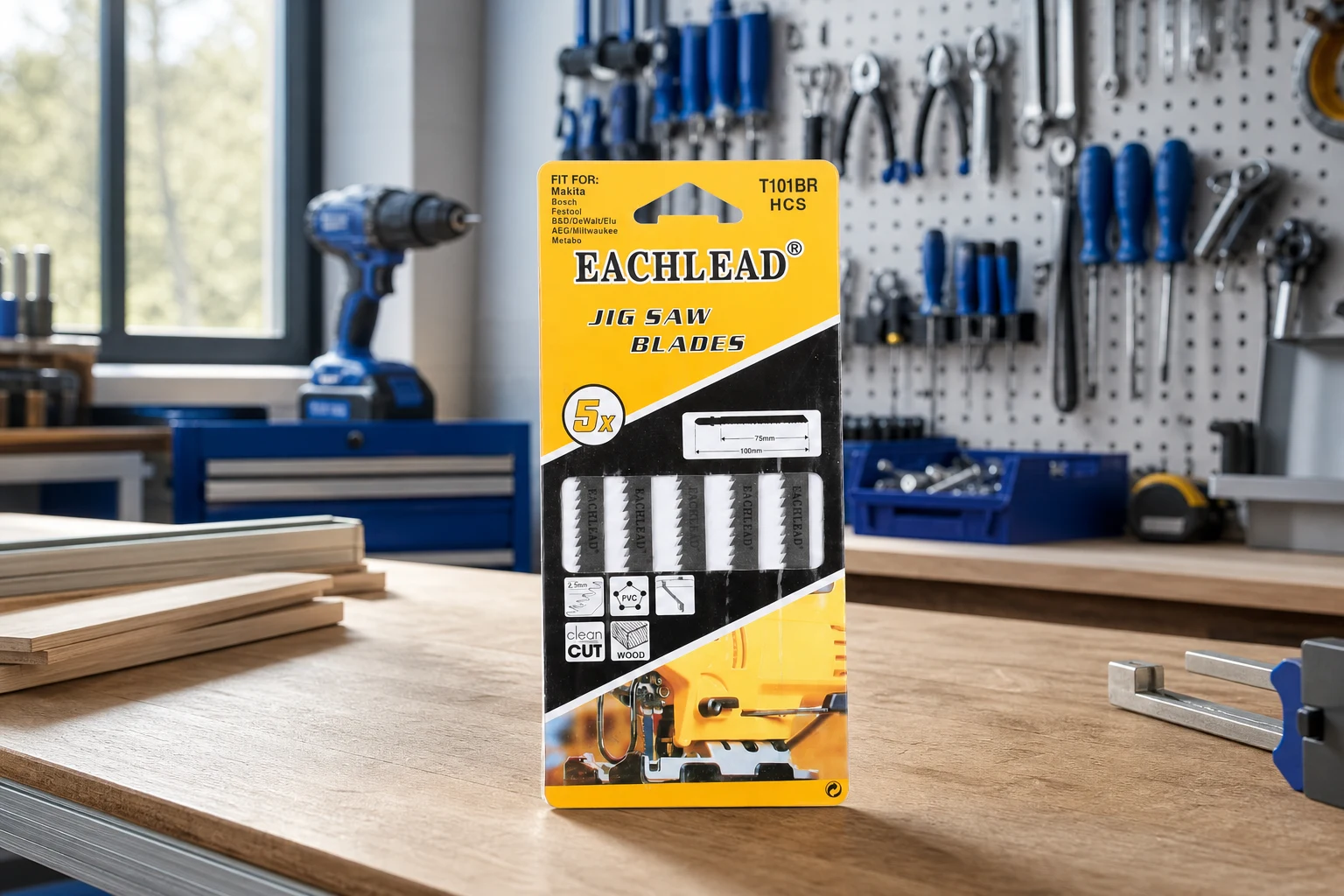
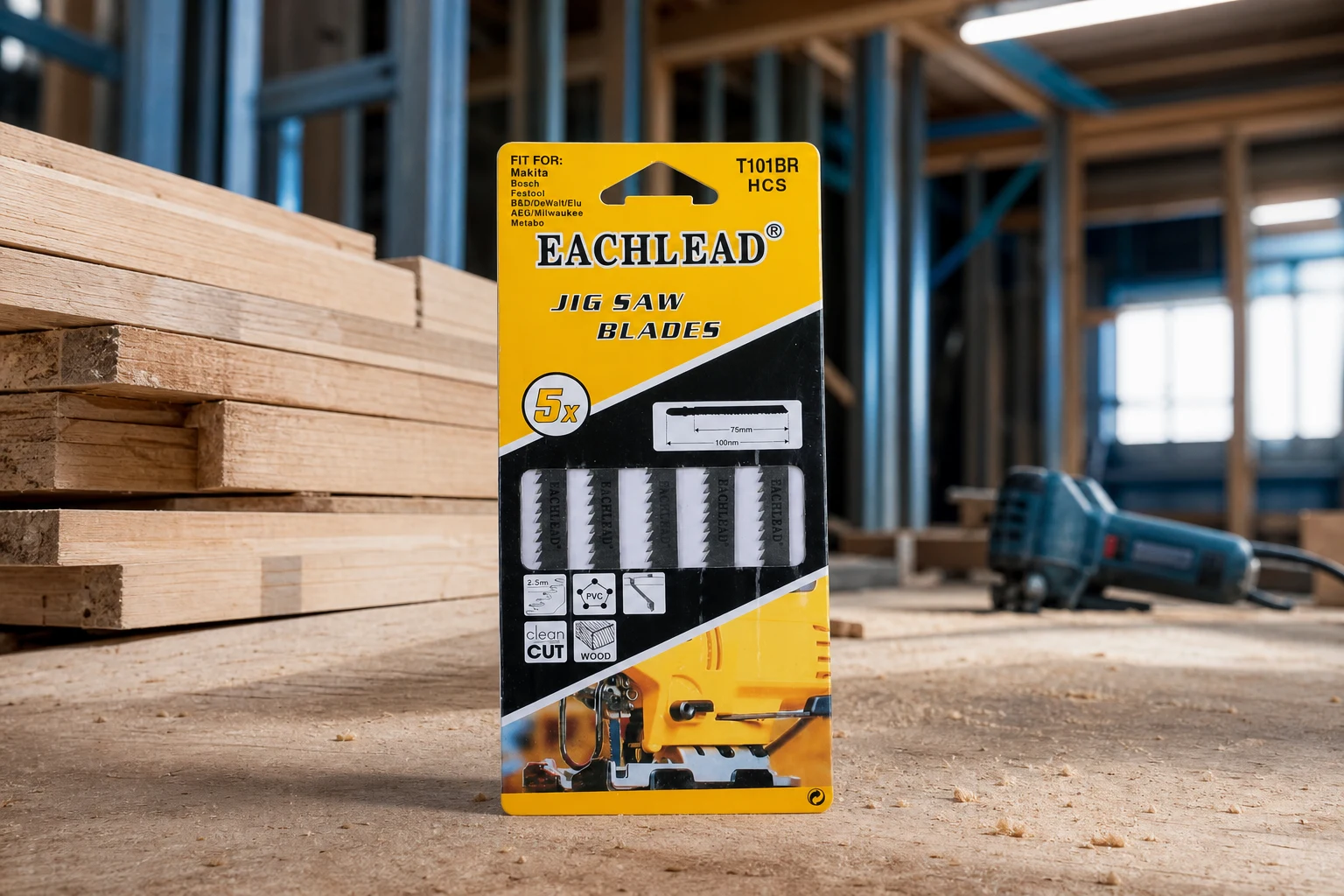
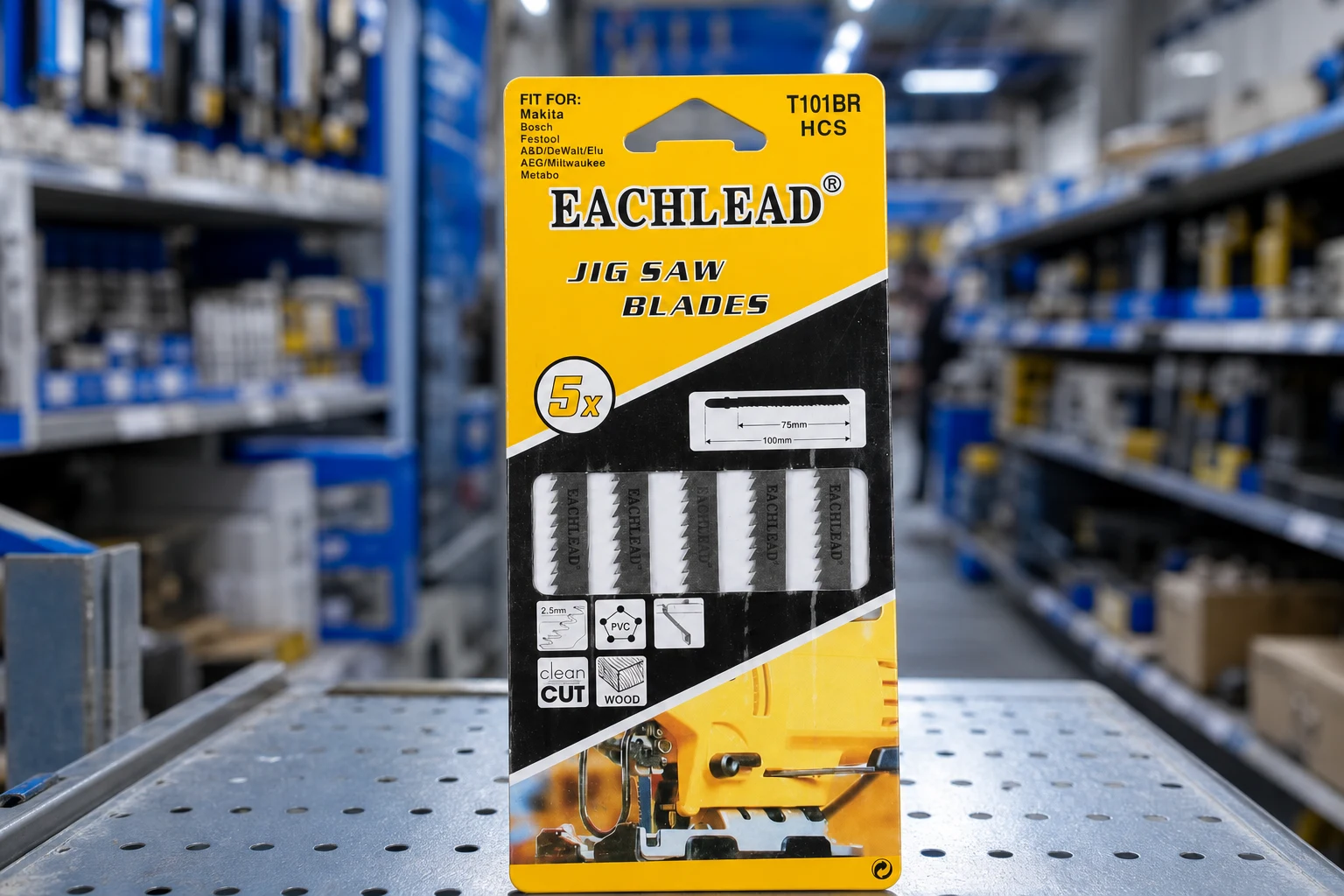
EACHLEAD lists T-shank assortments such as 10-piece T-shank sets and countertop downstroke SKUs like T101BR for laminate work for channel buyers building mixed hardware planograms.
Private-label programs should specify shank drawings and clamp compatibility tests—visual similarity between T and U cards does not mean interchangeable performance.
Counterfeit-prone markets should add a small shank silhouette icon on the blister front—buyers return packs when the tang geometry does not seat in the tool clamp.
> **From the field:** “T-shank is what every cordless jig on the job site takes—U-shank is legacy stock.” — Rockler jigsaw blade guide
Part 2. T-Shank vs U-Shank and Tool Compatibility
U-shank blades use a screw clamp common on older tools and some specialty saws. U-shank guide covers legacy compatibility—this article focuses on T-shank stocking for current fleets.
Most Bosch-type, DeWalt, Milwaukee, and Makita cordless jigsaws accept standard T-shank blades; Makita-type and half-bore variants need matched tangs—confirm the tool manual before export cartons.
Rental counters should separate T and U inventory bins—mixed returns drive complaints when a U pack is sold for a cordless T-only tool.
Universal marketing claims are risky: “fits most jigsaws” should still list excluded shank families on the back panel.
Export buyers shipping mixed T-shank cartons to the EU should confirm CE labeling and language blocks for shank type—German and French hardware chains reject ambiguous “universal” copy.
| Shank type | Tool era | Change method | Stocking note |
|---|---|---|---|
| T-shank (bayonet) | Current cordless/corded | Tool-less | Default hardware bay |
| U-shank | Legacy / specialty | Screw clamp | Separate bin from T |
| Makita-type T | Makita-compatible | Tool-less | Label on card |
| Half-bore | Select Festool/Mafell | Vendor-specific | Do not mix in universal sets |
Part 3. Tooth Design and TPI for Common Materials
Tooth design drives chip clearance and finish. Reverse-tooth (downstroke) blades such as T101BR reduce splintering on laminate and countertops; aggressive side-set teeth speed rough wood cuts.
TPI bands: roughly 6–10 for fast wood, 10–14 for cleaner plywood and laminate, 14–21 for thin metal and conduit. Metal jigsaw guide covers bi-metal and carbide edges for harder stock.
Curve cutting favors narrow blades with fine TPI—see curve-cutting guide for geometry notes separate from straight countertop work.
Variable-pitch T-shank lines help renovation where one cut crosses wood, laminate, and light metal without a blade change—label the full TPI range on the card.
Ground-tooth bi-metal T-shank blades cost more than HCS but survive nail-adjacent cabinet retrofits—merchandise them beside standard wood TPI, not only in the metal bay.
| Material | Typical TPI | Tooth form | Common mistake |
|---|---|---|---|
| Softwood / framing | 6–10 | Side-set | Metal blade on timber |
| Laminate / countertop | 10–14 | Downstroke / reverse | Coarse wood blade |
| Plywood / MDF | 10–12 | Clean-cut ground | Pruning-style gullet |
| Sheet metal / conduit | 14–21 | Bi-metal | Wood TPI on steel |
Part 4. Stocking T-Shank Assortments for Channels
Hardware endcaps need a balanced T-shank mix: wood, laminate/downstroke, metal bi-metal, and one curve or scroll SKU per length family.
Assorted ten-piece sets simplify rental and DIY counters—T10048 mixed sets and T10046 lines give OEM buyers a template for private-label blister counts.
Pro dealers may break assortments into open-stock bins by TPI and tooth material—barcode each inner pack so POS maps to the right replenishment slot.
Cross-link wood jigsaw blade article for seasonal SKU ratios; T-shank is the shank layer on top of material intent.
Seasonal endcaps can rotate T-shank wood-heavy sets in spring remodel and metal-heavy sets in fall MRO restock—track sell-through by TPI, not only pack count.
Part 5. Safety, Sourcing, and OEM Checklist for Buyers
Jigsaw cuts throw chips upward toward the user—eye protection and dust control matter on laminate and MDF; metal cuts need gloves and stable workholding.
Request from suppliers: shank drawings, TPI matrix, tooth material (HCS, BIM, carbide), pack count, blister artwork, and clamp compatibility statement. Contact EACHLEAD for OEM quotes. Factory background supports export labeling.
Confirm MOQ, lead time, and multilingual card text in writing—do not publish universal-fit claims without tool-compatibility testing on your target shank variants.
Attach a one-page TPI and shank matrix to RFQs so factory quotes stay comparable across vendors.
Recommended EACHLEAD Products
For project support, explore our related product line, solution options, and OEM/ODM capabilities on eachlead.com.
FAQ
What is a T-shank jigsaw blade?
A T-shank (bayonet) blade uses a tang that locks into modern jigsaws without tools—common on Bosch-type and most cordless tools.
T-shank vs U-shank jigsaw blades?
T-shank fits most current jigsaws; U-shank suits older or specialty tools—check the saw manual before stocking.
Are T-shank jigsaw blades universal?
Most brands accept standard T-shank geometry, but Makita-type and half-bore tools need matched shank variants.
What TPI for wood jigsaw blades?
Roughly 6–10 TPI for fast wood cuts; 10–14 TPI for cleaner finish and plywood or laminate.
Can T-shank blades fit all jigsaws?
Not all—verify shank type on the tool nameplate; U-shank and specialty shanks are not interchangeable.
How do OEM buyers spec T-shank jigsaw blades?
Confirm shank type, TPI matrix, tooth material (HCS, BIM, carbide), pack count, and blister labeling before MOQ orders.
References
- Bosch — Jigsaw Blades
- Rockler — Jigsaw Blade Guide
- EACHLEAD T10046 T-Shank set
- EACHLEAD T101BR countertop blade
Ready to discuss your project? Contact EACHLEAD engineering support with your project parameters and technical requirements.